Supreme Court Upholds High Court Order on MGNREGA Restoration
Source:Indian Express ↗
Why It Matters
The judgment highlights the delicate balance in Centre-State relations regarding centrally sponsored schemes. It underscores the judiciary's role in ensuring that statutory welfare rights (like employment guarantee) are not broadly denied to citizens due to administrative irregularities, promoting targeted accountability instead of sweeping suspensions.
Summary
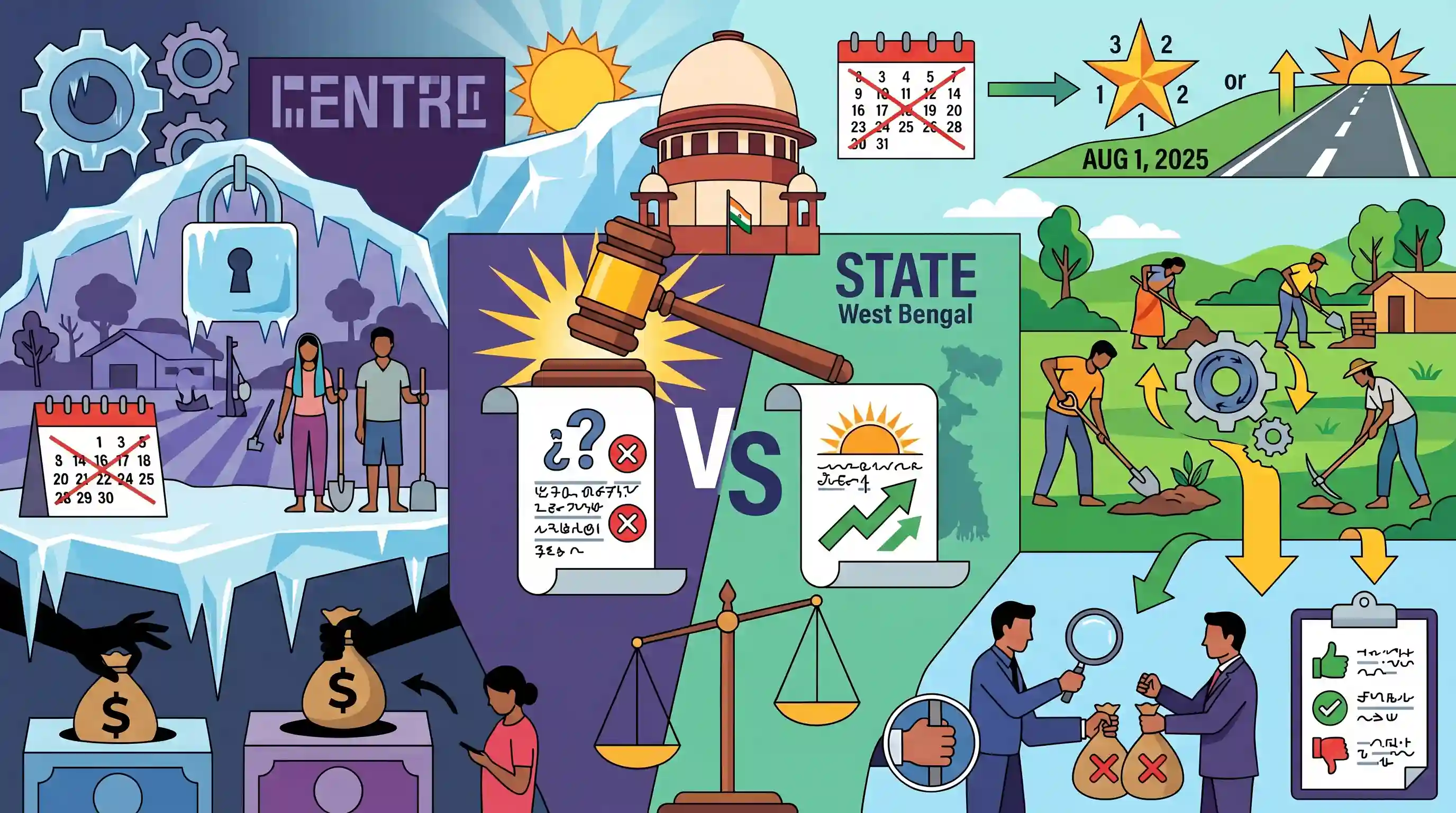
The Supreme Court has rejected the Centre’s special leave petition challenging a Calcutta High Court order that directed the implementation of the Mahatma Gandhi National Rural Employment Guarantee Act (MGNREGA) in West Bengal. The scheme was previously suspended for three years due to allegations of severe irregularities and fund misappropriation. The High Court had ruled that the welfare scheme cannot be kept in 'cold storage for eternity' and ordered its prospective implementation from August 1, 2025. Furthermore, the courts noted that the Centre retains full authority to investigate past anomalies, recover misappropriated funds from beneficiaries who obtained them illegally, and enforce strict administrative conditions to ensure proper implementation without future leakages.
Key Points
- The Supreme Court dismissed the Centre's appeal, upholding a Calcutta High Court order mandating the prospective implementation of MGNREGA in West Bengal from August 1, 2025.
- The rural employment guarantee scheme had been suspended in the state for three years over allegations of irregularities, fund misappropriation, and non-payment of wages.
- The High Court ruled that a statutory welfare scheme cannot remain in 'cold storage for eternity' due to administrative lapses.
- Courts affirmed that the Centre retains the authority to investigate past irregularities, recover misappropriated funds, and impose stringent regulations to prevent future leakages.
Important Terms
MGNREGA

A social security measure providing a legal guarantee of at least 100 days of unskilled manual work per financial year to every rural household.
UPSC context
GS II: Welfare schemes. Tests knowledge of rights-based approaches to rural poverty alleviation and social security.
Special Leave Petition (SLP)
The Supreme Court's discretionary power under Article 136 to grant special permission to appeal against any judgment or order from any court in India.
UPSC context
GS II: Judiciary. Tests understanding of the Supreme Court's extraordinary jurisdiction and appellate powers.
Centre-State Relations
The constitutional distribution of legislative, administrative, and financial powers between the Union and States, primarily governed by Part XI and Part XII.
UPSC context
GS II: Federal structure. Tests understanding of administrative frictions and fiscal federalism between tiers of government.
Social Audit
A participatory process where citizens verify government records against ground reality to ensure transparency and accountability in public schemes.
UPSC context
GS II: Governance. Tests mechanisms of grassroots monitoring and community participation in ensuring government accountability.
Judicial Review
The judiciary's power to examine the constitutionality of legislative and executive actions, ensuring they conform to the Constitution's provisions.
UPSC context
GS II: Separation of powers. Tests knowledge of judicial checks on executive policy and the basic structure doctrine.
Prelims Trap
The Central Government cannot legally withhold MGNREGA funds from a State since it guarantees a statutory right to work.
Section 27(2) of the MGNREGA Act expressly authorizes the Centre to stop fund release upon prima facie evidence of financial irregularities or misappropriation by the State.
Static Concepts Connected
What is the statutory funding and implementation structure of MGNREGA?
- Wage cost: The Central Government is legally mandated to bear 100% of the cost for unskilled manual labor.
- Material cost: The cost of materials and wages for skilled/semi-skilled workers is shared between the Centre and State in a 75:25 ratio.
- Local execution: Gram Panchayats are primarily responsible for planning and must execute at least 50% of the works in terms of cost.
Which Constitutional provisions directly underpin MGNREGA?
- Article 41 (DPSP): Directs the State to make effective provision for securing the right to work and public assistance in cases of unemployment.
- Article 21: The Supreme Court widely interprets the Right to Life to include the Right to Livelihood, preventing indefinite suspension of welfare due to administrative lapses.
Cross-Topic Patterns
Fiscal centralization vs Cooperative Federalism
Withholding scheme funds under statutory clauses highlights fiscal friction. Opposition-ruled states facing budget blockades show how centrally sponsored schemes can impact cooperative federalism, a recurring GS-2 theme.
Article 21 limits on executive auditing
Courts ruled that while the Centre must ensure financial accountability, indefinite suspension of a statutory scheme due to ongoing administrative audits violates vulnerable beneficiaries' fundamental Right to Livelihood.

Expect a 2026 GS-2 mains question analyzing the tension between scheme accountability (Section 27 of MGNREGA) and cooperative federalism.
Linked PYQs · 4
Linked PYQs · 4
- 2024MainsGS2
What changes has the Union Government recently introduced in the domain of Centre-State relations ? Suggest measures to be adopted to build the trust between the Centre and the States and for strengthening federalism.
- 2020MainsGS2
Judicial Legislation is antithetical to the doctrine of separation of powers as envisaged in the Indian Constitution. In this context justify the filing of large number of public interest petitions praying for issuing guidelines to executive authorities.
- 2011PrelimsGS1
Among the following who are eligible to benefit from the “Mahatma Gandhi National Rural Employment Guarantee Act”?
- 2006PrelimsGS1
Consider the following statements in respect of welfare schemes launched by the Ministry of Rural Development, Government of India. 1. Drinking water for rural areas in one of the components of the Bharat Nirman Plan. 2. NREGA 2005 provides that statutory minimum wage for agricultural workers must be paid.
