Supreme Court Ruling on Criminal Case Diary Access and Fair Trial
Source:Indian Express ↗
Why It Matters
It highlights the procedural boundaries of the Indian criminal justice system, specifically balancing the rights of the accused to a fair trial with the statutory limits on accessing police investigation diaries under the CrPC.
Summary
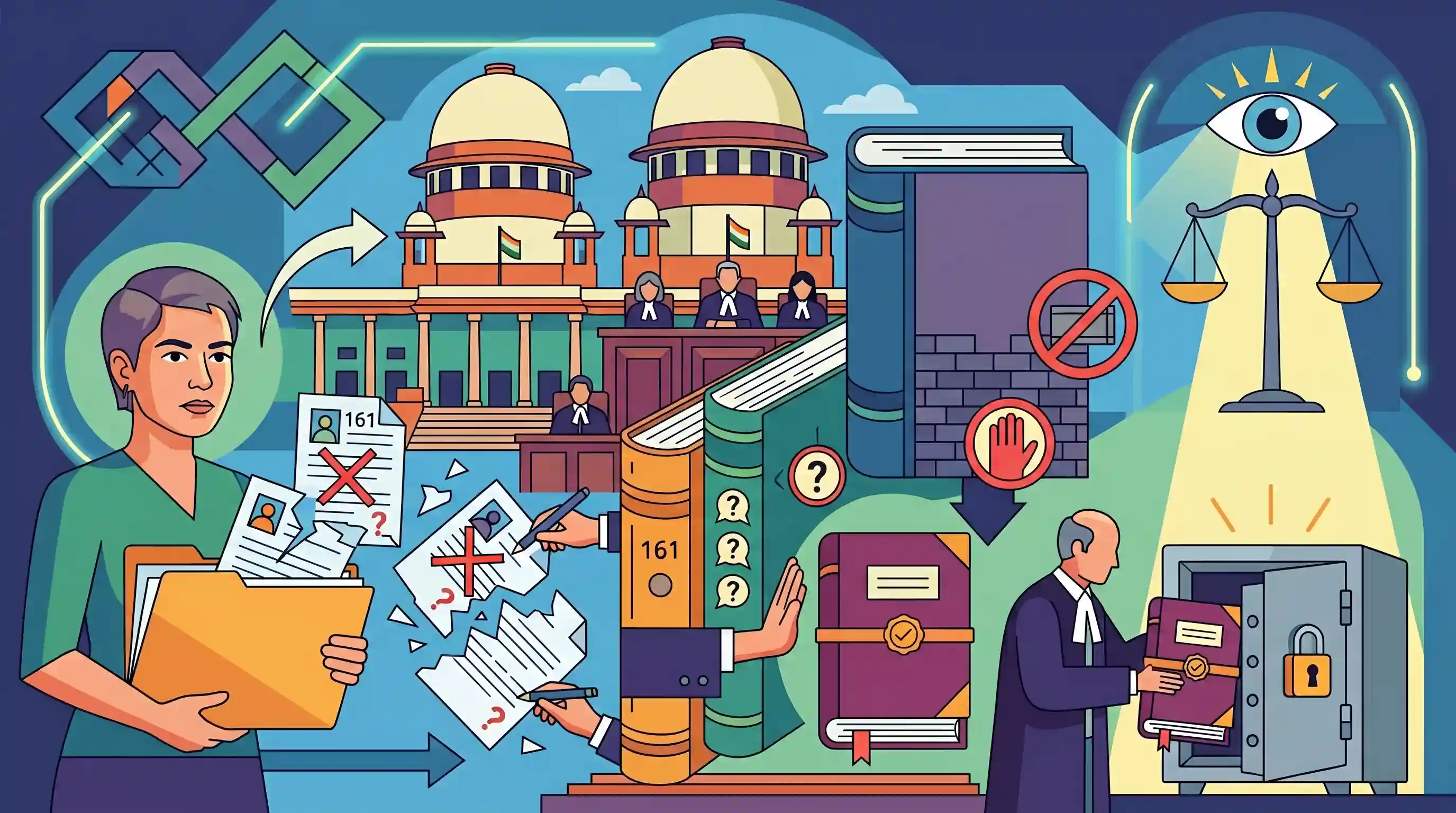
The Supreme Court rejected activist Devangana Kalita's plea to reconstruct the case diary in the 2020 anti-CAA protests case. Kalita alleged that prosecution material, specifically CrPC Section 161 witness statements, was forged and ante-dated. The SC and the Delhi High Court relied on Section 172(3) of the CrPC, emphasizing that the accused cannot demand access to case diaries unless they are used by police to refresh memory or by the court for contradicting an officer. The High Court, however, directed the preservation of the diary, recognizing its necessity for a fair trial.
Key Points
- The Supreme Court rejected activist Devangana Kalita's plea to reconstruct the case diary in the 2020 anti-CAA protests case, where she alleged tampering and ante-dating of witness statements.
- The Court cited Section 172(3) of the CrPC, which restricts the accused from accessing police case diaries unless used by the police to refresh memory or by the court for contradiction.
- The Delhi High Court had earlier denied the reconstruction plea but mandated the preservation of the case diary, noting its absence could affect the fairness of the trial.
- The case originates from an FIR concerning an anti-CAA road blockade at Jafrabad, which escalated into the Northeast Delhi riots in 2020.
Important Terms
Citizenship Amendment Act (CAA)

A 2019 law granting fast-tracked Indian citizenship to persecuted non-Muslim minorities (Hindus, Sikhs, Buddhists, Jains, Parsis, Christians) from Afghanistan, Bangladesh, and Pakistan who entered India by 2014.
UPSC context
GS Paper II: Statutory provisions regarding citizenship, secularism, and constitutional equality (Article 14).
Case Diary
A daily record maintained by an investigating officer documenting the progress of a case, including times of information, places visited, and circumstances ascertained during the investigation.
UPSC context
GS Paper II: Criminal Justice System; tests understanding of investigative transparency vs. confidentiality.
CrPC Section 172(3)
A provision barring the accused from inspecting police case diaries unless used by an officer to refresh memory or by the court to contradict the officer.
UPSC context
GS Paper II: Rights of the accused and procedural safeguards in the criminal justice system.
CrPC Section 161
Empowers police to record witness statements during investigation. These are not substantive evidence but can be used by the defense to contradict prosecution witnesses during trial.
UPSC context
GS Paper II: Role of investigative agencies and evidentiary value of police statements.
Right to a Fair Trial
A fundamental right derived from Article 21, ensuring the accused has adequate opportunity to defend themselves and that the prosecution acts with integrity and transparency.
UPSC context
GS Paper II: Fundamental Rights and the evolving jurisprudence of the judiciary regarding Article 21.
Interlocutory Order
A temporary or provisional court order issued during the course of a legal proceeding before the final decision is reached.
UPSC context
GS Paper II: Judiciary structure and legal procedures in high-stakes criminal litigation.
Prelims Trap
"An accused has a fundamental right to access the police case diary to ensure a fair trial."
Under CrPC Sec 172(3) (now BNSS Sec 192), the accused cannot demand access unless the diary is used by the police to refresh memory or by the court to contradict an officer.
Static Concepts Connected
What is the evidentiary value of a police Case Diary in Indian law?
- Not substantive evidence: It is not substantive evidence. Courts use it only to aid an inquiry or trial, not to prove the guilt of the accused directly.
- Restricted access: The accused cannot access it automatically. Access is permitted only if the investigating officer refreshes memory from it, or the court uses it for contradiction.
What are the constitutional limits on the Right to Protest?
- Article 19(3) restrictions: The right to assemble peacefully without arms (Art 19(1)(b)) is subject to reasonable restrictions regarding India's sovereignty, integrity, and public order.
- No indefinite occupation: In the Amit Sahni case (2020), the Supreme Court ruled that constitutional right to protest cannot entail the indefinite occupation of public roads and spaces.
Cross-Topic Patterns
Transition from CrPC to BNSS
With the replacement of CrPC by the Bharatiya Nagarik Suraksha Sanhita (BNSS), mapping old evidentiary rules (like CrPC Sec 161 to BNSS Sec 180) will be a critical GS2 Prelims pattern.
Article 21 and Fair Trial rights
The SC routinely balances state investigative powers against the Right to a Fair Trial (implicit in Art 21). The preservation of police diaries is seen as essential protection against arbitrary prosecution.

Expect a Prelims question testing the evidentiary value of case diaries and witness statements under the new BNSS (replacing CrPC).
Linked PYQs · 2
Linked PYQs · 2
- 2023MainsGS2
“Constitutionally guaranteed judicial independence is a prerequisite of democracy.” Comment.
- 2014MainsGS2
What do you understand by the concept "freedom of speech and expression"? Does it cover hate speech also ? Why do the films in India stand on a slightly different plane from other forms of expression ? Discuss.
