Supreme Court Refers DPDP Act RTI Provisions to Constitution Bench
Source:The Hindu ↗
Why It Matters
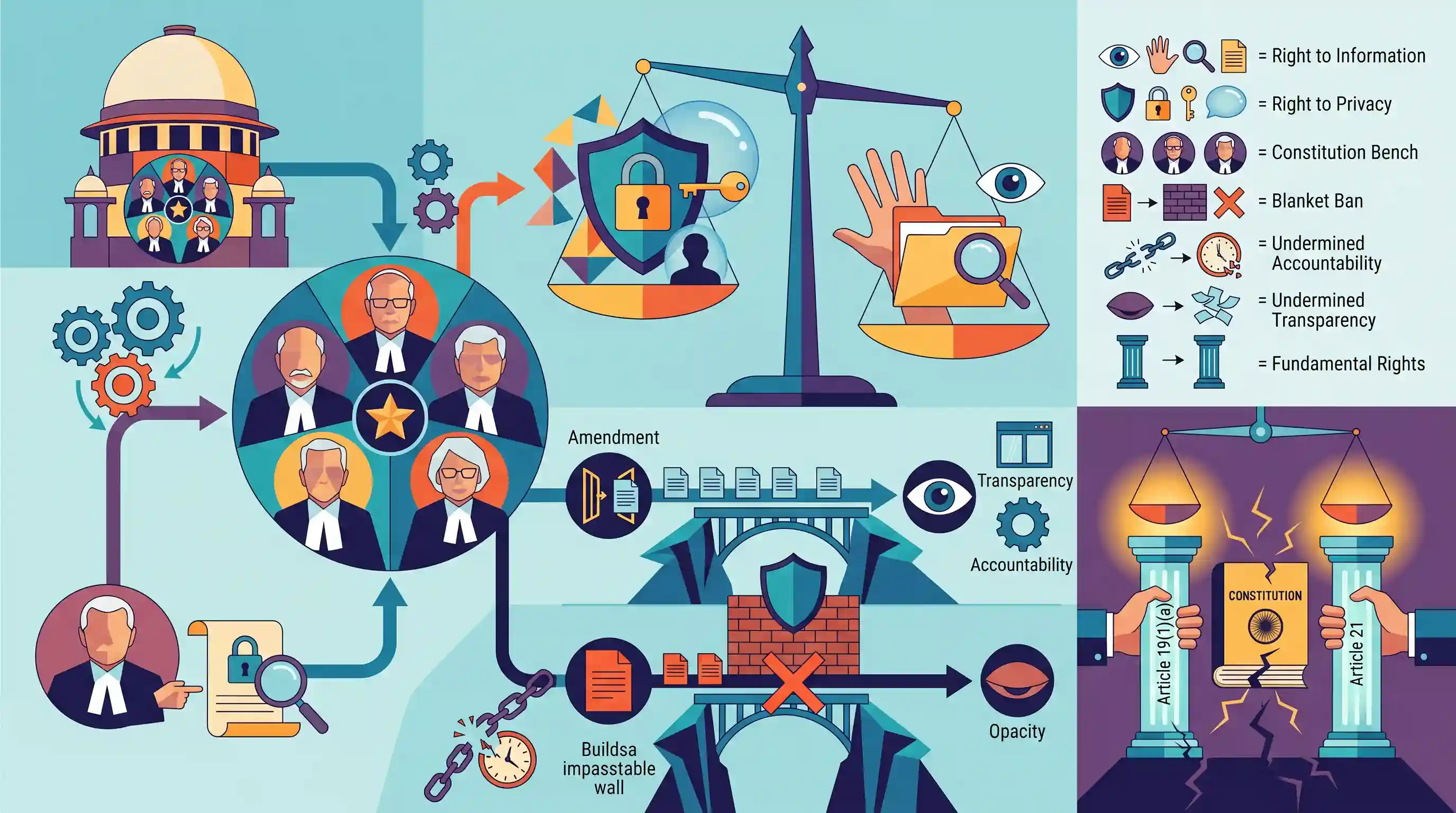
The conflict between the DPDP Act and the RTI Act touches upon the core of democratic governance. The Supreme Court's decision will determine how to legally balance the fundamental right to privacy (Article 21) against the right to know (Article 19), significantly impacting transparency, anti-corruption efforts, and public accountability.
Summary
The Supreme Court has referred petitions challenging Section 44(3) of the Digital Personal Data Protection (DPDP) Act, 2023, to a Constitution Bench. Petitioners argue that the provision undermines transparency and accountability by amending Section 8(1)(j) of the Right to Information (RTI) Act to impose a 'blanket ban' on disclosing 'personal information.' This legal challenge tests the critical constitutional balance between a citizen's right to privacy and the broader public interest embedded in the right to information.
Key Points
- The Supreme Court has referred petitions challenging Section 44(3) of the Digital Personal Data Protection (DPDP) Act, 2023 to a Constitution Bench.
- Section 44(3) of the DPDP Act amends Section 8(1)(j) of the RTI Act, 2005, which originally allowed personal information disclosure if it served a larger public interest.
- Petitioners argue that the DPDP Act imposes a blanket ban on the disclosure of personal information by removing the public interest balancing test.
- The petitioners assert that this blanket exemption harms transparency and accountability by preventing citizens from accessing crucial information regarding politicians, public servants, and government functions.
- The core legal issue is the constitutional balancing of two fundamental rights: the citizen's right to information (implicit under Article 19) and the right to privacy (Article 21).
Important Terms
Digital Personal Data Protection (DPDP) Act, 2023

India's first comprehensive personal data protection law, regulating the processing of digital personal data while balancing individual privacy rights with the state's need for lawful data processing.
UPSC context
GS Paper 2: Governance, Polity, and Legislations. Tests understanding of data sovereignty and fundamental rights in the digital age.
Right to Information (RTI) Act, 2005
A landmark 2005 law empowering citizens to access government-held information, thereby promoting transparency and accountability across public authorities in India.
UPSC context
GS Paper 2 and 4: Transparency, Accountability, and Ethics. Crucial for understanding citizen-state relationships and democratic oversight.
Section 8(1)(j) of the RTI Act
A specific clause in the RTI Act exempting 'personal information' from disclosure; its 2023 amendment is controversial for allegedly removing the 'public interest' override.
UPSC context
GS Paper 2: Judiciary and Polity. Specifically tests the legal friction between transparency and the fundamental Right to Privacy.
Constitution Bench
A Supreme Court bench of at least five judges, mandated under Article 145(3) to decide cases involving substantial questions of constitutional interpretation.
UPSC context
GS Paper 2: Judiciary. Focuses on judicial procedures, Article 145(3), and the evolution of landmark constitutional jurisprudence.
Puttaswamy Judgment
The landmark 2017 Supreme Court ruling that declared the Right to Privacy a fundamental right under Article 21, establishing the 'proportionality test' for state interference.
UPSC context
GS Paper 2: Fundamental Rights. Essential for understanding the constitutional basis of privacy and its limits against state action.
Prelims Trap
The DPDP Act removes the public interest override for all exemptions under the RTI Act.
The DPDP Act specifically amends Section 8(1)(j) related to 'personal information' to make it a blanket ban. Other exemptions under the RTI Act still retain nuance.
Static Concepts Connected
What is the constitutional basis of Information and Privacy Rights?
- Right to Information: An implicit fundamental right derived from Article 19(1)(a) (freedom of speech and expression), recognized by the Supreme Court in the State of UP vs. Raj Narain case.
- Right to Privacy: Declared an intrinsic part of the right to life and personal liberty under Article 21 in the landmark 2017 K.S. Puttaswamy judgment.
- Balancing Test: Courts utilize the doctrine of proportionality to resolve conflicts between two competing fundamental rights, ensuring neither right completely extinguishes the other.
What is Section 8 of the Right to Information Act, 2005?
- Section 8(1) Exemptions: Details specific exemptions from disclosure, including matters of national security, foreign state relations, trade secrets, and cabinet papers.
- Section 8(1)(j): Exempts 'personal information'. Prior to the DPDP Act, this could be disclosed if it served a 'larger public interest'. The amendment removed this qualifier.
- Section 8(2) Override: A general override clause stating that information can be disclosed despite the Official Secrets Act or Section 8(1) exemptions if public interest outweighs the protected harm.
Cross-Topic Patterns
Privacy vs. Electoral Transparency
The RTI vs. DPDP clash mirrors the Electoral Bonds case, where the Supreme Court prioritized voters' right to know (Article 19) over the privacy of corporate donors (Article 21).
Constitution Bench Mechanics
The referral highlights Article 145(3), requiring a minimum 5-judge Constitution Bench to decide cases involving substantial questions of constitutional law, such as balancing competing Fundamental Rights.

Expect a 2026 Mains GS2 question evaluating how the DPDP Act impacts RTI transparency, requiring a balance between Articles 19 and 21.
Linked PYQs · 5
Linked PYQs · 5
- 2024MainsGS2
Right to privacy is intrinsic to life and personal liberty and is inherently protected under Article 21 of the constitution. Explain. In this reference discuss the law relating to D.N.A. testing of child in the womb to establish its paternity.
- 2020MainsGS2
Recent amendments to the Right to Information Act will have profound impact on the autonomy and independence of the Information Commission". Discuss.
- 2017MainsGS2
Examine the scope of Fundamental Rights in the light of the latest judgement of the Supreme Court on Right to Privacy.
- 2024PrelimsGS1
Under which of the following Articles of the Constitution of India, has the Supreme Court of India placed the Right to Privacy ?
- 2018MainsGS4
"The Right to Information Act is not all about citizens' empowerment alone, it essentially redefines the concept of accountability." Discuss.
