Supreme Court Questions Judge Challenge to In House Inquiry
Source:The Hindu ↗
Why It Matters
Provides a critical case study on the mechanisms available for disciplining higher judiciary judges, specifically exploring the constitutional validity of the "in-house procedure" versus the parliamentary removal process outlined in Article 124(4) and the Judges (Inquiry) Act, 1968.
Summary
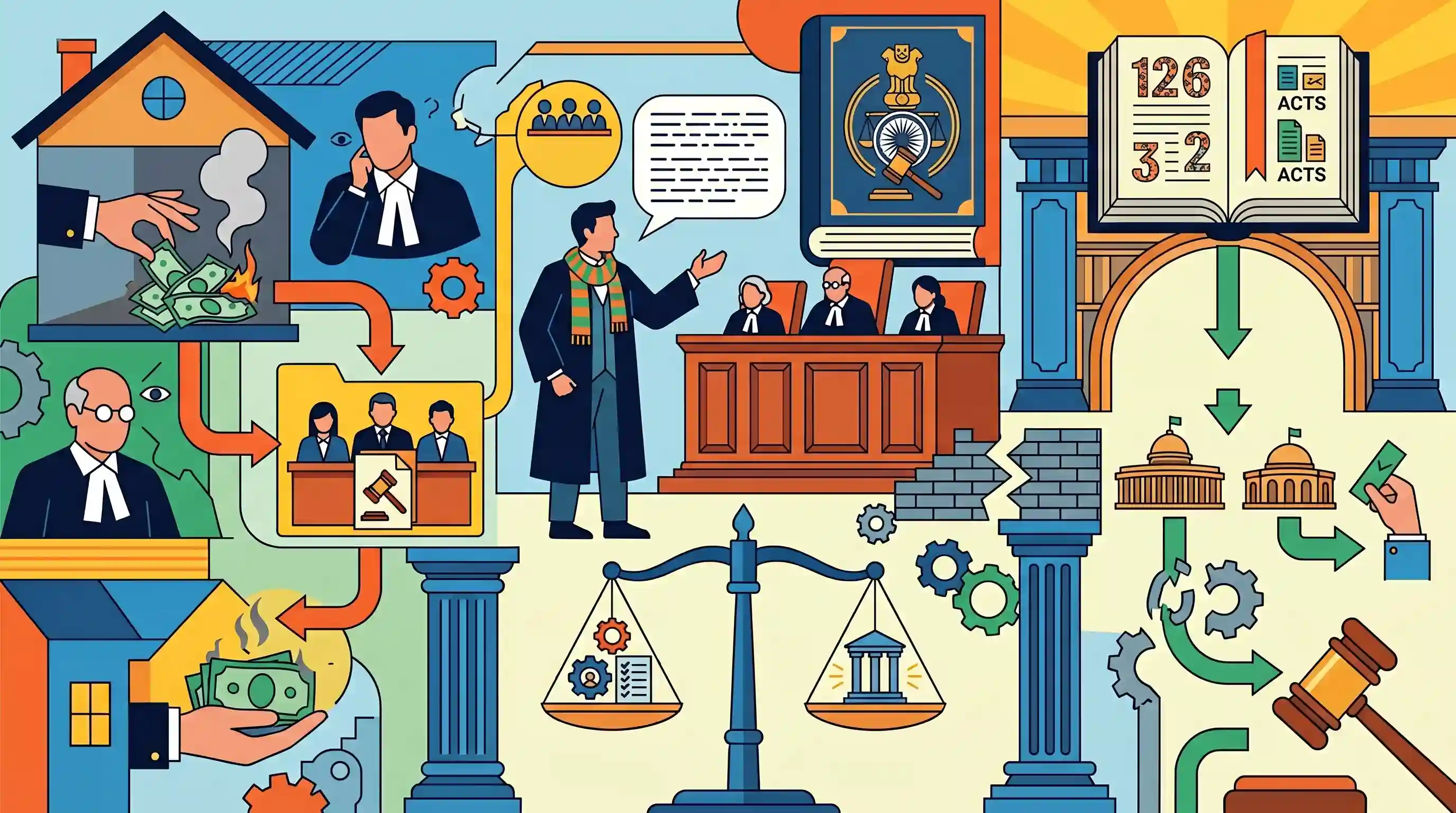
The Supreme Court scrutinized Justice Yashwant Varma of the Allahabad High Court for challenging an in-house inquiry only after it recommended his removal over the discovery of "burnt currency" at his residence. Representing Varma, senior advocate Kapil Sibal argued that the Constitution (under Articles 124 and 218) and the Judges (Inquiry) Act of 1968 lay down the exclusive procedures for the removal of a higher judiciary judge through Parliament. Sibal contended that any in-house judicial procedure recommending removal is ultra vires of the Constitution. The case highlights crucial constitutional debates around judicial accountability, the validity of the judiciary's internal disciplinary mechanisms, and the delicate balance required to maintain judicial independence while ensuring ethical conduct among judges.
Key Points
- The Supreme Court questioned Allahabad High Court judge Yashwant Varma for challenging an in-house inquiry only after its results, which recommended his removal over the discovery of 'burnt currency' at his residence, were finalized.
- Senior advocate Kapil Sibal argued that the Constitution provides a complete and exclusive mechanism for the removal of judges under Articles 124(4), 124(5), and 218 via a parliamentary motion, asserting that an in-house procedure resulting in removal is ultra vires.
- Justice Dipankar Datta highlighted Section 3(2) of the Judges (Protection) Act, 1985, during the proceedings.
- The case exposes the tension between the judiciary's internal disciplinary mechanisms (in-house procedures) and the formal constitutional and statutory processes (Judges Inquiry Act, 1968) for ensuring judicial accountability.
Important Terms
Judges (Inquiry) Act, 1968

A 1968 statute regulating the investigation and proof of 'misbehaviour or incapacity' of Supreme Court and High Court judges. It operationalizes the constitutional removal process via a parliamentary inquiry committee.
UPSC context
GS Paper 2: Statutory provisions for judicial removal; tests understanding of the intersection between legislative oversight and judicial independence.
Article 124 and 218
Article 124 prescribes the removal process for Supreme Court judges by the President following a parliamentary address; Article 218 extends this identical procedure to High Court judges.
UPSC context
GS Paper 2: Constitutional safeguards for the higher judiciary; essential for answers on the 'Security of Tenure'.
In-house Inquiry Procedure
An internal peer-review mechanism adopted by the Supreme Court in 1999 to investigate allegations of judicial misconduct that may not warrant formal parliamentary removal (impeachment).
UPSC context
GS Paper 2: Judicial accountability mechanisms; examines the judiciary's power of self-regulation versus constitutional procedures.
Judicial Accountability
The principle that judges should be answerable for their conduct and decisions to maintain public trust, balanced against the need for independence from external pressures.
UPSC context
GS Paper 2 & 4: Core theme in 'Governance' and 'Ethics'; tests ability to balance independence with transparency.
Judicial Independence
The constitutional requirement that the judiciary remains free from interference by the executive or legislature, ensuring impartial adjudication and the 'Basic Structure' of the Constitution.
UPSC context
GS Paper 2: Basic Structure doctrine; fundamental for understanding the separation of powers.
Judges (Protection) Act, 1985
A 1985 law providing immunity to judges from civil or criminal proceedings for acts performed in the discharge of their official judicial duties.
UPSC context
GS Paper 2: Legal protections for the judiciary; distinguishes personal immunity from the removal process.
Prelims Trap
The Supreme Court's in-house inquiry committee has the authority to formally remove an erring High Court judge.
Only the President can remove a judge post-parliamentary impeachment (Art 124/218). In-house panels only recommend resignation or withdrawal of work; they cannot dismiss.
Static Concepts Connected
What is the constitutional and statutory procedure to remove a High Court Judge?
- Constitutional Basis: Article 218 extends the Supreme Court removal process (Article 124(4)) to High Court judges strictly on grounds of proved misbehaviour or incapacity.
- Statutory Framework: The Judges (Inquiry) Act, 1968 provides the framework regulating the investigation and proof of misbehaviour.
- Initiation: Requires a motion signed by 100 Lok Sabha or 50 Rajya Sabha members. The presiding officer has discretionary power to admit or reject it.
- Final Removal: Removal is done by the President after a special majority vote in both Houses of Parliament in the same session.
What is the Supreme Court's 1999 In-House Procedure?
- Origin: Adopted by the Supreme Court in 1999 as an internal peer-review mechanism to investigate judicial misconduct.
- Scope: It handles complaints that fall below the strict constitutional threshold for impeachment but require disciplinary action.
- Outcomes: It cannot remove a judge. It can advise resignation/voluntary retirement, withdraw judicial work, or advise the executive to initiate parliamentary impeachment.
Cross-Topic Patterns
Judicial accountability vs. Independence mechanisms
The debate mirrors the struck-down National Judicial Appointments Commission (NJAC), highlighting the judiciary's resistance to external oversight and reliance on opaque internal mechanisms for both appointments and discipline.
Statutory protection of public servants
Section 3 of the Judges (Protection) Act, 1985 provides civil/criminal immunity similar to Section 197 of the CrPC/BNSS for civil servants, linking to broader GS2 themes of public servant immunity.

Expect a 2026 Prelims question contrasting the statutory Judges (Inquiry) Act 1968 with the extra-constitutional 1999 In-House Procedure.
Linked PYQs · 1
Linked PYQs · 1
- 2019PrelimsGS1
Consider the following statements: 1. The motion to impeach a Judge of the Supreme Court of India cannot be rejected by the Speaker of the Lok Sabha as per the Judges (Inquiry) Act, 1968. 2. The Constitution of India defines and gives details of what constitutes 'incapacity and proved misbehaviour' of the Judges of the Supreme Court of India. 3. The details of the process of impeachment of the Judges of the Supreme Court of India are given in the Judges (Inquiry) Act, 1968. 4. If the motion for the impeachment of a Judge is taken up for voting, the law requires the motion to be backed by each House of the Parliament and supported by a majority of total membership of that House and by not less than two-thirds of total members of that House present and voting. Which of the statements given above is/are correct?
