FSSAI Timeline for Front of Package Labelling and Public Health
Source:The Hindu ↗
Why It Matters
It highlights judicial oversight on regulatory bodies like FSSAI regarding public health policy enforcement, consumer right to information, and preventive healthcare challenges against non-communicable diseases.
Summary
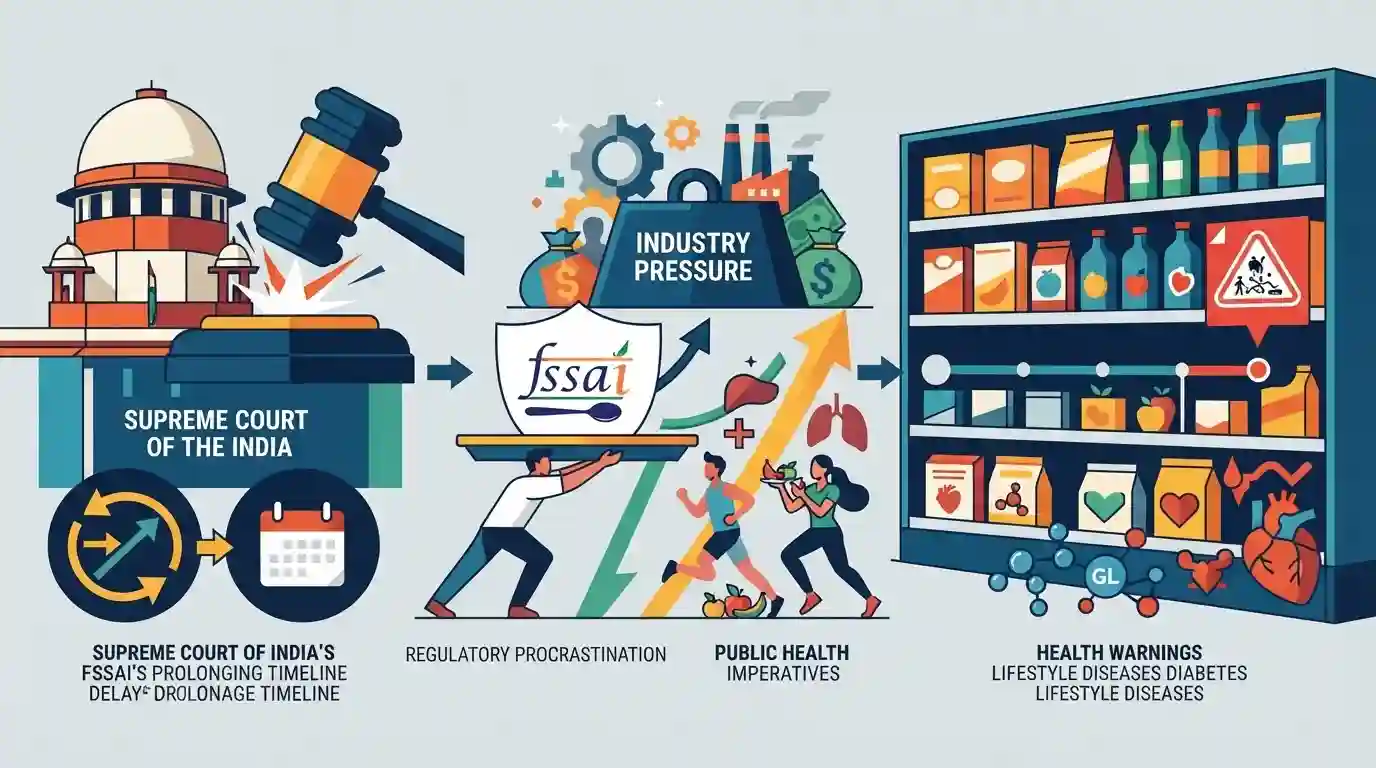
The Supreme Court has pulled up the Food Safety and Standards Authority of India (FSSAI) over its delayed timeline for implementing Front-of-Package Labelling (FoPL) on packaged food items. The court's scrutiny underscores the tension between public health imperatives—such as combating lifestyle diseases linked to high fat, sugar, and salt—and regulatory procrastination under industry pressure.
Key Points
- The Supreme Court questioned the Food Safety and Standards Authority of India (FSSAI) regarding the prolonged timeline proposed for implementing Front-of-Package Labelling (FoPL) on packaged foods.
- FoPL aims to combat the rising incidence of non-communicable diseases (NCDs) like obesity, diabetes, and hypertension by enabling consumers to easily identify foods high in fat, sugar, and salt.
- The judiciary expressed concern over bureaucratic delays in adopting stringent public health warning labels, balancing consumer rights to information against industry pushback.
Important Terms
FSSAI (Food Safety and Standards Authority of India)

An apex statutory body established under the Ministry of Health and Family Welfare, tasked with laying down science-based standards for food items and regulating their manufacture, storage, distribution, sale, and import in India.
UPSC context
Important for GS Paper II (Statutory Bodies, Health, Governance) and GS Paper III (Food Security). Tests understanding of regulatory enforcement.
Front-of-Package Labelling (FoPL) regulations
An interpretative nutrition labeling system placed on the front of food packages to provide consumers with quick, clear warnings about high levels of critical nutrients like fat, sugar, and salt.
UPSC context
Important for GS Paper II (Public Health, Consumer Rights) and GS Paper III (Food Processing). Tests policy interventions against lifestyle diseases.
Food Safety and Standards Act, 2006
The principal legislation that consolidated various food laws in India, establishing the FSSAI to regulate food safety standards and safeguard public health.
UPSC context
Important for GS Paper II and III under statutory frameworks, consumer protection laws, and regulatory governance.
Prelims Trap
FSSAI is an autonomous executive body set up by a cabinet resolution under the Ministry of Health.
FSSAI is a statutory body under the Ministry of Health and Family Welfare, but it is established under a specific overarching statute rather than being an executive body.
Static Concepts Connected
What are the key powers and mandate of the FSSAI under the Food Safety and Standards Act, 2006?
- Statutory Basis: Statutory origin established under the FSS Act, 2006, consolidating multiple central acts like the Prevention of Food Adulteration Act, 1954.
- Standard Setting: Framing regulations laying down food safety standards, contaminant limits, pesticide residues, and labelling requirements across India.
- Licensing & Enforcement: Granting licenses and registrations to food business operators (FBOs) and enforcing compliance through state food safety commissioners.
- Administrative Control: Functioning under the administrative control of the Ministry of Health and Family Welfare, Government of India.
Cross-Topic Patterns
Judicial Activism in Public Health Regulation
Judicial push for FSSAI warning labels mirrors public interest litigation tactics used in tobacco control (COTPA) and environmental clean-ups to overcome executive inertia.
Industry Lobbying vs. Consumer Welfare
Implementation delays highlight corporate lobbying pressures similar to those seen in pharmaceutical price caps under DPCO and medical device regulation.

FSSAI powers, statutory backing under FSS Act 2006, and public health NCD linkages frequently appear in Prelims and Mains governance questions.
Linked PYQs · 1
Linked PYQs · 1
- 2018PrelimsGS1
Consider the following statements: 1. The Food Safety and Standards Act, 2006 replaced the Prevention of Food Adulteration Act, 1954. 2. The Food Safety and Standards Authority of India (FSSAI) is under the charge of Director General of Health Services in the Union Ministry of Health and Family Welfare. Which of the statements given above is/are correct?
