Supreme Court Questions FSSAI on Front of Package Labelling Delay
Source:The Hindu ↗
Why It Matters
The case highlights the crucial intersection of food safety governance, corporate accountability, and consumer rights in public health policy, directly testing the implementation efficacy of statutory bodies like FSSAI.
Summary
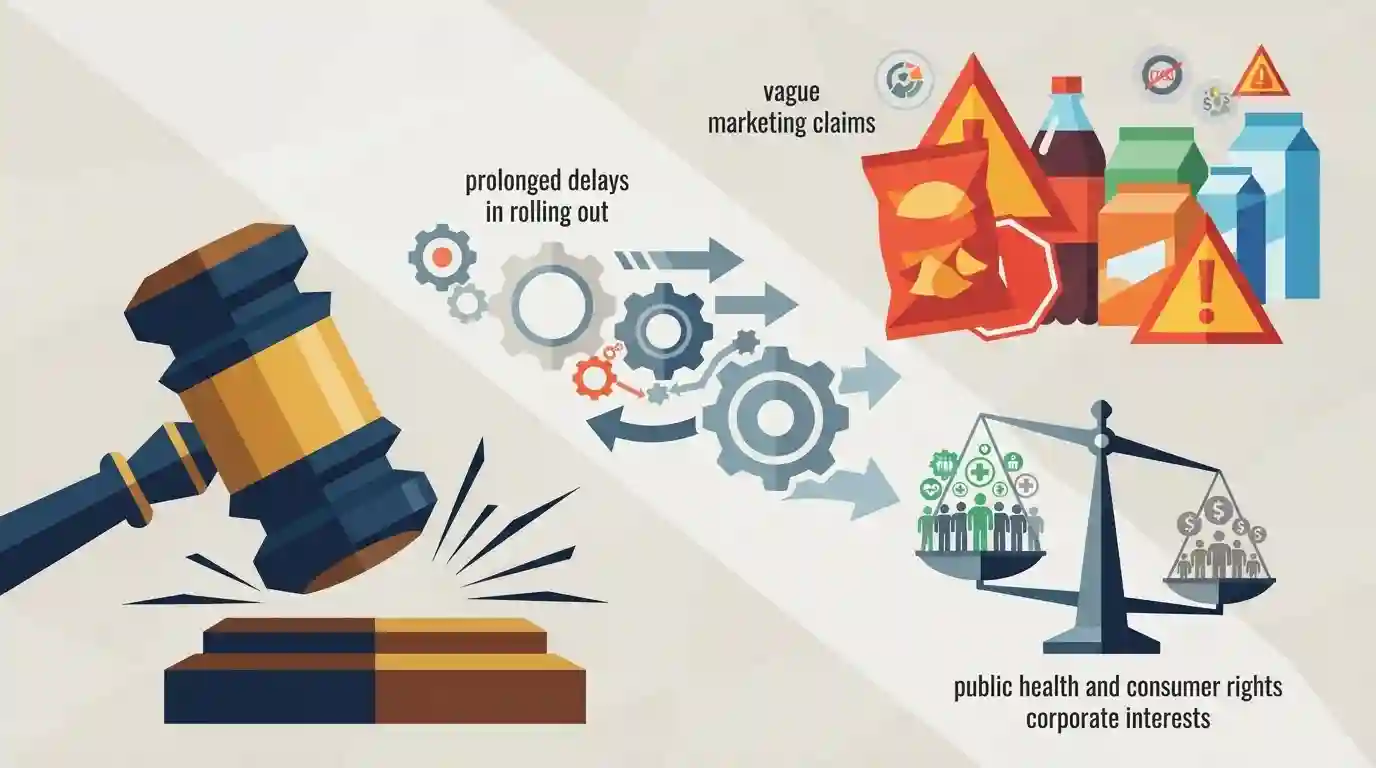
The Supreme Court expressed strong dissatisfaction with the Food Safety and Standards Authority of India (FSSAI) over prolonged delays in rolling out Front-of-Package Labelling (FoPL) for packaged food items. The court emphasized that public health and consumer rights must supersede corporate interests, questioning the rationale behind extended implementation timelines for nutritional warning labels.
Key Points
- The Supreme Court of India questioned the Food Safety and Standards Authority of India (FSSAI) regarding its extended timeline for implementing Front-of-Package Labelling (FoPL) on packaged foods.
- FoPL aims to provide clear, easy-to-read warning labels on food items regarding high levels of sugar, salt, and fat to tackle rising non-communicable diseases (NCDs) and obesity.
- The judiciary expressed concern over bureaucratic delays and pressures from commercial interests affecting public health measures.
Important Terms
Food Safety and Standards Authority of India (FSSAI)

A statutory regulatory body established under the Food Safety and Standards Act, 2006, functioning under the Ministry of Health and Family Welfare to lay down science-based standards for food safety and regulate their manufacture, storage, and distribution in India.
UPSC context
UPSC GS Paper III (Food Processing and Related Industries, Government Policies & Interventions). Tests knowledge of institutional frameworks for food safety and consumer protection.
Food Safety and Standards Act, 2006
An umbrella legislation enacted in 2006 to consolidate various food laws, establishing the FSSAI as a single reference point for all matters relating to food safety and standards in India.
UPSC context
UPSC GS Paper III (Regulatory framework, Governance). Essential for understanding legal provisions governing food industry standards and consumer rights.
Front-of-Package Labelling (FoPL) regulations
A simplified nutritional labelling system placed on the front of packaged food items (such as red hexagonal warning labels) to alert consumers about high levels of critical nutrients like sugar, salt, and fat.
UPSC context
UPSC GS Paper II/III (Public Health, Consumer Rights). Evaluates policy interventions tackling lifestyle diseases, non-communicable diseases, and consumer awareness.
Static Concepts Connected
What are the core mandates and statutory framework of the FSSAI under Indian law?
- Statutory Basis: Statutory body established under the Food Safety and Standards Act, 2006 to consolidate various food laws.
- Parent Ministry: Operates under the administrative control of the Ministry of Health and Family Welfare.
- Core Functions: Responsible for framing science-based standards for food and regulating their manufacture, storage, distribution, sale, and import.
Cross-Topic Patterns
Public Health versus Corporate Lobbying in Trade
Judicial push for nutrition labels directly intersects with consumer rights and competition law, checking corporate misleading claims and opacity in processed food marketing.
Institutional Capacity in Public Health Regulation
FSSAI's regulatory delays highlight wider institutional capacity bottlenecks in statutory bodies tasked with enforcing preventive healthcare standards.

FSSAI mandate + NCD rise + judicial intervention is a prime candidate for an analytical Mains question on balancing trade and health.
Linked PYQs · 2
Linked PYQs · 2
- 2025MainsGS3
Examine the scope of the food processing industries in India. Elaborate the measures taken by the government in the food processing industries for generating employment opportunities.
- 2018PrelimsGS1
Consider the following statements: 1. The Food Safety and Standards Act, 2006 replaced the Prevention of Food Adulteration Act, 1954. 2. The Food Safety and Standards Authority of India (FSSAI) is under the charge of Director General of Health Services in the Union Ministry of Health and Family Welfare. Which of the statements given above is/are correct?
