Supreme Court Regulations for AI Use in Courts
Source:Indian Express ↗
Why It Matters
It marks a pivotal step in institutionalizing technology within the Indian judiciary, highlighting the balance between technological innovation and fundamental rights, accountability, and the rule of law.
Summary
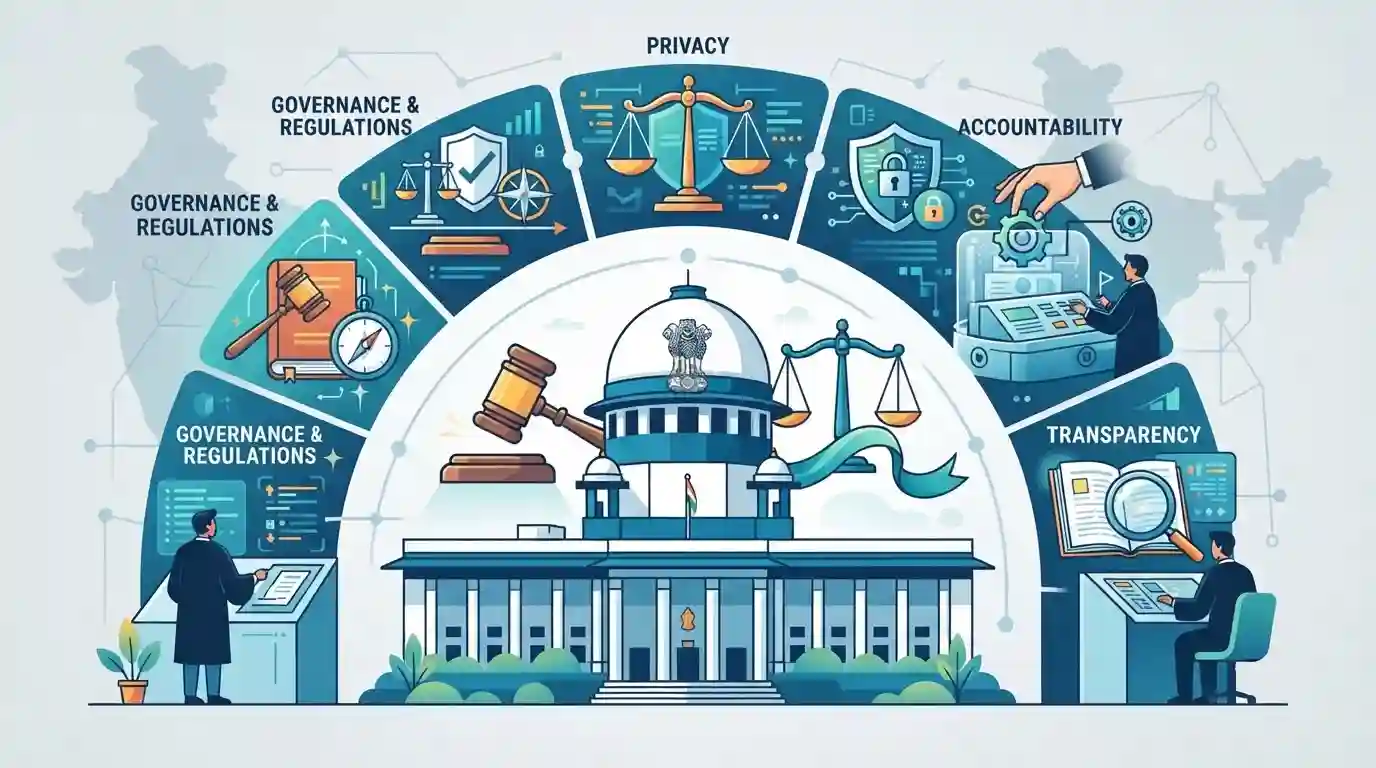
The Supreme Court of India has proposed regulations to govern the use of Artificial Intelligence in judicial processes. This initiative addresses the challenges of integrating emerging technologies into the justice system, ensuring that AI serves as a supportive tool while safeguarding core judicial values, privacy, accountability, and transparency.
Key Points
- The Supreme Court of India proposed comprehensive regulations regarding the use of Artificial Intelligence (AI) tools in court proceedings and judicial work.
- The guidelines aim to balance technological efficiency in legal delivery with critical safeguards against algorithmic bias, privacy breaches, and over-reliance on automated tools.
- It highlights the growing intersection of technology and justice delivery, addressing concerns over accountability, transparency, and human oversight in judicial decision-making.
Important Terms
Supreme Court of India

The apex judicial body of India, which has proposed draft regulations to govern the ethical, transparent, and accountable use of artificial intelligence across all courts and tribunals.
UPSC context
Relevant for GS Paper II (Polity and Governance - Judiciary and Institutional Reforms) and GS Paper III (Science & Technology - Emerging Tech).
Prelims Trap
AI systems in court proceedings can share final adjudicatory responsibilities with judges to clear backlogs.
Aspirants often assume regulatory guidelines allow AI tools to share judicial decision-making authority or act as independent adjudicators to reduce backlog.
Static Concepts Connected
What are the constitutional provisions and institutional mechanisms governing judicial independence and administrative reforms in India?
- Article 145: Guardianship: Supreme Court acts as the custodian of the Constitution and holds administrative rulemaking powers under Article 145.
- e-Courts Project: Digitization: The e-Courts Mission Mode Project aims to modernize judicial infrastructure through technology and information communications.
- Judicial Discretion: Primacy: Human oversight is constitutionally mandated; non-delegation of judicial discretion is a core tenet of the separation of powers (Article 50).
Cross-Topic Patterns
AI in Judiciary + DPDP Act + Article 21
Integration of AI in courts intersects with Article 21 (Right to Fair Trial) and data protection principles under the Digital Personal Data Protection Act.
Judicial AI + e-Courts Project + Good Governance
Court automation and e-initiatives relate directly to Mission Mode Projects under the National e-Governance Plan (NeGP) for the judiciary.

SC's AI regulations framework will likely be tested via a statement-based question covering human primacy vs algorithmic decision-making.
Linked PYQs · 1
Linked PYQs · 1
- 2023MainsGS3
Introduce the concept of Artificial Intelligence (AI). How does Al help clinical diagnosis? Do you perceive any threat to privacy of the individual in the use of Al in healthcare?
