Supreme Court Proposed Regulations for AI Use in Judiciary
Source:Indian Express ↗
આ શા માટે મહત્વનું છે
It highlights the evolving interface between emerging technologies like AI and traditional institutions like the judiciary, setting critical benchmarks for ethical governance, transparency, and the rule of law.
સારાંશ
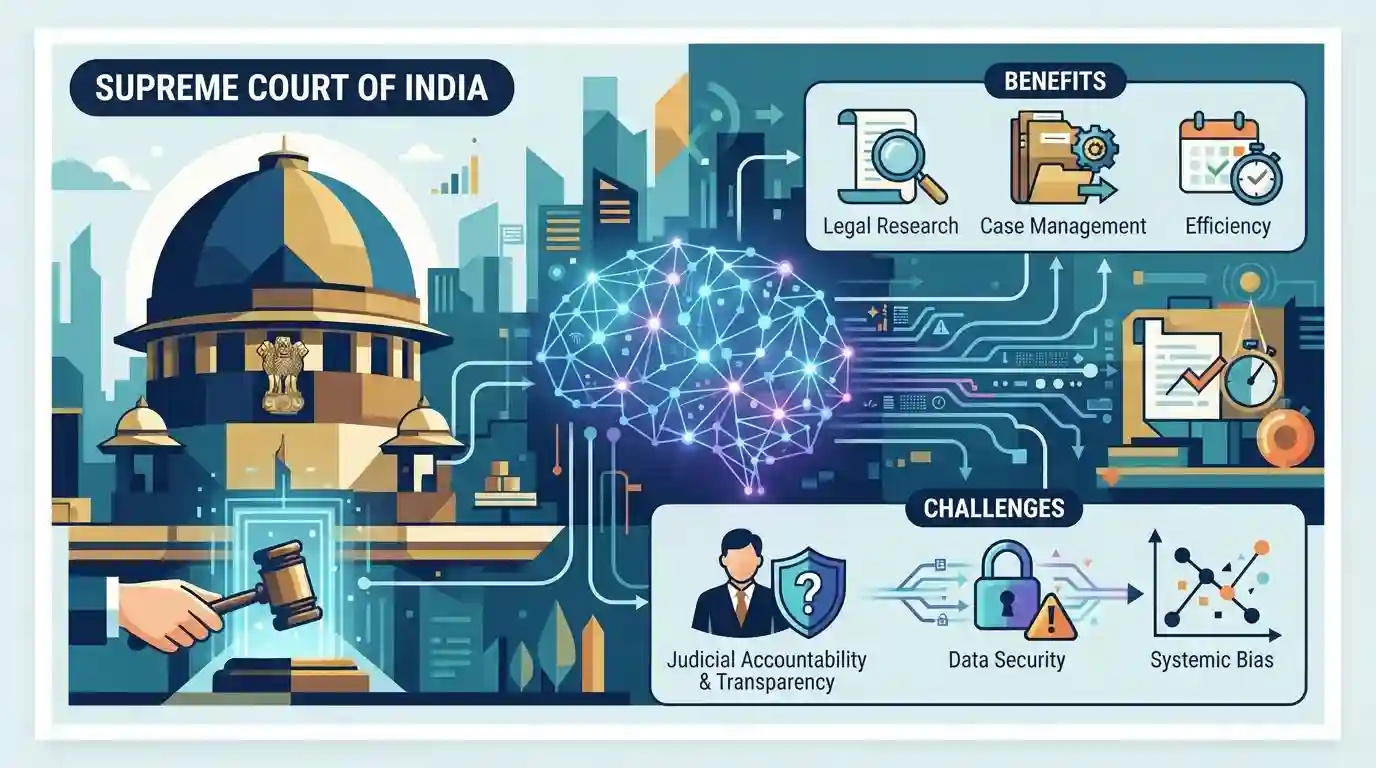
The Supreme Court of India has proposed regulations for the use of Artificial Intelligence in courts, highlighting the intersection of modern technology and judicial administration. While AI holds promise for enhancing legal research and case management, the move underscores critical issues concerning judicial accountability, transparency, data security, and systemic bias.
મુખ્ય મુદ્દા
- The Supreme Court has proposed regulations regarding the use of Artificial Intelligence (AI) in judicial proceedings and courts.
- The integration of AI in the judiciary offers benefits like process efficiency, case management, and data analysis, but raises concerns regarding bias, data privacy, accountability, and transparency.
- Regulation is necessary to balance technological adoption with constitutional safeguards, fairness, and the protection of fundamental rights in the delivery of justice.
મહત્વપૂર્ણ શબ્દો
Supreme Court of India

The apex judicial body in India comprising the Chief Justice and other judges, functioning as the constitutional court, final court of appeal, and guarantor of fundamental rights.
UPSC context
UPSC GS Paper II: Structure, organization, and functioning of the Judiciary; crucial for testing judicial governance and constitutional roles.
E-Governance Applications
The integration of digital technology into governance and administrative processes to improve transparency, accountability, and the delivery of public services.
UPSC context
UPSC GS Paper II: Role of e-governance in applications, models, successes, limitations, and potential in public administration.
Human Primacy in AI
The principle that artificial intelligence systems in judicial administration must remain strictly assistive, ensuring human judges retain ultimate authority and accountability for all decisions.
UPSC context
UPSC GS Paper III: Ethical considerations in emerging technologies like Artificial Intelligence, accountability, and bureaucratic/judicial governance.
સંલગ્ન સ્થિર ખ્યાલો
What are the constitutional provisions ensuring judicial independence and administration in India?
- Complete Justice: Article 142 empowers the Supreme Court to pass any decree or order necessary for doing complete justice in any pending case.
- SC Rule-Making: Article 145 enables the Supreme Court to make rules for regulating the practice and procedure of the Court with Presidential approval.
- Control of Subordinate Judiciary: Article 235 vests administrative control over district courts and subordinate judiciary in the respective High Courts.
આંતર-વિષય પેટર્ન
AI in Judiciary vs. NeVA E-Governance
The judiciary's embrace of AI for transcription and research links directly to the Digital India and NeVA (National e-Vidhan Application) e-governance push.
AI Governance and Fundamental Rights
Draft AI regulations touch upon Article 14 (Equality) and Article 21 (Due Process), testing how administrative tech frameworks protect fundamental rights.

SC's AI regulations prohibiting algorithmic sentencing/bail will likely feature as a statement-based question in Prelims or Ethics.
સંલગ્ન PYQ · 3
સંલગ્ન PYQ · 3
- 2025MainsGS2
e-governance projects have a built-in bias towards technology and back-end integration than user-centric designs. Examine.
- 2024MainsGS2
e-governance is not just about the routine application of digital technology in service delivery process. It is as much about multifarious interactions for ensuring transparency and accountability. In this context evaluate the role of the 'Interactive Service Model' of e-governance.
- 2023MainsGS3
Introduce the concept of Artificial Intelligence (AI). How does Al help clinical diagnosis? Do you perceive any threat to privacy of the individual in the use of Al in healthcare?
