Supreme Court Drafts Framework for AI Deployment in Judiciary
Source:Indian Express ↗
Why It Matters
This framework is a critical step in technology governance, addressing how the state protects fundamental rights (like fair trial and privacy) against algorithmic bias and automation. It directly relates to GS2 (Judicial functioning, e-governance, accountability) and GS3 (S&T, AI development, and ethical regulation).
Summary
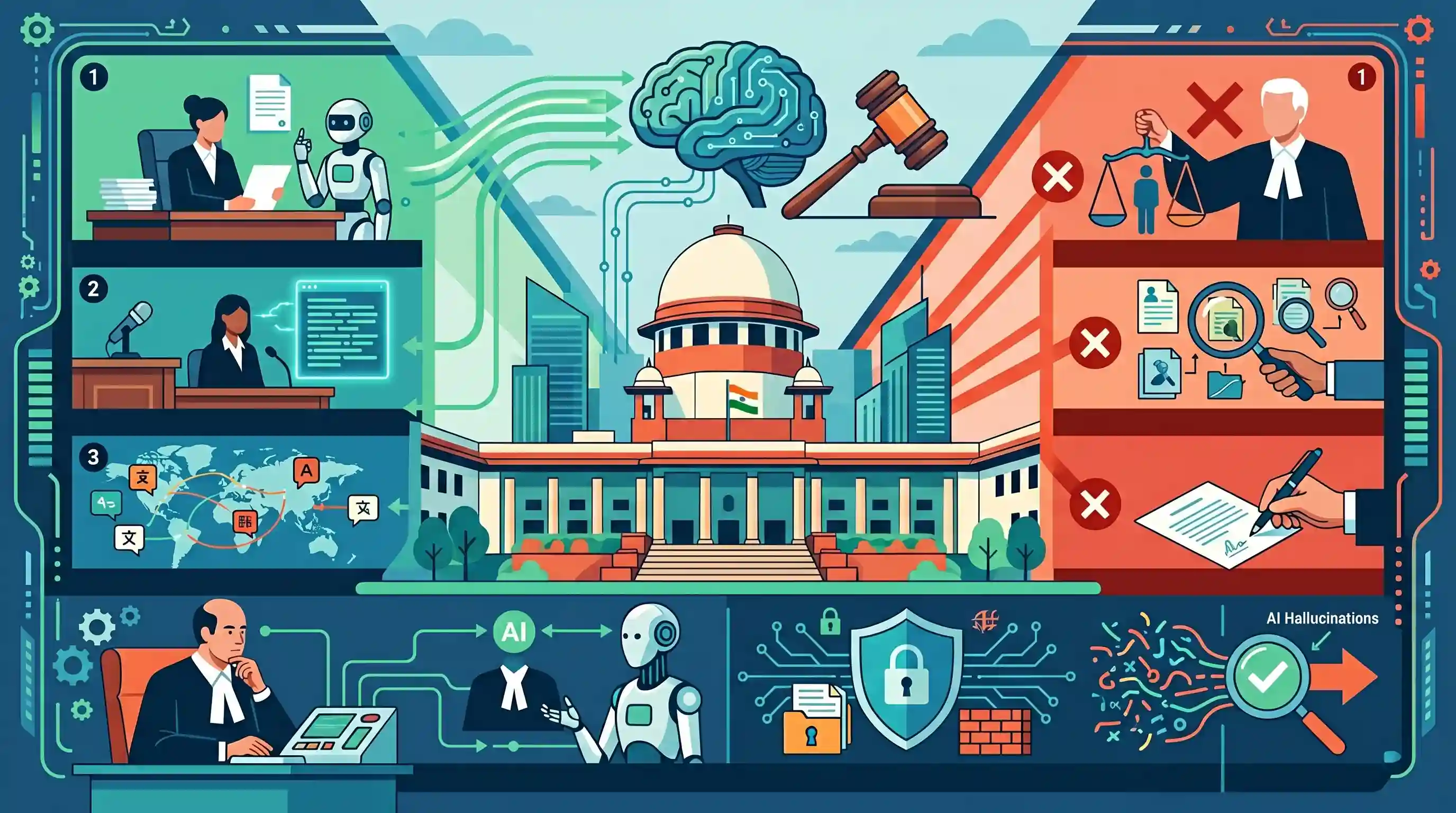
The Supreme Court of India has proposed draft regulations defining the legal boundaries for the integration of Artificial Intelligence (AI) within the country's court system. While the framework embraces AI to enhance administrative efficiency, transcribe proceedings, and facilitate translations, it draws a strict line against AI involvement in core judicial functions. AI is prohibited from determining guilt, evaluating evidence, or writing judgments. Highlighting the 'human-in-the-loop' principle, the draft rules place complete accountability on judges and lawyers, while enforcing strict guidelines to address AI hallucinations, protect data privacy, and safeguard sensitive court records.
Key Points
- The Supreme Court of India has proposed draft regulations to govern the deployment of Artificial Intelligence (AI) in courts, aiming to balance technological efficiency with the constitutional integrity of the judicial system.
- Permitted applications (Auxiliary Tasks): AI is allowed for administrative, non-decisional tasks such as case scheduling, document translation (e.g., using SUVAS), real-time transcription of court proceedings, case categorization, and summarizing voluminous legal documents.
- Strict Prohibitions (Core Judicial Functions): AI is absolutely barred from core judicial decision-making. It cannot draft final judgments, evaluate witness credibility, weigh evidence, or make decisions on bail, sentencing, or substantive rights.
- Preventing AI Hallucinations: Litigants and legal professionals are barred from submitting AI-generated drafts, legal arguments, or case citations without human verification, minimizing the risk of fabricated case laws.
- Data Privacy and Confidentiality: Sensitive case files—specifically those concerning matrimonial disputes, juvenile justice, sexual assault, and in-camera proceedings—must not be uploaded to public or open-source AI models.
- Human-in-the-Loop Principle: The regulations mandate human oversight at every stage, emphasizing that the final responsibility and accountability for any legal or judicial submission rest solely with human judges and lawyers.
Important Terms
Draft Regulations on the Use of Artificial Intelligence in Courts, 2026

A proposed governance framework released by the Supreme Court of India's AI Committee to regulate the deployment of AI in judicial processes, establishing human primacy, prohibiting algorithmic decision-making, and protecting data privacy.
UPSC context
GS Paper II: Judicial Reforms and Governance. Tests understanding of technological integration in judiciary, ethical boundaries of AI, and preservation of human primacy.
e-Courts Project
A pan-India Mission Mode Project funded by the Department of Justice to transform the Indian judiciary through Information and Communication Technology (ICT) enablement of district and subordinate courts.
UPSC context
GS Paper II: E-Governance and Judicial Reforms. Relevant for evaluating digital initiatives, improving justice delivery, and modernizing legal infrastructure in India.
SUVAS (Supreme Court Vidhik Anuvaad Software)
An AI-powered, machine-assisted translation tool developed by the Supreme Court of India to translate English judicial documents, orders, and judgments into various Indian regional languages to improve access to justice.
UPSC context
GS Paper II: E-Governance and Judiciary. Important for essays and answers on technology-driven inclusion, linguistic accessibility, and constitutional language provisions under Article 348.
e-Committee of the Supreme Court of India
A body constituted to assist in formulating a National Policy for implementation of Information and Communication Technology (ICT) in the Indian judiciary and overseeing the execution of the e-Courts Project.
UPSC context
GS Paper II: Structure and Functioning of the Judiciary. Relates to institutional mechanisms driving technological adaptation, e-governance policies, and court management.
Supreme Court of India
The highest judicial forum and final court of appeal under the Constitution of India, possessing original, appellate, and advisory jurisdictions, and acting as the ultimate guardian of fundamental rights.
UPSC context
GS Paper II: Indian Polity. Constitutional provisions, powers, jurisdiction, independence, and the landmark rulings of the country's apex judicial institution.
Prelims Trap
AI-generated draft judgments are permitted under the draft regulations provided they are verified and signed by a presiding judge.
The draft regulations absolutely prohibit AI from writing judgments, even as preliminary drafts. No judicial decision-making functions can be delegated to AI.
Static Concepts Connected
What is the e-Courts Mission Mode Project?
- Mandate & Agency: A pan-India project under the National e-Governance Plan, monitored by the SC e-Committee and Department of Justice.
- Phase III Focus: Phase III focuses heavily on cloud infrastructure, paperless courts, and integrating AI/ML exclusively for administrative and research assistance.
- NJDG Integration: The National Judicial Data Grid provides open access to case data, enhancing systemic transparency and tracking pendency.
How does AI decision-making challenge Natural Justice?
- Right to Reason: A reasoned order is central to Article 14 and 21. Black-box AI algorithms cannot explain their cognitive pathways.
- Rule Against Bias: Training data inherits human biases, which automated systems scale, violating the core principle of a fair and unbiased trial.
Cross-Topic Patterns
AI bias and criminal justice
Western use of recidivism algorithms shows deep systemic bias. India's ban on automated risk-scoring ensures historical socio-economic marginalization is not digitally hardcoded into bail decisions.
DPDP Act meets Judicial Records
Applying the DPDP Act 2023 to courts balances the open-court principle (Article 129) with the right to privacy of victims in matrimonial or juvenile cases.

2026 Prelims may test the distinction between permitted administrative AI (SUVAS/SUPACE) and absolute bans on algorithmic bail/judgment drafting.
Linked PYQs · 4
Linked PYQs · 4
- 2024MainsGS2
e-governance is not just about the routine application of digital technology in service delivery process. It is as much about multifarious interactions for ensuring transparency and accountability. In this context evaluate the role of the 'Interactive Service Model' of e-governance.
- 2023MainsGS3
Introduce the concept of Artificial Intelligence (AI). How does Al help clinical diagnosis? Do you perceive any threat to privacy of the individual in the use of Al in healthcare?
- 2020PrelimsGS1
With the present state of development, Artificial Intelligence can effectively do which of the following? 1. Bring down electricity consumption in industrial units 2. Create meaningful short stories and songs 3. Disease diagnosis 4. Text-to-Speech Conversion 5. Wireless transmission of electrical energy Select the correct answer using the code given below:
- 2025MainsGS2
e-governance projects have a built-in bias towards technology and back-end integration than user-centric designs. Examine.
