Debate on judicial rulings and citizen right to clean air
Source:Indian Express ↗
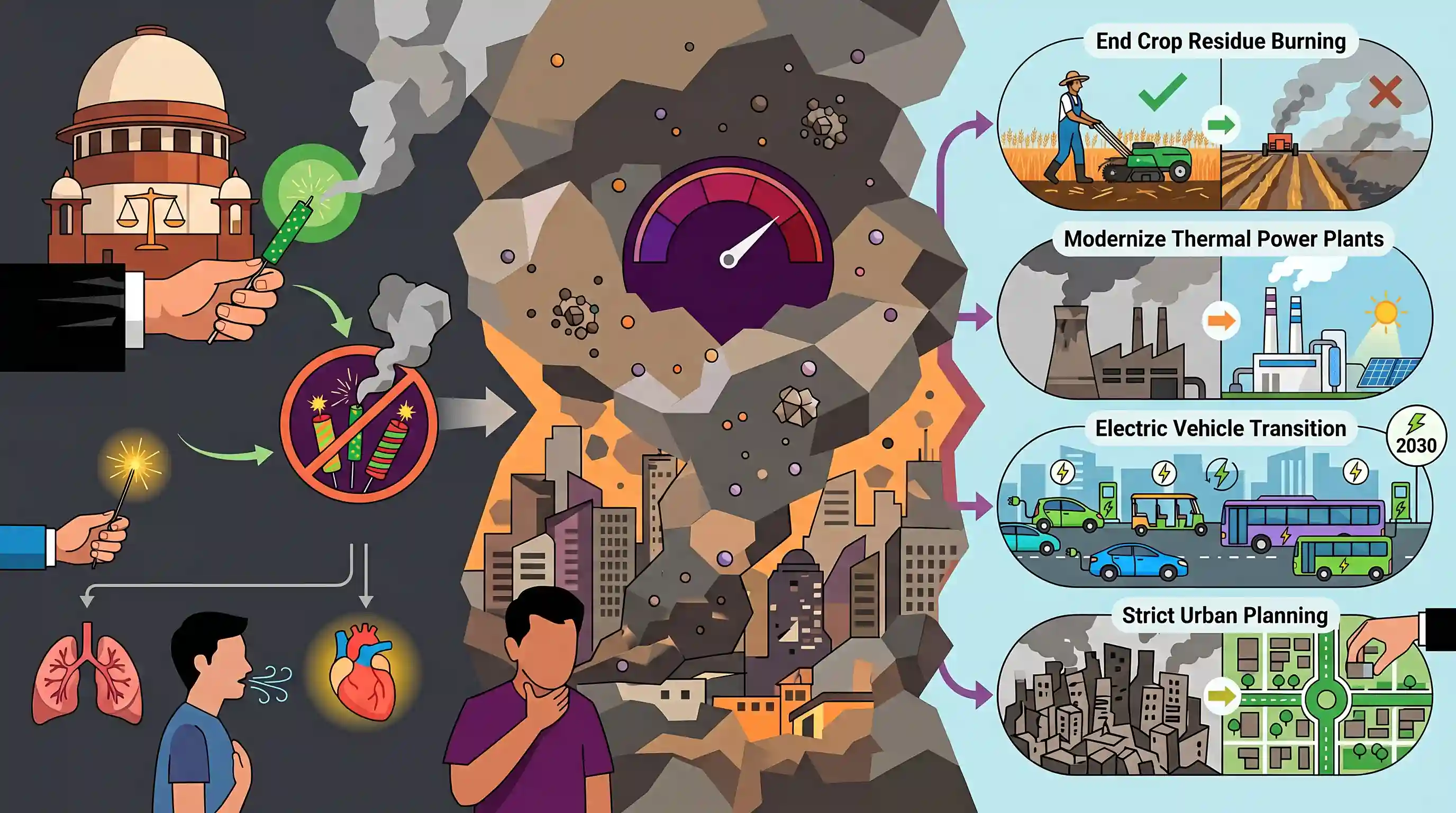
Why It Matters
The article directly addresses the perennial crisis of air pollution in Delhi-NCR, bringing into focus the constitutional debate between cultural practices and the fundamental right to clean air under Article 21. It also highlights the limitations of judicial interventions (like easing restrictions for green crackers) when enforcement is weak, reinforcing the need for structural policy shifts.
Summary
Former NITI Aayog CEO Amitabh Kant strongly criticized the Supreme Court's decision to allow "green" firecrackers during Diwali, stating it prioritized the "right to burn crackers over the right to live and breathe." With Delhi's Air Quality Index (AQI) plunging into the 'severe' zone and PM2.5/PM10 levels breaching safe limits by up to 18 times, Kant called for a unified, ruthless action plan. He advocated for ending crop residue burning, modernizing thermal power plants, shifting all transport to electric vehicles by 2030, and implementing strict urban planning measures to tackle the recurring environmental catastrophe.
Key Points
- Following Diwali celebrations, Delhi\'s Air Quality Index (AQI) plunged into the \'severe\' category, with PM2.5 and PM10 levels breaching safe limits by 15 to 18 times.
- Former NITI Aayog CEO Amitabh Kant criticized the Supreme Court for permitting \'green\' crackers, stating it prioritized the right to burn crackers over citizens\' right to breathe.
- Supreme Court directives restricting fireworks to specific two-hour time slots were widely flouted across Delhi-NCR.
- Kant advocated for a unified action plan including an end to crop burning, shutting or modernizing thermal plants, and shifting all transport to electric by 2030.
Important Terms
Article 21 (Right to Life)

Guarantees protection of life and personal liberty. The Supreme Court (Subhash Kumar v. State of Bihar, 1991) expanded this to include the right to enjoy pollution-free water and air as essential for dignity.
UPSC context
GS Paper 2/3; tests understanding of Fundamental Rights and judicial activism in environmental protection.
Central Pollution Control Board (CPCB)
A statutory body established under the Water Act, 1974. It monitors air/water quality, advises the Central Government, and coordinates State Pollution Control Boards to implement environmental standards.
UPSC context
GS Paper 3; critical for topics on environmental pollution and statutory regulatory bodies.
Green Crackers
Eco-friendly fireworks developed by CSIR-NEERI. They reduce emissions (PM 2.5/SO2/NOx) by 30-40% and exclude hazardous chemicals like Barium Nitrate, using water vapor or dust suppressants instead.
UPSC context
GS Paper 3; relevant for environmental degradation and scientific solutions to pollution.
Air Quality Index (AQI)
A tool launched in 2014 to communicate air quality status via 'One Number-One Color-One Description'. It measures 8 pollutants: PM10, PM2.5, NO2, SO2, CO, O3, NH3, and Pb.
UPSC context
GS Paper 3; essential for understanding environmental monitoring and urban pollution metrics.
Particulate Matter (PM 2.5/10)
Microscopic solids or liquid droplets in the air. PM 2.5 (diameter <2.5 microns) is particularly dangerous as it can penetrate deep into the lungs and enter the bloodstream.
UPSC context
GS Paper 3; core concept in atmospheric pollution and public health.
Delhi Pollution Control Committee (DPCC)
A statutory body under the Delhi Government responsible for implementing environmental laws in the National Capital Territory, working under the guidance of CPCB and NGT.
UPSC context
GS Paper 2/3; tests knowledge of regional environmental governance and urban administrative challenges.
Prelims Trap
"Green crackers developed by CSIR-NEERI are zero-emission fireworks that completely eliminate particulate matter."
Green crackers are NOT zero-emission. They merely reduce particulate matter and gaseous emissions (SO2, NO2) by about 30% by substituting specific toxic chemicals like Barium Nitrate.
Static Concepts Connected
What makes a firecracker "Green" under CSIR-NEERI guidelines?
- Chemical substitution: They eliminate specific highly toxic salts like Barium Nitrate (traditionally used for green light) and Lithium to reduce hazardous heavy-metal smoke.
- Emission reduction: They are not pollution-free but are designed to reduce particulate matter (PM) and gaseous emissions like SO2 and NO2 by approximately 30%.
- Key variants: CSIR-NEERI developed three main types: SWAS (Safe Water Releaser), STAR (Safe Thermite Cracker), and SAFAL (Safe Minimal Aluminium).
Which pollutants constitute the National Air Quality Index (AQI)?
- 8 Target Pollutants: It is calculated based on 8 pollutants: PM10, PM2.5, Nitrogen Dioxide (NO2), Sulphur Dioxide (SO2), Carbon Monoxide (CO), Ozone (O3), Ammonia (NH3), and Lead (Pb).
- Notable exclusions: Greenhouse gases like Carbon Dioxide (CO2) and Methane (CH4) are NOT included in the AQI measurement.
Cross-Topic Patterns
Article 21 vs. Cultural Freedom (Article 25)
The Supreme Court constantly balances Article 21 (interpreted to include the right to a clean environment) against Article 25 (the right to practice cultural/religious traditions) during Diwali firecracker hearings.
Subsoil Water Act and Stubble Burning
Delhi's winter smog is structurally linked to the Punjab Preservation of Subsoil Water Act, which delays paddy sowing to save groundwater, drastically shrinking the harvest window and forcing mechanized stubble burning.

Expect a 2026 Prelims multi-statement question combining CSIR-NEERI's Green Cracker chemistry with the 8 specific AQI pollutants.
Linked PYQs · 4
Linked PYQs · 4
- 2015MainsGS2
Does the right to clean environment entail legal regulations on burning crackers during Diwali? Discuss in the light of Article 21 of the Indian Constitution and Judgement(s) of the Apex Court in this regard.
- 2022MainsGS2
“The most significant achievement of modern law in India is the constitutionalization of environmental problems by the Supreme Court.” Discuss this statement with the help of relevant case laws.
- 2022PrelimsGS1
In the context of WHO Air Quality Guidelines, consider the following statements: 1. The 24-hour mean of PM2.5 should not exceed 15 µg/m³ and annual mean of PM2.5 should not exceed 5 µg/m³. 2. In a year, the highest levels of ozone pollution occur during the periods of inclement weather. 3. PM10 can penetrate the lung barrier and enter the bloodstream. 4. Excessive ozone in the air can trigger asthma. Which of the statements given above are correct?
- 2016PrelimsGS1
In the cities of our country, which among the following atmospheric gases are normally considered in calculating the value of Air Quality Index? 1. Carbon dioxide 2. Carbon monoxide 3. Nitrogen dioxide 4. Sulfur dioxide 5. Methane Select the correct answer using the code given below.
