PIL in Supreme Court challenges UGC caste bias definition
Source:Indian Express ↗
Why It Matters
This issue perfectly encapsulates the Constitutional debate over substantive equality, affirmative action, and reverse discrimination—a core component of GS2 Polity. It tests candidates' understanding of Article 14 (intelligible differentia, rational nexus) and the continuing relevance of the Indra Sawhney judgment in contemporary administrative regulations.
Summary
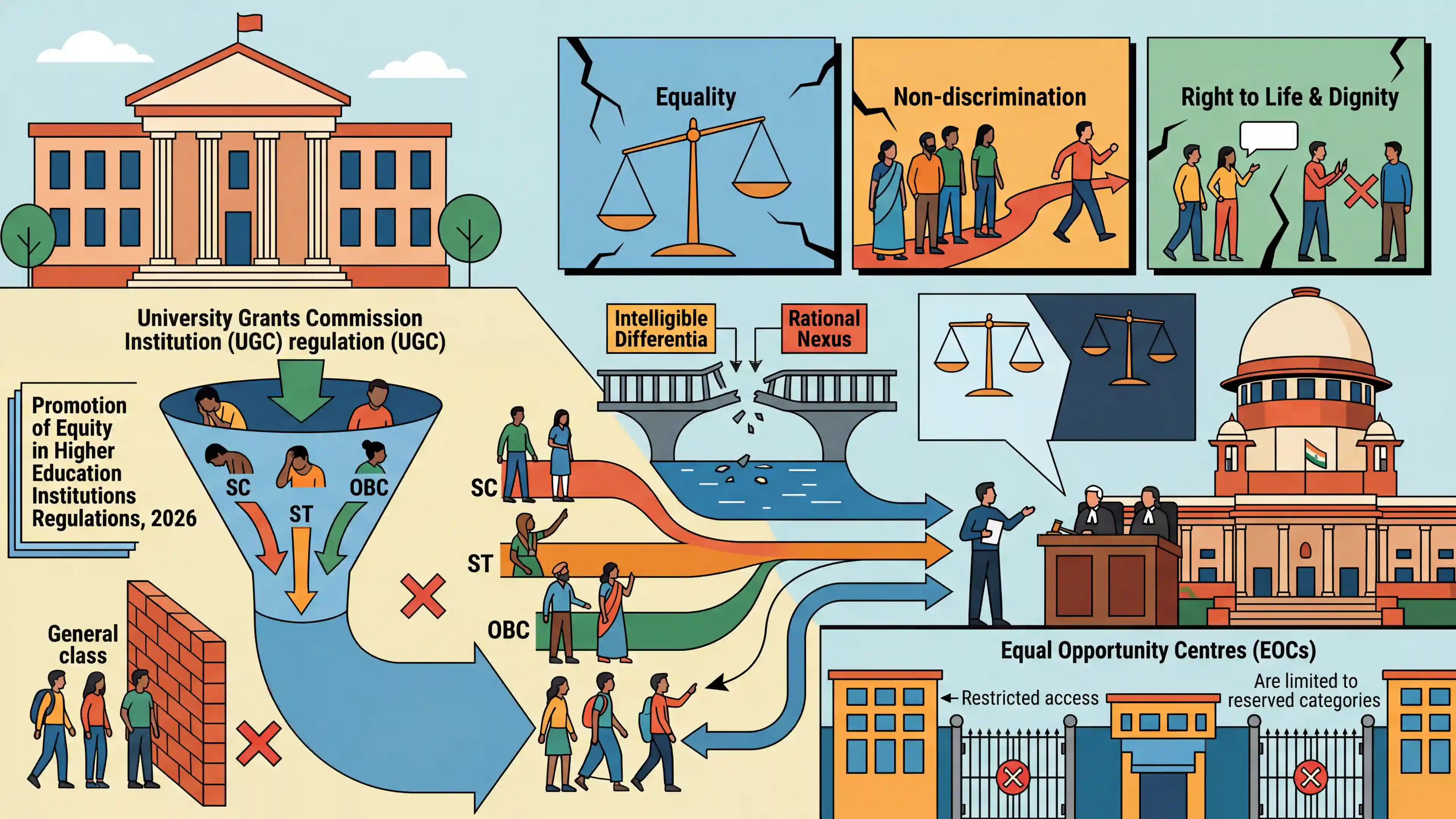
The Supreme Court has agreed to hear a Public Interest Litigation (PIL) challenging the University Grants Commission's (Promotion of Equity in Higher Education Institutions) Regulations, 2026. The petitioners argue that the regulations narrowly define "caste-based discrimination" as abuse solely against SC, ST, and OBC individuals, thereby excluding "General class" students. The plea contends that this exclusionary framework violates Fundamental Rights under Articles 14, 15, and 21 of the Constitution, arguing that the classification lacks an intelligible differentia and rational nexus to promoting educational equity. Citing the 1992 Indra Sawhney judgment, the petitioners emphasize that affirmative action should not devolve into reverse discrimination and that institutional remedies like Equal Opportunity Centres should not be restricted to reserved categories alone.
Key Points
- The Supreme Court will hear a PIL challenging the UGC (Promotion of Equity in Higher Education Institutions) Regulations, 2026, for its definition of caste-based discrimination.
- The regulations limit the definition of caste-based discrimination to prejudice against SC, ST, and OBC members, excluding general category students.
- Petitioners argue this exclusionary protection violates Articles 14, 15, and 21 of the Constitution, as it establishes an arbitrary classification lacking an intelligible differentia.
- The plea contends that denying institutional recourse (like Equal Opportunity Centres) to the general category amounts to hostile reverse discrimination.
- The petitioners cited the landmark Indra Sawhney vs Union of India (1992) judgment, which cautioned against affirmative action measures that perpetuate reverse discrimination without adequate safeguards.
Important Terms
UGC (Promotion of Equity in Higher Education Institutions) Regulations, 2026

Mandatory rules notified in January 2026 to curb campus discrimination, replacing the 2012 advisory framework; currently stayed by the Supreme Court over exclusionary definitions of caste-based discrimination.
UPSC context
GS Paper II: Social Sector/Education. Tests understanding of regulatory shifts from advisory to mandatory compliance in educational equity.
University Grants Commission (UGC)
A statutory body established under the UGC Act, 1956, responsible for coordinating, determining, and maintaining standards of university education in India.
UPSC context
GS Paper II: Statutory, regulatory and various quasi-judicial bodies. Focuses on the executive's power to regulate social conduct in HEIs.
Article 14
A fundamental right guaranteeing 'Equality before the Law' and 'Equal Protection of the Laws,' permitting reasonable classification but prohibiting arbitrary class legislation.
UPSC context
GS Paper II: Constitution. Core principle for testing the validity of any discriminatory or exclusionary state regulation.
Intelligible Differentia
A legal doctrine requiring that any classification by law must be based on clear, logical distinctions that differentiate those grouped from those excluded.
UPSC context
GS Paper II: Judiciary/Polity. A vital sub-topic for understanding the 'Reasonable Classification' test applied by courts.
Equal Opportunity Centres (EOCs)
Mandatory institutional offices in Higher Education Institutions (HEIs) designed to handle discrimination complaints and provide academic, financial, and social support to disadvantaged groups.
UPSC context
GS Paper II: Governance/Welfare Schemes. Relates to institutional mechanisms for social inclusion and grievance redressal in the education sector.
Indra Sawhney Judgment (1992)
The landmark 1992 Supreme Court ruling that upheld the 27% OBC reservation but established a 50% cap and the 'creamy layer' exclusion principle.
UPSC context
GS Paper II: Social Justice/Judiciary. Foundational case for all debates surrounding reservations and affirmative action limits.
Prelims Trap
"Article 15 protections against caste discrimination are exclusively available to socially and educationally backward classes."
Article 15(1) prohibits the State from discriminating against ANY citizen solely on grounds of religion, race, caste, sex, or place of birth. It is a universal protection.
Static Concepts Connected
What constitutes a valid classification under Article 14?
- Intelligible Differentia: The classification must be founded on an intelligible differentia which clearly distinguishes persons grouped together from others left out.
- Rational Nexus: The differentia must have a rational relation (nexus) to the object sought to be achieved by the statute or rule.
What is the mandate and status of the UGC?
- Statutory Body: UGC is a statutory body set up by the UGC Act, 1956 under the Ministry of Education.
- Core Mandate: It is strictly responsible for the coordination, determination, and maintenance of standards of higher education in India.
- Rule-making power: It holds powers to frame binding regulations on universities (delegated legislation), shifting away from mere advisory guidelines.
Cross-Topic Patterns
Affirmative action vs reverse discrimination
The debate mirrors controversies over the EWS quota (103rd Amendment), questioning where protective discrimination ends and arbitrary exclusion under Article 14 begins.
Judicial review of delegated legislation
The Supreme Court assessing UGC regulations highlights the judicial review of delegated legislation, testing whether a statutory body's rule-making powers infringe upon core Fundamental Rights.

Expect a Prelims question testing the precise constitutional meaning of 'intelligible differentia' and 'rational nexus' under Art 14.
Linked PYQs · 2
Linked PYQs · 2
- 2021MainsGS2
Analyze the distinguishing features of the notion of Right to Equality in the Constitutions of the USA and India.
- 2023MainsGS2
“Development and welfare schemes for the vulnerable, by its nature, are discriminatory in approach.” Do you agree? Give reasons for your answer.
