Dalit Land Encroachments and Recovery Measures in Andhra Pradesh
Source:The Hindu ↗
हे का महत्त्वाचे आहे
It highlights systemic challenges related to land alienation among marginalized communities like Dalits and tests the enforcement capacity of institutional mechanisms designed for their protection.
सारांश
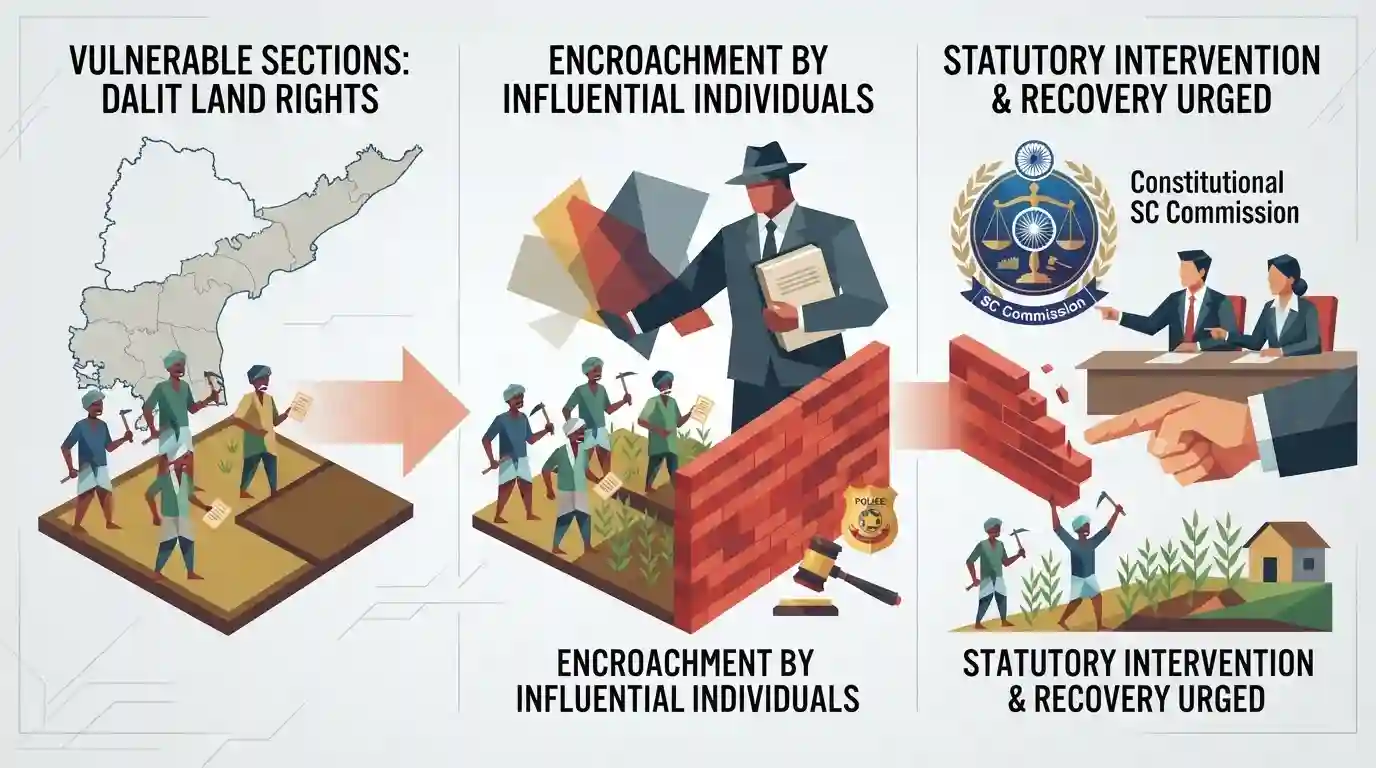
An SC panel in Andhra Pradesh has urged authorities to take strict action to recover lands belonging to Dalits that have been encroached upon by influential individuals, highlighting systemic issues of land alienation and enforcement gaps in welfare protections.
मुख्य मुद्दे
- A panel looking into Scheduled Caste (SC) issues has flagged large-scale illegal encroachments on Dalit assigned lands by influential people in Andhra Pradesh.
- The panel urged strict administrative and legal measures to recover these lands and restore them to the rightful Dalit owners.
- Land alienation remains a key driver of socio-economic vulnerability among marginalized communities, underlining gaps in implementation of protective laws.
महत्त्वाच्या संज्ञा
Assigned lands

Government-owned lands distributed free of cost to landless poor persons (frequently Dalits) for farming or housing, protected against illegal transfer or alienation by special state enactments.
UPSC context
GS Paper II/III (Vulnerable Sections, Land Reforms) – crucial for assessing the socioeconomic security and land rights of marginalized communities.
Scheduled Castes panel
State-level statutory bodies empowered to safeguard the constitutional and legal rights of Scheduled Castes, investigate rights violations, and recommend remedial action against atrocities or land encroachments.
UPSC context
GS Paper II (Constitutional & Statutory Bodies, Vulnerable Sections) – tests knowledge of mechanisms protecting marginalized groups.
Assigned Lands (Prohibition of Transfers) Act
State legislation designed to prevent the alienation and illegal transfer of lands assigned to landless poor, declaring unauthorized transactions void and empowering authorities to restore lands to original assignees.
UPSC context
GS Paper III (Land Reforms, Inclusive Growth) – tests understanding of state laws protecting vulnerable classes from land grabbing.
पूर्वपरीक्षा सापळा
The NCSC possesses direct enforcement and executive eviction powers to recover encroached lands.
Aspirants often assume constitutional bodies like the NCSC have binding executive powers to enforce eviction, whereas they primarily investigate, monitor, and recommend.
संबंधित स्थिर संकल्पना
What are the constitutional provisions and civil court powers of the National Commission for Scheduled Castes (NCSC)?
- Article 338: Constitutional basis established under Article 338 of the Indian Constitution as a national watchdog for SC rights.
- Civil Court Powers: Possesses all civil court powers regarding summoning witnesses, receiving evidence, and requisitioning public records during investigations.
- Reporting Mandate: Submits annual reports directly to the President of India for tabling before both Houses of Parliament.
आंतर-विषय नमुने
Land Reforms + Vulnerable Sections: Agrarian Alienation
Encroachment on assigned lands highlights systemic failures in translating agrarian reforms into socio-economic security for marginalized rural communities.
Constitutional Bodies + Federal Implementation Gaps
The NCSC's investigative mandate intersects with judicial review and executive compliance under federal administrative frameworks.

NCSC powers (civil court equivalence) combined with state-level assigned land alienation laws is a high-yield prelims match trap.
संबंधित PYQ · 2
संबंधित PYQ · 2
- 2018MainsGS2
Whether National Commission for Scheduled Castes (NCSC) can enforce the implementation of constitutional reservation for the Scheduled Castes in the religious minority institutions? Examine.
- 2026PrelimsGS1
Consider the following statements about the provisions pertaining to the Scheduled Castes and the Scheduled Tribes in India : 1. Provisions regarding the administration of the Tribal Areas in the States of Assam, Meghalaya, Tripura and Mizoram are given in the Fifth Schedule of the Constitution of India. 2. Some tribes of India are entitled to exemption from paying Income Tax on certain incomes. 3. The Constitution of India provides for reservation of seats in Panchayats for women belonging to the Scheduled Castes and the Scheduled Tribes. Which one of the following conclusions based on the above statements is correct ?
