Supreme Court Orders AG SG Oversight in Bar Council Policy Decisions
Source:The Hindu ↗
हे का महत्त्वाचे आहे
It highlights critical questions regarding the autonomy of statutory professional bodies like the BCI and the extent of judicial interventions or oversight mechanisms required to ensure fairness and neutrality during election periods.
सारांश
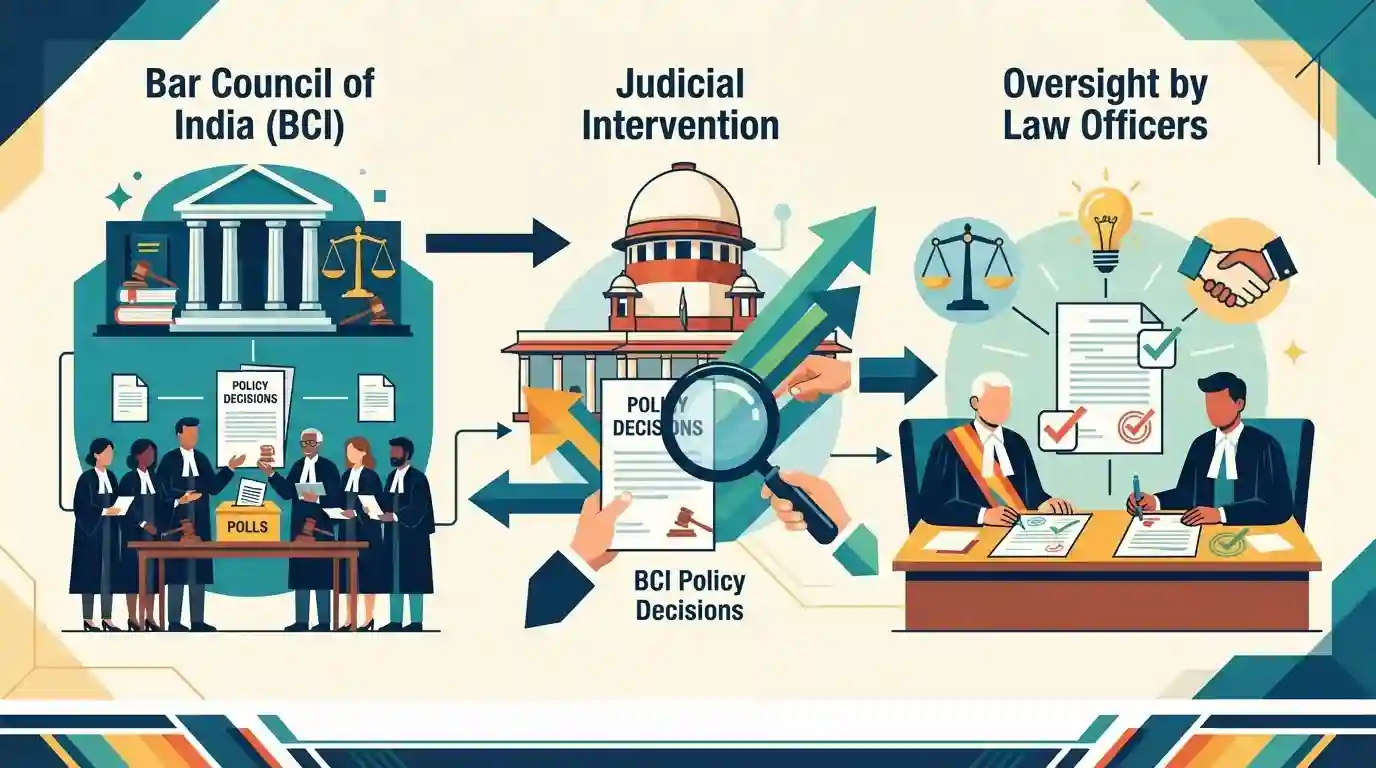
The Supreme Court directed that policy decisions made by the Bar Council of India (BCI) ahead of polls should be subjected to oversight by the Attorney General and Solicitor General, emphasizing transparency and fairness in the functioning of statutory regulatory bodies.
मुख्य मुद्दे
- The Supreme Court of India ordered oversight by the Attorney General (AG) and Solicitor General (SG) in policy decisions of the Bar Council of India (BCI) ahead of elections.
- The decision aims to ensure neutrality, fairness, and institutional integrity in statutory professional bodies during election cycles.
- Highlights the delicate balance between autonomy of professional regulatory bodies and judicial oversight to prevent potential conflicts of interest or electoral bias.
महत्त्वाच्या संज्ञा
Bar Council of India

A statutory body established under Section 4 of the Advocates Act, 1961, to regulate legal practice, legal education, and professional standards in India.
UPSC context
Important for GS Paper II under Statutory, Regulatory and Quasi-Judicial Bodies; tests the governance and legal oversight of professional regulators.
Advocates Act
An umbrella legislation enacted by Parliament in 1961 that consolidates the law relating to legal practitioners and provides for the constitution of State Bar Councils and the Bar Council of India.
UPSC context
Important for GS Paper II (Polity and Governance); tests knowledge of statutory frameworks governing legal professions and institutional autonomy.
Supreme Court of India
The highest constitutional court of India, possessing powers of judicial review, original, appellate, and writ jurisdiction under Article 32 and Article 136.
UPSC context
Core topic for GS Paper II under Judiciary and Separation of Powers; tests the scope of judicial intervention in regulatory bodies.
संबंधित स्थिर संकल्पना
What are the constitutional provisions relating to the Attorney General for India under Article 76?
- Appointment Eligibility: Appointed by the President and must be qualified to be appointed as a Judge of the Supreme Court.
- Parliamentary Rights: Has the right to speak and take part in proceedings of both Houses of Parliament, but without the right to vote (Article 88).
- Term & Remuneration: Holds office during the pleasure of the President and receives remuneration as determined by the President.
आंतर-विषय नमुने
Article 76 and Judicial Oversight Mandates
The Attorney General's constitutional role under Article 76 extends beyond advisory duties to the Executive when courts assign special public-interest oversight tasks.
Statutory Autonomy vs Judicial Review
Professional bodies created by statute like the BCI balance self-regulation with public accountability and judicial review.

Expect a statement-based question combining Article 76 powers, the Advocates Act, and the limits of statutory body autonomy.
संबंधित PYQ · 2
संबंधित PYQ · 2
- 2015MainsGS2
For achieving the desired objectives, it is necessary to ensure that the regulatory institutions remain independent and autonomous. Discuss in the light of the experiences in recent past.
- 2020MainsGS2
Judicial Legislation is antithetical to the doctrine of separation of powers as envisaged in the Indian Constitution. In this context justify the filing of large number of public interest petitions praying for issuing guidelines to executive authorities.
