Supreme Court Notice on Medical Post-Graduate Admission Cut-Offs
Source:The Hindu ↗
Why It Matters
The issue touches upon fundamental constitutional provisions (Article 14) relating to arbitrary state action, as well as the governance of medical education in India. It is highly relevant for GS Paper 2 topics concerning the management of social sector services relating to health and education, and the role of regulatory bodies like the NMC.
Summary
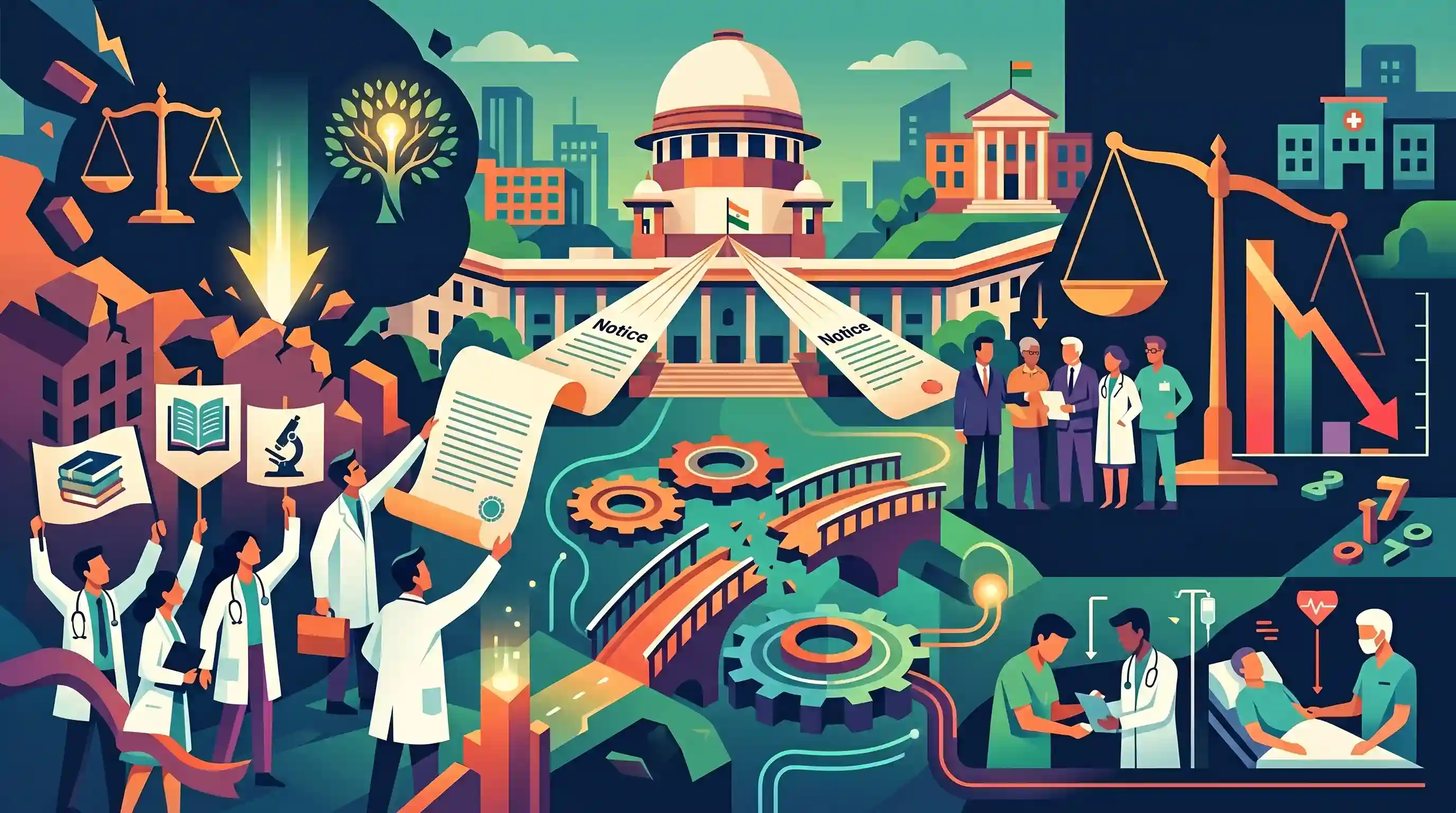
The Supreme Court has issued notices to the Centre, the National Board of Examinations in Medical Sciences (NBEMS), and the National Medical Commission (NMC) in response to a petition challenging the significant reduction of the NEET-PG cut-off percentile. The petition contests the decision to lower the qualifying threshold to the 7th percentile for the general category and zero for reserved categories. The petitioners argue that such a drastic reduction compromises the quality and standards of medical education in India and violates Articles 14 and 21 of the Constitution by arbitrarily changing the eligibility criteria after the selection process has commenced.
Key Points
- The Supreme Court has issued notices to the Centre, NBEMS, and NMC regarding the drastic reduction of NEET-PG 2025-26 cut-off percentiles.
- The cut-off was reduced to the 7th percentile for general category candidates and zero for reserved category candidates.
- Petitioners argue this move compromises medical education standards and violates Articles 14 (Right to Equality) and 21 (Right to Life) by acting arbitrarily.
- The plea asserts that modifying eligibility criteria after the selection process has already commenced contradicts established legal norms.
- The controversy highlights the ongoing tension between filling vacant postgraduate medical seats and maintaining rigorous standards of professional medical competence.
Important Terms
National Medical Commission (NMC)

The apex statutory regulatory body for medical education and professionals in India, established under the NMC Act 2019 to replace the Medical Council of India (MCI).
UPSC context
GS Paper II: Statutory/Regulatory Bodies. Tests understanding of healthcare governance and medical education reforms.
National Board of Examinations in Medical Sciences (NBEMS)
An autonomous body under the Ministry of Health and Family Welfare responsible for standardizing postgraduate medical education and conducting national entrance exams like NEET-PG and DNB.
UPSC context
GS Paper II: Important Institutions. Relevant for governance and transparency in examination processes.
Article 14
A Fundamental Right ensuring equality before the law and equal protection of laws; often invoked to challenge 'arbitrary' government actions or changes in selection criteria.
UPSC context
GS Paper II: Fundamental Rights. Tests the application of the 'Doctrine of Arbitrariness' in administrative law.
Article 21
A Fundamental Right protecting life and personal liberty, which the judiciary has expanded to encompass the rights to health, dignity, and quality education.
UPSC context
GS Paper II: Fundamental Rights. Tests the evolving scope of 'Right to Life' including professional standards and public health.
NEET-PG
The mandatory national entrance examination for doctors seeking admission to postgraduate medical courses (MD/MS/Diploma) in government and private institutions across India.
UPSC context
GS Paper II: Issues relating to Education and Health. Tests knowledge of merit-based selection and medical infrastructure issues.
Judicial Review
The power of the judiciary to examine the constitutionality of legislative acts and executive orders, ensuring they align with the Fundamental Rights.
UPSC context
GS Paper II: Constitution. Essential for understanding the Supreme Court's role in checking administrative overreach.
Prelims Trap
The Right to Health is explicitly enshrined as a Fundamental Right under Article 21 of the Indian Constitution.
The Right to Health is an implicit fundamental right read into Article 21 by the Supreme Court. It is not explicitly written in Part III, though Article 47 (DPSP) mentions public health.
Static Concepts Connected
What is the mandate and structure of the National Medical Commission (NMC)?
- Statutory Body: Established under the NMC Act, 2019, it replaced the Medical Council of India (MCI) to serve as the apex regulatory authority for medical education.
- Core Mandate: It regulates medical education and professionals, standardizes healthcare infrastructure, and maintains the National Medical Register.
- Autonomous Boards: Functions through four autonomous boards, including the Under-Graduate and Post-Graduate Medical Education Boards.
What is the doctrine regarding mid-way alteration of selection rules?
- Core Principle: The Supreme Court consistently holds that eligibility criteria or cut-offs cannot be changed after an admission or recruitment process has officially commenced.
- Article 14 Link: Such mid-process alterations, unless backed by pre-existing statutory rules, are deemed manifestly arbitrary and violate the Right to Equality.
Cross-Topic Patterns
Academic Autonomy vs Judicial Review
Courts traditionally defer to expert bodies like NMC in academic standard-setting, intervening only when executive actions breach the threshold of manifest arbitrariness under Article 14.
Article 47 vs Quality of Care
Lowering cut-offs highlights the policy tension between increasing doctor availability to meet public health duties (Article 47) and ensuring high-quality patient care implicit in Article 21.

Expect a 2026 Mains question on the ethical and legal tensions of diluting professional medical standards to overcome healthcare deficits.
Linked PYQs · 4
Linked PYQs · 4
- 2021MainsGS2
Analyze the distinguishing features of the notion of Right to Equality in the Constitutions of the USA and India.
- 2024MainsGS2
What are the aims and objects of recently passed and enforced, The Public Examination (Prevention of Unfair Means) Act, 2024? Whether University/State Education Board examinations, too, are covered under the Act ?
- 2015MainsGS2
The quality of higher education in India requires major improvements to make it internationally competitive. Do you think that the entry of foreign educational institutions would help improve the quality of higher and technical education in the country? Discuss.
- 2014MainsGS2
Should the premier institutes like IITs/IIMs. be allowed to retain premier status, allowed more academic independence in designing courses and also decide mode/criteria of selection of students. Discuss in light of the growing challenges.
