Judicial Independence and Tribunal Staffing Controversies
Source:The Hindu ↗
Why It Matters
It directly addresses the independence of quasi-judicial bodies like tribunals, checking executive overreach and administrative control over judicial infrastructure and appointments.
Summary
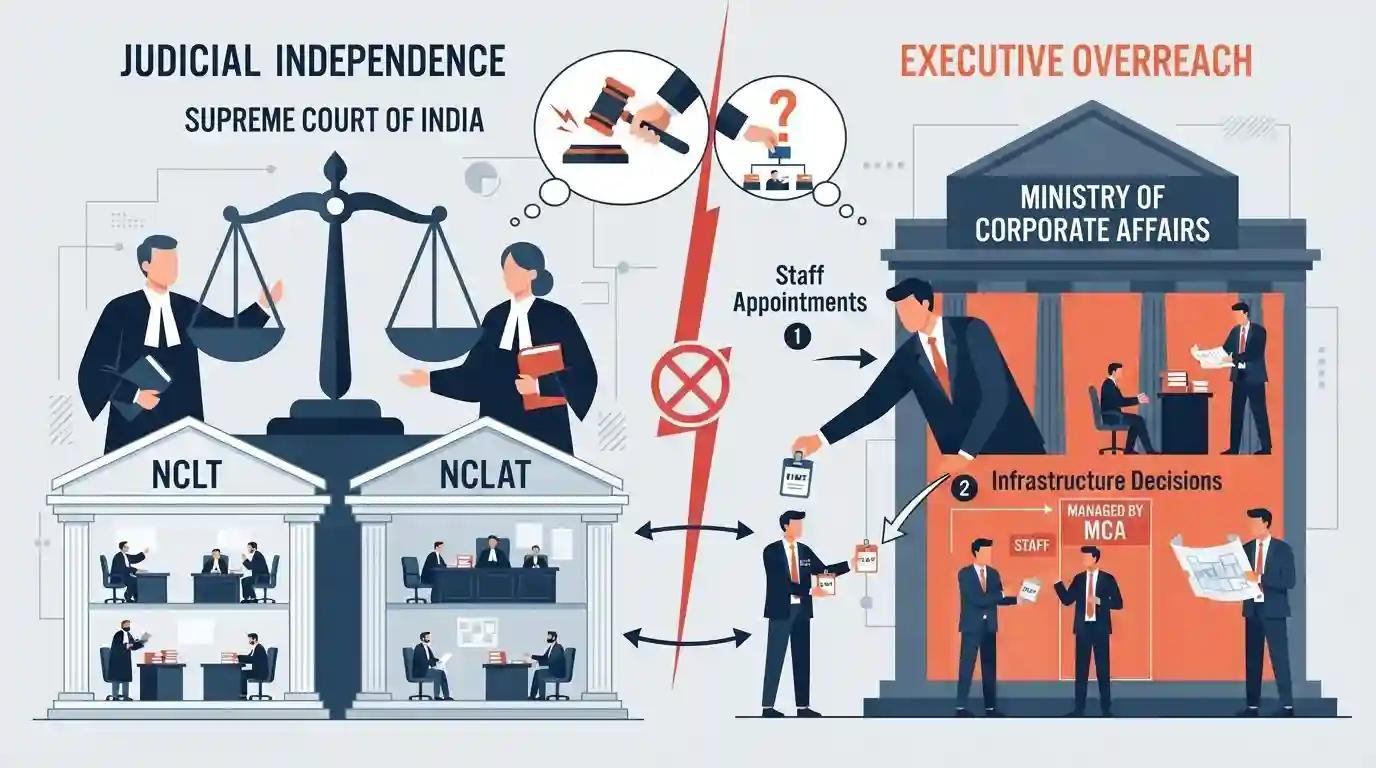
The Supreme Court raised serious concerns over the Ministry of Corporate Affairs taking over staff appointments and infrastructure decisions meant for the NCLT and NCLAT, emphasizing threats to judicial independence within tribunals.
Key Points
- The Supreme Court criticized the Ministry of Corporate Affairs for allegedly 'hijacking' staff appointments and infrastructure requirements in the NCLT and NCLAT.
- Proposals regarding staff and infrastructure intended for the President of the NCLT/NCLAT have faced administrative interference by the executive branch.
- The case highlights ongoing tensions concerning the independence of tribunals and executive overreach in quasi-judicial institutional frameworks.
Important Terms
National Company Law Tribunal (NCLT)

A quasi-judicial body established under the Companies Act, 2013, to handle corporate civil disputes, insolvency resolutions, and company law matters in India.
UPSC context
GS Paper II (Polity & Governance — Tribunals, Judicial Independence, Separation of Powers). Tests understanding of tribunalization of justice.
National Company Law Appellate Tribunal (NCLAT)
The appellate body that hears appeals against orders passed by the National Company Law Tribunal (NCLT) under the Companies Act and Insolvency and Bankruptcy Code.
UPSC context
GS Paper II (Polity & Governance — Statutory bodies, institutional autonomy, separation of powers).
Corporate Affairs Ministry
The Union government ministry responsible for the administration of the Companies Act, Insolvency and Bankruptcy Code, and related corporate governance laws and regulatory bodies in India.
UPSC context
GS Paper II (Polity & Governance — Executive control over quasi-judicial bodies and institutional independence).
Supreme Court
The apex constitutional court of India, tasked with judicial review and safeguarding the fundamental rights, rule of law, and separation of powers.
UPSC context
GS Paper II (Indian Constitution, Judiciary, checks and balances, judicial independence).
Prelims Trap
The Ministry of Corporate Affairs has absolute administrative authority to manage all staff appointments and infrastructure for the NCLT without judicial interference.
Aspirants often assume tribunal infrastructure and staff recruitment are exclusively managed by the parent ministry without judicial oversight, missing the constitutional mandate for institutional independence.
Static Concepts Connected
What are the constitutional and statutory provisions governing the National Company Law Tribunal (NCLT)?
- Statutory Basis: Established under Section 408 of the Companies Act, 2013, based on the recommendations of the Eradi Committee.
- Jurisdiction: Acts as a quasi-judicial body adjudicating corporate disputes, insolvency resolutions under IBC, and company law matters in India.
- Appellate Mechanism: Appeals against NCLT orders lie with the National Company Law Appellate Tribunal (NCLAT).
Cross-Topic Patterns
Tribunal Independence vs. Executive Overreach
Tribunal appointments continue to spark friction between the judiciary and executive, echoing past debates over the Tribunals Reforms Act and independence of quasi-judicial bodies.

Tribunal appointments, executive interference, and Madras Bar Association judgments are high-yield areas for UPSC Polity mains and prelims.
Linked PYQs · 3
Linked PYQs · 3
- 2025MainsGS2
Comment on the need of administrative tribunals as compared to the court system. Assess the impact of the recent tribunal reforms through rationalization of tribunals made in 2021.
- 2018MainsGS2
How far do you agree with the view that tribunals curtail the jurisdiction of ordinary courts? In view of the above, discuss the constitutional validity and competency of the tribunals in India.
- 2019MainsGS2
“The Central Administrative Tribunal which was established for redressal of grievances and complaints by or against central government employees, nowadays is exercising its powers as an independent judicial authority.” Explain.
