Retrospective Environmental Clearances and Sariska Reserve Boundaries
Source:The Hindu ↗
Why It Matters
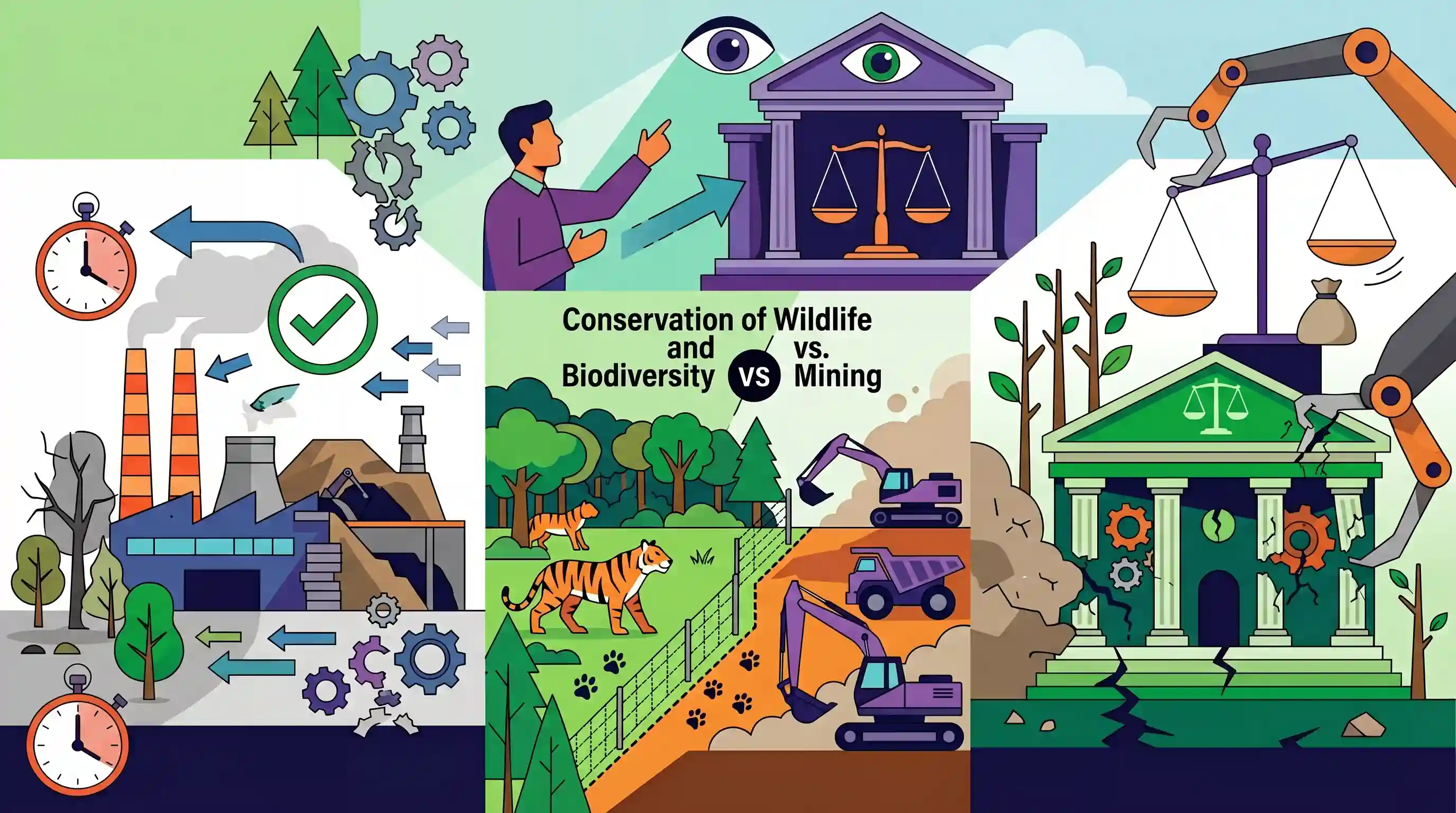
The article touches upon the core conflict between developmental activities (mining) and ecological conservation. The debate over ex post facto environmental clearances is a major loophole in the EIA framework. Furthermore, it highlights the crucial role of the higher judiciary and specialized tribunals (NGT) in enforcing environmental jurisprudence in India.
Summary
Former Environment Minister Jairam Ramesh has appealed to the Supreme Court to intervene in three critical ecological matters: the practice of granting retrospective environmental clearances, the revision of the Sariska Tiger Reserve boundaries to allow mining, and the systematic dilution of the National Green Tribunal's (NGT) powers. Welcoming the apex court's recent recall of an order on the Aravalli hills, Ramesh emphasized the need for judicial oversight to prevent irreversible environmental degradation and to uphold the integrity of Environmental Impact Assessment (EIA) processes.
Key Points
- Congress leader Jairam Ramesh urged the Supreme Court to take suo motu cognisance of three major environmental issues: retrospective environmental approvals, the redrawing of Sariska Tiger Reserve boundaries, and the dilution of the NGT's powers.
- The appeal follows the Supreme Court's recent suo motu recall of its November 20 verdict regarding the redefinition of the Aravalli hills.
- The Union government's push for ex post facto (retrospective) environmental clearances has been controversial. The Supreme Court had previously barred such approvals but recently opened the door for reviewing its own verdict.
- The Rajasthan government's move to revise the boundaries of the Sariska Tiger Reserve to facilitate the reopening of 57 closed mines was highlighted as a major ecological threat.
- Ramesh expressed concern over the systematic weakening of the National Green Tribunal (NGT) over the past decade, impacting environmental governance.
Important Terms
National Green Tribunal (NGT)

A statutory body established under the NGT Act, 2010, for the expeditious disposal of cases relating to environmental protection, forest conservation, and legal rights of the environment.
UPSC context
GS II Statutory Bodies; GS III Environmental Conservation. Tests knowledge of specialized judicial mechanisms for ecological justice.
Environmental Impact Assessment (EIA)
A regulatory process under the Environment (Protection) Act, 1986, evaluating potential ecological consequences of projects before approval to ensure sustainable development.
UPSC context
GS III Environmental Governance. Central to understanding the balance between industrial growth and biodiversity conservation.
Sariska Tiger Reserve
A protected area in Rajasthan's Alwar district and part of the Aravalli Range; notable as the first reserve to relocate tigers after local extinction.
UPSC context
GS III Biodiversity. Tests knowledge of Project Tiger, protected areas, and regional geography.
Retrospective Environmental Clearance
The granting of environmental approval to projects after they have already commenced construction or operations, potentially bypassing mandatory prior scrutiny and public hearings.
UPSC context
GS II Executive Discretion; GS III Environmental Ethics. Relates to the dilution of preventive ecological safeguards.
Aravalli Hills
One of the world's oldest fold mountain ranges, it acts as a critical ecological barrier preventing the eastward expansion of the Thar Desert.
UPSC context
GS I Physical Geography; GS III Environment. Vital for regional climate, groundwater recharge, and legal mining disputes.
Precautionary Principle
A doctrine stating that where there is a threat of serious environmental harm, lack of full scientific certainty shall not postpone preventive measures.
UPSC context
GS III Environment; GS IV Ethics. A fundamental principle of sustainable development often invoked by the Supreme Court.
Prelims Trap
"State governments can alter the boundaries of a Tiger Reserve on the recommendation of the State Board for Wildlife."
False. Under the Wildlife (Protection) Act, 1972, altering a Tiger Reserve's boundary explicitly requires the recommendation of the NTCA and approval of the NBWL.
Static Concepts Connected
What is the statutory process for altering the boundaries of a Tiger Reserve?
- State limitation: State governments have the power to notify tiger reserves but cannot alter their boundaries unilaterally to allow activities like mining.
- NTCA recommendation: Any proposed boundary alteration requires the mandatory recommendation of the National Tiger Conservation Authority (NTCA).
- NBWL approval: Final approval for altering boundaries must be granted by the National Board for Wildlife (NBWL), which is chaired by the Prime Minister.
How do ex-post facto clearances conflict with Indian environmental jurisprudence?
- Precautionary Principle: It violates the core tenet that environmental harm must be anticipated, mitigated, and prevented prior to project execution, rather than cured after the fact.
- EIA Notification 2006: It bypasses the mandatory prior-clearance mechanism, effectively treating illegal environmental damage or unauthorized construction as a compoundable administrative offense.
Cross-Topic Patterns
NGT vs. Tribunalization debates
The weakening of NGT powers connects directly to Polity syllabus themes on Article 323B tribunals, specifically the tension between executive control, rule-making over tribunal appointments, and judicial independence.
Aravallis: Geography meets Judicial Activism
The Aravalli mining issue bridges Physical Geography (relict mountains acting as a barrier to desertification) with Polity (Supreme Court expanding Article 21 to encompass environmental protection and applying the precautionary principle).

Expect a 2026 Prelims question blending Tiger Reserve boundary rules (NTCA/NBWL) with EIA exemptions and the Precautionary Principle.
Linked PYQs · 4
Linked PYQs · 4
- 2022MainsGS2
“The most significant achievement of modern law in India is the constitutionalization of environmental problems by the Supreme Court.” Discuss this statement with the help of relevant case laws.
- 2024MainsGS3
What role do environmental NGOs and activists play in influencing Environmental Impact Assessment (EIA) outcomes for major projects in India? Cite four examples with all important details.
- 2025MainsGS3
Mineral resources are fundamental to the country's economy and these are exploited by mining. Why is mining considered an environmental hazard? Explain the remedial measures required to reduce the environmental hazard due to mining.
- 2020PrelimsGS1
Among the following Tiger Reserves, which one has the largest area under "Critical Tiger Habitat"?
