Supreme Court Examination of Personal Law Succession Rules
Source:Indian Express ↗
Why It Matters
This development is crucial for UPSC aspirants as it strikes at the core of the ongoing Uniform Civil Code (UCC) debate. It highlights the constitutional tension between community-specific personal laws and the individual's fundamental rights to equality (Article 14) and religious freedom (Article 25). Establishing a legal right to opt out of personal laws could serve as a pragmatic step towards standardizing civil codes, impacting gender justice and the secular fabric of Indian law.
Summary
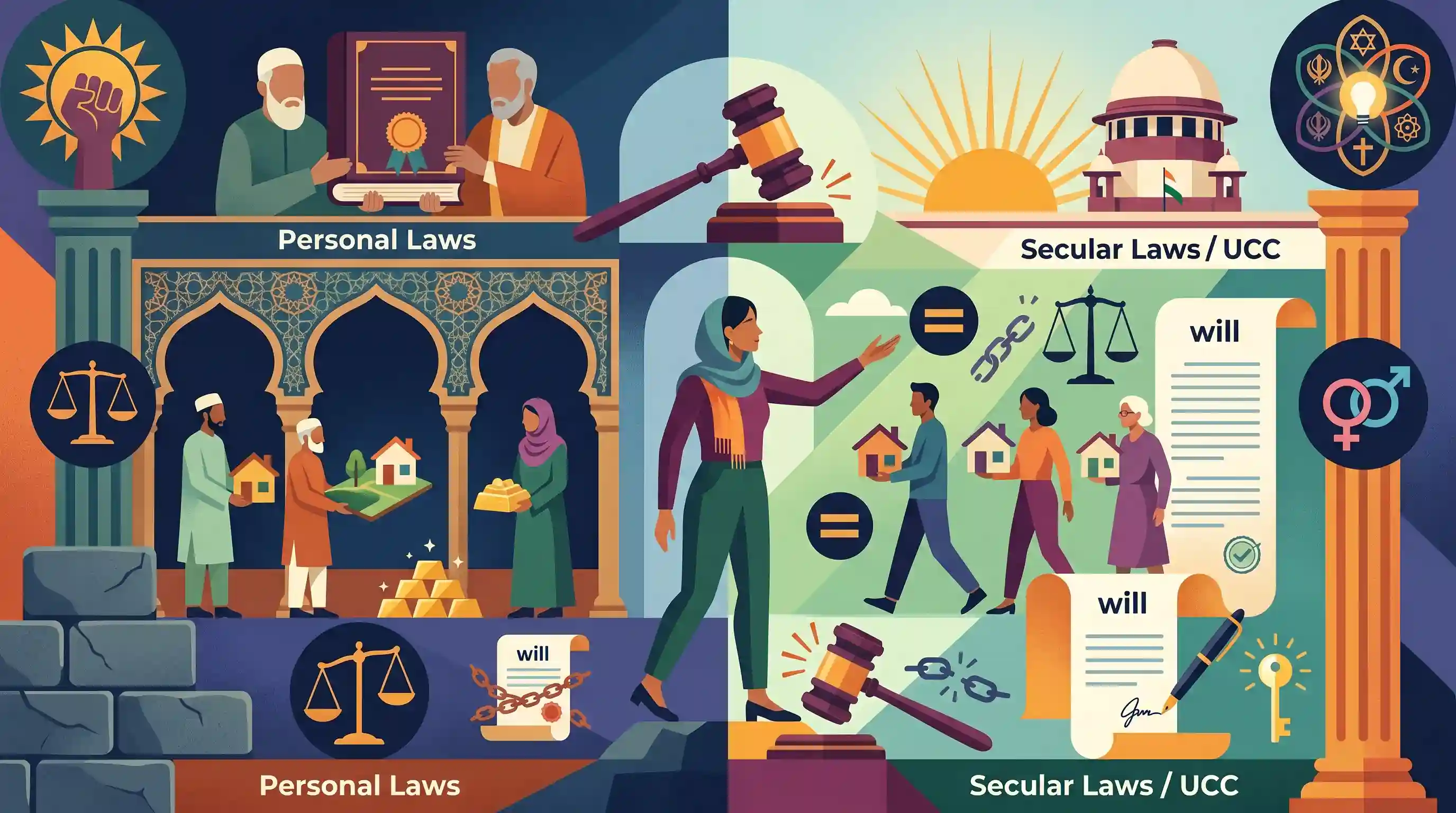
The Supreme Court of India has agreed to examine a petition challenging the mandatory application of the Muslim Personal Law (Shariat) Application Act, 1937, for inheritance, asserting the right of Muslim citizens to opt for secular inheritance laws instead. The petitioner seeks the liberty to be governed by the Indian Succession Act, 1925, to exercise "testamentary autonomy." Currently, Islamic principles (Faraid) limit a Muslim from bequeathing more than one-third of their property through a will, with the remainder divided among legal heirs. Highlighting fundamental rights and equality, the plea argues against religious restrictions on property rights and overlaps with a separate pending case concerning the inheritance laws applicable to ex-Muslims. The outcome of these petitions could significantly impact the debate over personal laws, secularism, and the Uniform Civil Code in India.
Key Points
- The Supreme Court issued notice on a plea seeking the right for Muslims to be governed by the secular Indian Succession Act, 1925, rather than the Shariat Act, for matters of inheritance and succession.
- Under current Islamic law (Faraid) and the Shariat Act, Muslims are restricted to bequeathing only up to one-third of their estate via a will; the remaining two-thirds must be distributed among legal heirs.
- The petitioner argued for "testamentary autonomy" as a fundamental right, claiming Muslims should not be denied the legal choices available to other citizens under secular inheritance laws.
- The plea points to Section 3 of the Shariat Act, which allows an individual to "opt in" for Shariat to apply to wills and legacies, implying that they should equally have a constitutional right to opt out.
- The Supreme Court tagged this case with a related pending plea by an ex-Muslim who argued that those who renounce the Islamic faith should automatically be governed by secular inheritance laws rather than personal law.
Important Terms
Muslim Personal Law (Shariat) Application Act, 1937

A 1937 legislation mandating that Indian Muslims be governed by Islamic Shariat in personal matters like marriage, divorce, and inheritance, overriding conflicting customary laws.
UPSC context
GS Paper II: Significant for debates on Personal Laws vs. Fundamental Rights and the push for legal uniformity.
Indian Succession Act, 1925
A secular legislation regulating inheritance and the distribution of assets. It applies to Christians, Jews, and Parsis, and excludes Muslims from its succession chapters.
UPSC context
GS Paper II: Relevant for understanding the duality of Indian inheritance laws and secular legal frameworks.
Uniform Civil Code (UCC)
A Directive Principle under Article 44 aiming to replace diverse religion-based personal laws with a common set of civil laws for all citizens.
UPSC context
GS Paper II/I: A core topic regarding national integration, secularism, and gender justice.
Testamentary Autonomy
The legal right of an individual to dispose of their property after death according to their own wishes through a valid will.
UPSC context
GS Paper II: Central to legal petitions seeking property rights independent of religious restrictions.
Special Marriage Act, 1954
A secular law allowing inter-faith and inter-caste marriages; those married under it generally fall under the Indian Succession Act for inheritance matters.
UPSC context
GS Paper II: Significant as a voluntary secular alternative to religious personal laws.
Islamic Law of Inheritance
The Islamic legal framework of inheritance (Faraid) that mandates specific fixed shares for heirs and restricts bequests to one-third of the estate.
UPSC context
GS Paper II: Contextual for understanding the conflict between religious mandates and individual property rights.
Prelims Trap
"The Shariat Act of 1937 automatically applies to all matters including wills and legacies for Muslims."
Under Section 3 of the Shariat Act, matters like wills and legacies require a formal 'opt-in' declaration, unlike marriage and divorce which apply automatically.
Static Concepts Connected
How does the Constitution govern personal laws?
- Concurrent List: Marriage, divorce, and inheritance fall under Entry 5 of the Concurrent List, allowing both Parliament and state legislatures to draft or amend laws.
- Article 44 vs 25: Article 44 mandates a Uniform Civil Code (non-justiciable), while Article 25 (religious freedom) is explicitly subject to fundamental rights like equality (Article 14).
Who is governed by the Indian Succession Act, 1925?
- Secular default: It acts as the secular default, applying to Christians, Parsis, Jews, and interfaith couples married under the Special Marriage Act, 1954.
- Explicit exclusions: Hindus, Muslims, Buddhists, Sikhs, and Jains are generally exempted and governed by their respective religious personal laws for intestate and testamentary succession.
Cross-Topic Patterns
Apostasy and Right to Property
The plea of ex-Muslims losing inheritance rights upon renouncing their faith pits uncodified religious laws directly against Article 300A (Right to Property) and Article 21 (Autonomy).
Hindu Succession Act parallels
Challenges to Muslim inheritance limits mirror the pre-2005 Hindu Succession Act debates, framing secular property distribution and testamentary autonomy as essential to modern gender justice.

Testamentary autonomy (Art 21) vs religious personal laws (Art 25) is a high-probability 2026 Mains question within the UCC debate.
Linked PYQs · 4
Linked PYQs · 4
- 2015MainsGS2
Discuss the possible factors that inhibit India from enacting for its citizens a uniform civil code as provided for in the Directive Principles of State Policy.
- 2024MainsGS2
Discuss India as a secular state and compare with the secular principles of the US constitution.
- 2023MainsGS2
Explain the constitutional perspectives of Gender Justice with the help of relevant Constitutional Provisions and case laws.
- 2019MainsGS2
What can France learn from the Indian Constitution's approach to secularism?
