Supreme Court sets aside criminal case in medical negligence
Source:Indian Express ↗
Why It Matters
It highlights the important legal distinction between civil liability (deficiency of service) and criminal liability (gross negligence) in the healthcare sector. Understanding this jurisprudence is essential for questions on the judiciary, healthcare accountability, and the protection of professionals from unwarranted litigation.
Summary
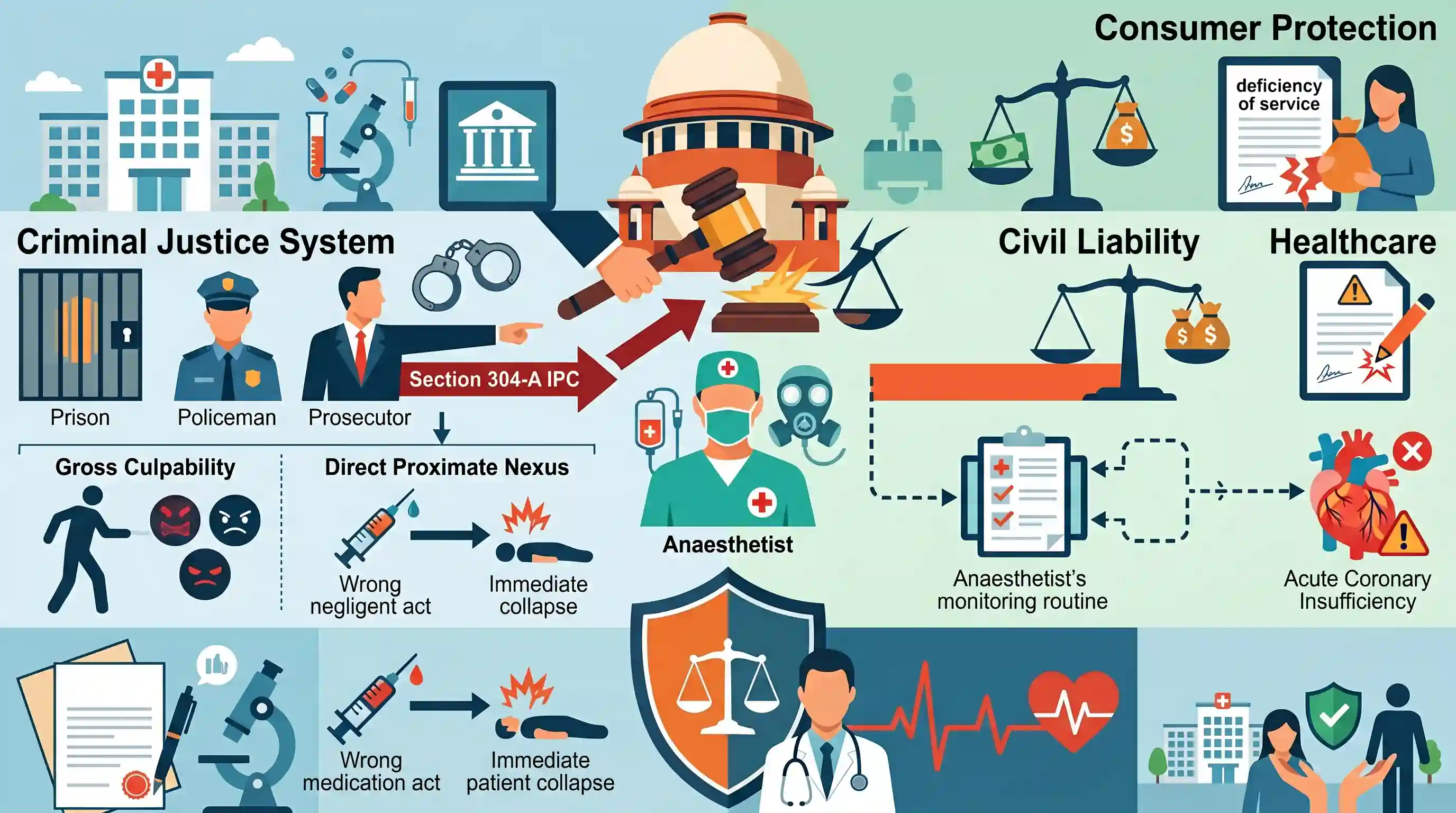
The Supreme Court of India quashed a criminal case against an anaesthetist under Section 304-A IPC (causing death by negligence) for a patient's death in 2002. The court emphasized that criminal liability for medical negligence requires gross culpability and a direct, proximate nexus between the negligent act and the cause of death. Distinguishing between civil liability (deficiency of service) and criminal liability, the SC held that the anaesthetist's actions were too remote from the patient's ultimate cause of death (acute coronary insufficiency) to justify criminal prosecution. The decision reinforces protections for medical professionals against unwarranted criminal charges for clinical outcomes.
Key Points
- The Supreme Court quashed a criminal negligence case against an anaesthetist whose patient died, citing lack of direct proximate nexus.
- Under Section 304-A of the IPC, criminal liability for medical negligence requires 'gross culpability' or mens rea, not just civil liability or deficiency of service.
- The court highlighted that an act must be the direct and immediate cause of death (causa causans) to warrant criminal prosecution, which was absent in this case.
- The ruling differentiates civil liability (handled via Consumer Forums for deficiency in service) and criminal liability, safeguarding medical practitioners from unwarranted prosecution.
Important Terms
Medical Negligence

Failure of a healthcare provider to provide the reasonable standard of care, resulting in patient harm or death. It requires a duty of care, breach of duty, causation, and resulting damage.
UPSC context
GS Paper II (Healthcare) & GS Paper IV (Professional Ethics); tests understanding of accountability and patient rights.
Section 304-A IPC
A provision in the Indian Penal Code (IPC) that punishes causing death by a rash or negligent act not amounting to culpable homicide with up to two years' imprisonment.
UPSC context
GS Paper II (Criminal Justice System); critical for understanding legal provisions for negligence in India.
Gross Negligence
A higher degree of recklessness or disregard for safety than ordinary negligence. The Supreme Court mandates that only "gross" negligence warrants criminal prosecution for medical professionals.
UPSC context
GS Paper II (Judiciary) & GS Paper IV (Ethics); tests the distinction between civil and criminal culpability.
Jacob Mathew v. State of Punjab
A landmark 2005 Supreme Court judgment establishing guidelines to protect doctors from frivolous criminal prosecution, requiring "gross negligence" and expert medical opinion before filing a case.
UPSC context
GS Paper II (Landmark Judgments); essential for judicial precedents regarding professional liability.
District Consumer Disputes Redressal Commission (DCDRC)
A quasi-judicial body at the district level established under the Consumer Protection Act (2019) to resolve consumer disputes involving claims up to ₹1 crore.
UPSC context
GS Paper II (Governance/Consumer Rights); tests knowledge of the three-tier grievance redressal mechanism.
Civil vs. Criminal Liability
Civil liability focuses on compensation for "deficiency in service," while criminal liability requires "gross culpability" and proof of a direct, proximate nexus to the cause of death.
UPSC context
GS Paper II (Judiciary/Laws); fundamental concept in legal theory and medical jurisprudence.
Prelims Trap
A doctor found liable for 'deficiency of service' is automatically subject to criminal prosecution if the patient dies.
Civil liability (deficiency of service) has a lower threshold. Criminal negligence strictly demands "gross culpability" and a direct, proximate nexus to the death (causa causans).
Static Concepts Connected
What is the 'Bolam Test' used by Indian courts?
- Definition: A legal standard used to objectively assess medical negligence.
- Standard of Care: A doctor is not negligent if their actions align with practices accepted as proper by a responsible body of peer medical professionals.
- Protection: It protects practitioners from liability simply because another doctor might have taken a different clinical approach.
How are medical professionals regulated under the Consumer Protection Act?
- Landmark Ruling: In 'IMA v. V.P. Shantha' (1995), the SC ruled that medical care provided for a fee falls under "service".
- Civil Liability: Patients can approach Consumer Disputes Redressal Commissions to seek civil compensation for "deficiency in service" without proving criminal intent.
- Exclusion: Medical services provided entirely free of charge (e.g., in fully free government hospitals) are generally outside the CPA's purview.
Cross-Topic Patterns
Balancing patient rights & doctor immunity
The strict threshold for criminal negligence prevents 'defensive medicine', balancing a patient's Right to Life (Article 21) against the protection of healthcare systems from unwarranted harassment.
IPC to BNS legal transition
With the shift from IPC to Bharatiya Nyaya Sanhita (BNS), provisions like Sec 304A IPC (now under Sec 106 BNS) regarding medical negligence hold special relevance for current legal affairs.

The "Bolam Test" and the threshold difference between civil (deficiency in service) and criminal (gross negligence) liability are likely 2026 targets.
