Supreme Court Ruling on Mangrove Felling for Coastal Road
Source:Indian Express ↗
Why It Matters
It exemplifies the real-world application of environmental impact assessments (EIA) and Coastal Regulation Zone (CRZ) regulations in large-scale infrastructure projects, a recurring theme in UPSC Mains GS3. It also highlights the judiciary's role in constitutionalizing and adjudicating environmental issues (GS2).
Summary
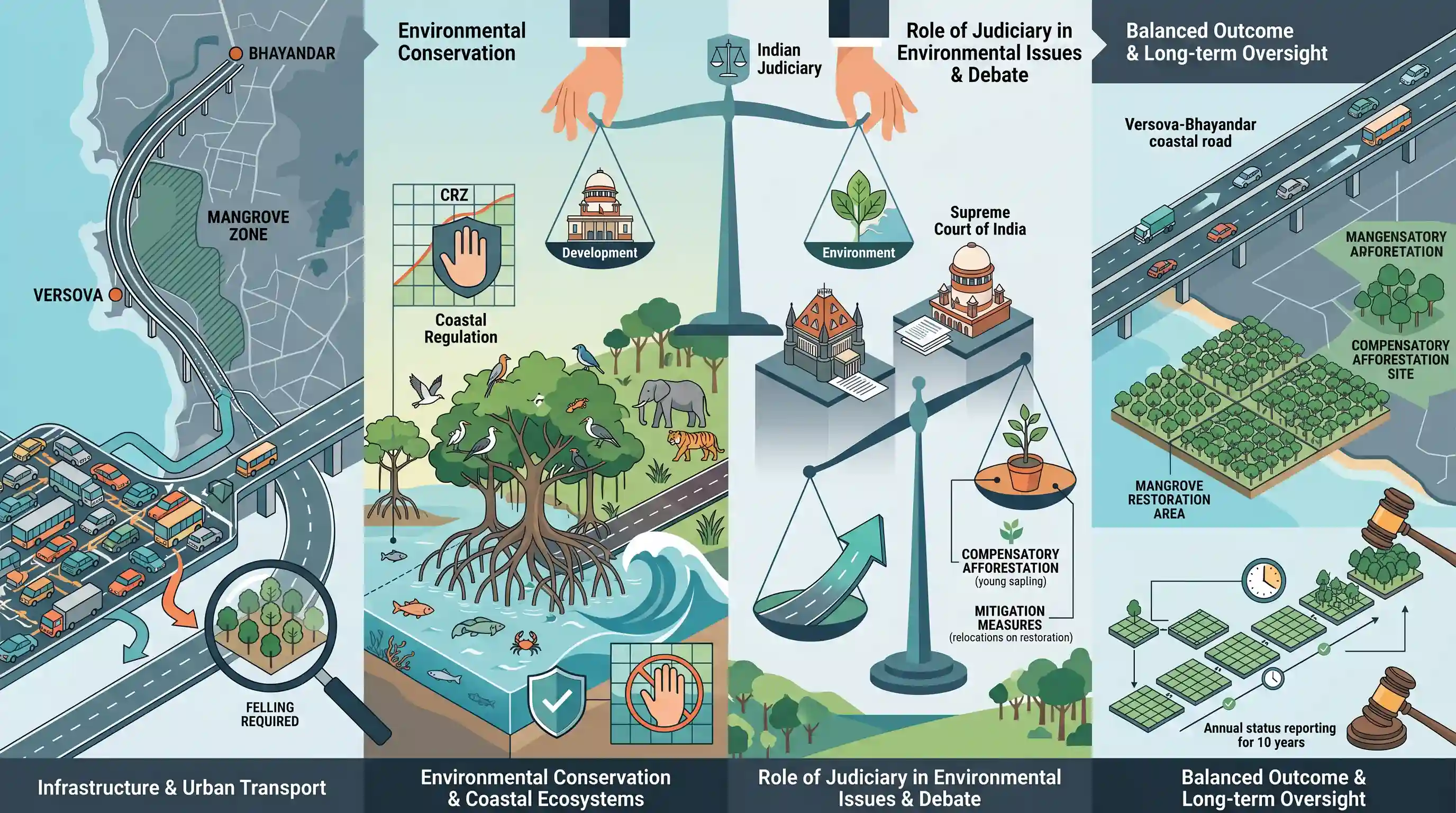
The Supreme Court of India refused to interfere with a Bombay High Court decision that permitted the felling of mangrove trees for the construction of the Versova-Bhayandar coastal road in Mumbai. The judiciary acknowledged the necessity of the infrastructure project for alleviating urban traffic while navigating complex environmental regulations. Mangroves, vital for coastal resilience and biodiversity, are heavily protected under Coastal Regulation Zone (CRZ) rules. This ruling highlights the delicate balancing act courts perform between fostering sustainable urban development and ensuring environmental conservation, often mandating mitigation measures like compensatory afforestation.
Key Points
- The Supreme Court declined to stay the Bombay High Court's order allowing the cutting of mangrove trees for the Versova-Bhayandar coastal road project.
- The judiciary balanced the critical need for urban infrastructure to ease Mumbai's traffic congestion against the ecological importance of mangroves.
- Mangroves are crucial coastal ecosystems protected under CRZ norms; infrastructure projects often require compensatory afforestation and strict environmental clearances to mitigate damage.
- The case highlights the ongoing 'development vs. environment' debate and the judiciary's role in evaluating environmental clearances for public utility projects.
Important Terms
Coastal Regulation Zone (CRZ) Rules

Notified under the Environment Protection Act 1986, these rules regulate activities within specified coastal stretches to protect fragile ecosystems and ensure livelihood security for coastal communities.
UPSC context
GS Paper 3 (Environment/Disaster Management). Tests knowledge of environmental governance, zone classifications (CRZ-I to IV), and coastal resilience.
Environment Protection Act, 1986
Umbrella legislation providing a framework for the Central Government to coordinate environmental protection activities, set pollution standards, and restrict industrial operations in sensitive areas.
UPSC context
GS Paper 3 (Environment). Tests understanding of the constitutional basis (Article 253) and legislative powers for environmental conservation.
Mangroves
Salt-tolerant intertidal forests that act as natural 'bio-shields' against cyclones and erosion, support high biodiversity, and sequester significantly more carbon than terrestrial forests.
UPSC context
GS Paper 3 (Biodiversity). Tests awareness of ecological adaptations (pneumatophores/vivipary) and restoration initiatives like MISHTI for coastal protection.
Compensatory Afforestation
The legal requirement for a project proponent to fund tree plantation on alternative land to mitigate the loss of forest diverted for non-forest purposes.
UPSC context
GS Paper 3 (Environmental Impact Assessment). Evaluates knowledge of the CAMPA Act 2016 and the 'Net Present Value' concept.
Supreme Court
The highest judicial body and final interpreter of the Constitution, which uses its writ jurisdiction and Article 142 to enforce environmental justice.
UPSC context
GS Paper 2 (Judiciary). Tests knowledge of judicial activism and the expansion of Article 21 (Right to Life).
Sustainable Development
A development paradigm that meets present needs without compromising the ability of future generations to meet theirs, balancing economic growth with environmental conservation.
UPSC context
GS Paper 3 (Environment/Economics). Tests the ability to analyze trade-offs between infrastructure and ecology in Mains answers.
Prelims Trap
Developmental and public utility projects are completely prohibited in CRZ-I areas under all circumstances.
While CRZ-I protects sensitive ecosystems like mangroves, specific public utilities, defense projects, and pipelines can be permitted under exceptional circumstances with stringent MoEFCC clearances.
Static Concepts Connected
How are Coastal Regulation Zones (CRZ) classified in India?
- CRZ-I: Ecologically sensitive areas (like mangroves, coral reefs) where construction is heavily restricted.
- CRZ-II: Substantially developed urban coastal areas that have been built up to the shoreline.
- CRZ-III: Relatively undisturbed rural coastal zones that do not fall under CRZ-I or II.
- CRZ-IV: The aquatic area extending from the Low Tide Line up to the territorial limits (12 nautical miles).
What are the key physiological adaptations of mangrove ecosystems?
- Pneumatophores: Aerial, blind roots that grow upwards to facilitate plant respiration in waterlogged, anaerobic soils.
- Vivipary: Seeds germinate while still attached to the parent tree, preventing them from washing away in tidal waters.
- Salt regulation: Specialized glands in the leaves excrete excess salt, allowing the plants to survive in highly saline intertidal zones.
Cross-Topic Patterns
Infrastructure vs. Blue Carbon sinks
Coastal projects threaten mangroves, which sequester carbon much faster than terrestrial forests. This directly impacts India's Nationally Determined Contribution (NDC) targets for creating additional carbon sinks.
Judicialization of Environmental Clearances
The SC and HCs frequently acting as final arbiters for infrastructure projects highlights systemic weaknesses and a lack of public trust in the statutory Environmental Impact Assessment (EIA) process.

Expect a multi-statement Prelims question combining specific CRZ-I exemptions with mangrove physiological adaptations in 2026.
Linked PYQs · 4
Linked PYQs · 4
- 2022MainsGS2
“The most significant achievement of modern law in India is the constitutionalization of environmental problems by the Supreme Court.” Discuss this statement with the help of relevant case laws.
- 2019MainsGS3
Define the concept of carrying capacity of an ecosystem as relevant to an environment. Explain how understanding this concept is vital while planning for sustainable development of a region.
- 2013PrelimsGS1
Which one of the following is the correct sequence of ecosystems in the order of decreasing productivity?
- 2014MainsGS3
Environmental Impact Assessment studies are increasingly undertaken before a project is cleared by the Government. Discuss the environmental impacts of coal-fired thermal plants located at coal pitheads.
