Supreme Court Directives to Curb Digital Arrests and Cyber Frauds
Source:The Hindu ↗
Why It Matters
The article highlights crucial institutional mechanisms (like I4C, e-Zero FIR, and Money Restoration Portals) to counter rapidly evolving cybercrimes like digital arrests. It is highly relevant for GS Paper 3 questions on cyber security threats, money laundering, and coordinated measures required to tackle them.
Summary
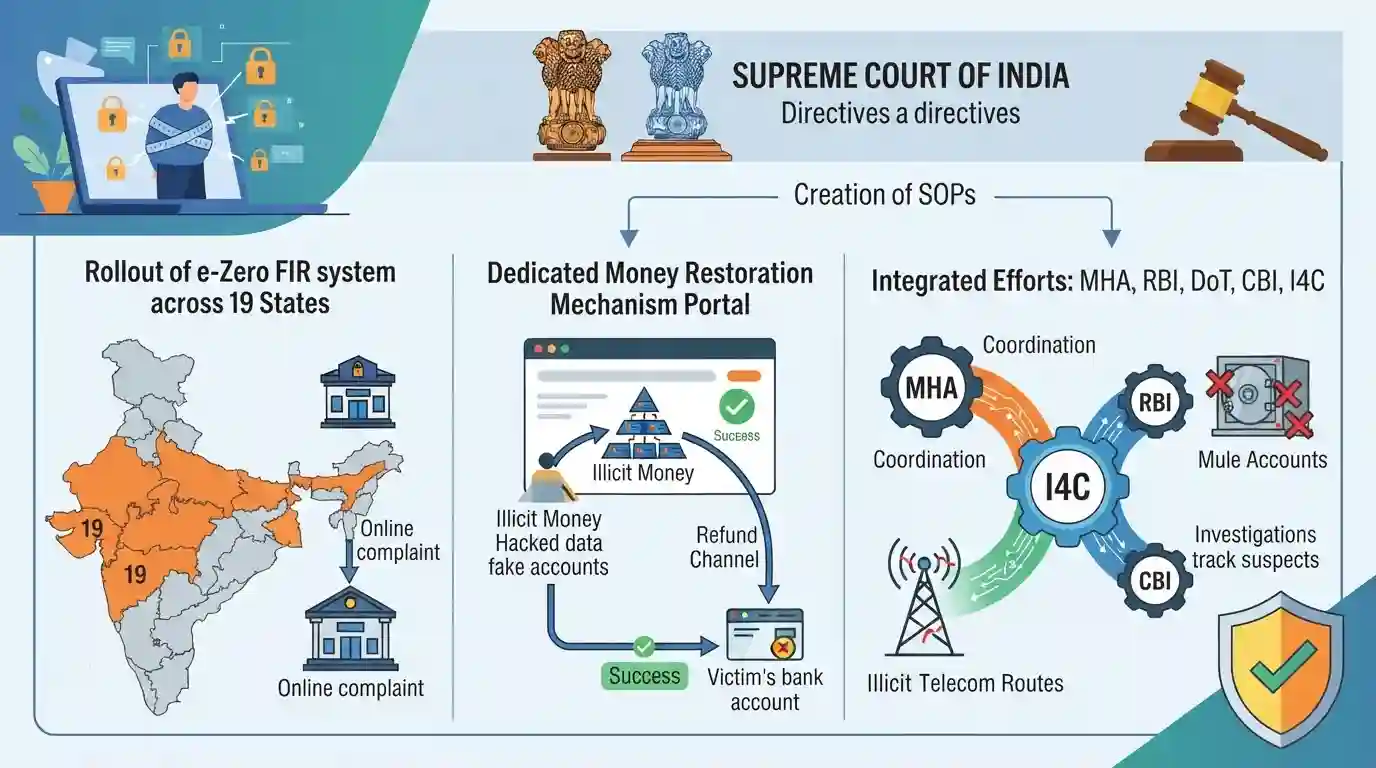
The Supreme Court of India has mandated the creation of comprehensive Standard Operating Procedures (SOPs) and robust mechanisms to tackle the rising menace of cyber-enabled financial frauds, specifically 'digital arrests'. Key interventions include the rollout of an e-Zero FIR system across 19 States and a dedicated Money Restoration Mechanism Portal to expedite victim refunds. The court's directives integrate efforts from the Ministry of Home Affairs, RBI, Department of Telecommunications, and the CBI to block illicit telecom routes, track mule accounts, and coordinate intelligence sharing via the Indian Cyber Crime Coordination Centre (I4C).
Key Points
- The Supreme Court has issued sweeping directives for a multi-stakeholder mechanism to curb 'digital arrests' and time-bound refund of duped money.
- An e-Zero FIR mechanism is now functional in 19 States, supported by a central 'Money Restoration Mechanism Portal' covering 69 banks.
- The Indian Cyber Crime Coordination Centre (I4C) under MHA and the RBI Innovation Hub signed an MoU for real-time intelligence and data sharing.
- The RBI has been tasked with creating comprehensive Standard Operating Procedures (SOPs) to tackle 'mule accounts' linked to cyber money laundering.
- New DoT regulations, including the Telecommunications Rules 2025, aim to trace SIM misuse, block spoofed messages, and track unauthorized communication equipment.
- The Court recommended the CBI handle complex, cross-border or inter-state cyber fraud cases, establishing a coordinated framework for fast-tracked investigation.
Important Terms
e-Zero FIR

A digital facility allowing citizens to electronically register a First Information Report at any police station regardless of jurisdiction, designed to expedite initial criminal action against cyber fraudsters.
UPSC context
Crucial for GS-2 (Governance) and GS-3 (Cyber Security). Highlights tech-driven judicial and police reforms.
Money Restoration Mechanism Portal
A specialized platform operationalized under the Ministry of Home Affairs to facilitate the time-bound tracking and refund of defrauded money to victims of cyber-enabled financial frauds.
UPSC context
Important for GS-3 (Cyber Security) and GS-2 (Grievance Redressal). Showcases state intervention to recover digital theft.
Indian Cyber Crime Coordination Centre (I4C)
An apex coordination center established under the Ministry of Home Affairs to assist state and central law enforcement agencies in dealing comprehensively with all types of cybercrime.
UPSC context
Highly relevant for GS-3 (Internal Security). Represents India's institutional framework against organized cybercrime networks.
Citizen Financial Cyber Fraud Reporting Management System (CFCFRMS)
A centralized reporting system (helpline 1930) under I4C that connects police, banks, and financial intermediaries to swiftly track, report, and freeze funds stolen through financial cyber frauds.
UPSC context
Relevant for GS-3 (Cyber Security & Money Laundering). Focuses on multi-agency cooperation to stop digital siphoning.
Telecommunications (User Identification) Rules, 2025
Upcoming rules by the Department of Telecommunications designed to curb identity fraud, fake SIM cards, and the misuse of telecom infrastructure that enable cybercrimes like 'digital arrests'.
UPSC context
Important for GS-3 (Cyber Security). Reflects government regulatory measures to intercept telecom-enabled financial frauds.
Prelims Trap
Zero FIRs can only be registered by a police station if the cybercrime occurred within its territorial jurisdiction.
A Zero FIR can be registered by any police station irrespective of territorial boundaries, specifically to prevent delays in time-sensitive cyber investigations.
Static Concepts Connected
What is the Indian Cyber Crime Coordination Centre (I4C) and its role?
- Nodal agency: Established under the Ministry of Home Affairs (MHA) to coordinate national-level response against cybercrimes.
- Key initiatives: Manages the National Cyber Crime Reporting Portal and the 1930 citizen helpline for financial frauds.
- Collaboration hub: Facilitates joint investigation teams and real-time intelligence sharing among law enforcement, RBI, and telecom service providers.
What is a 'Zero FIR' and its statutory basis?
- Jurisdictional freedom: Allows a police station to register an FIR regardless of where the offence took place, bypassing territorial limitations.
- Legal mandate: Explicitly institutionalized under the Bharatiya Nagarik Suraksha Sanhita (BNSS), making quick registration legally binding on police.
- Numbering process: Registered as serial number '0'; subsequently transferred to the competent jurisdictional police station for regular investigation.
Cross-Topic Patterns
Judicial mandate vs Executive policy
The Supreme Court directing the RBI and DoT to frame specific cyber SOPs highlights growing judicial intervention to bridge systemic regulatory vacuums in tech governance.
Mule accounts and money laundering
Cyber-extortion proceeds moved through rented mule accounts tie cybercrime directly to money laundering, bridging internal security concerns with the Prevention of Money Laundering Act (PMLA).

Expect a multi-statement Prelims question testing the statutory basis of Zero FIRs under BNSS and I4C's nodal ministry (MHA).
Linked PYQs · 4
Linked PYQs · 4
- 2020MainsGS3
Discuss different types of cyber crimes and measures required to be taken to fight the menace.
- 2022MainsGS3
What are the different elements of cyber security ? Keeping in view the challenges in cyber security, examine the extent to which India has successfully developed a comprehensive National Cyber Security Strategy.
- 2021MainsGS3
Discuss how emerging technologies and globalisation contribute to money laundering. Elaborate measures to tackle the problem of money laundering both at national and international levels.
- 2013MainsGS3
Money laundering poses a serious security threat to a country's economic sovereignty. What is its significance for India and what steps are required to be taken to control this menace?
