Supreme Court Restricts Illegal Detention and Upholds Free Movement
Source:The Hindu ↗
Why It Matters
The ruling reiterates the judiciary's role as a vital check against arbitrary executive actions and safeguards fundamental rights such as personal liberty and freedom of movement against illegal detentions.
Summary
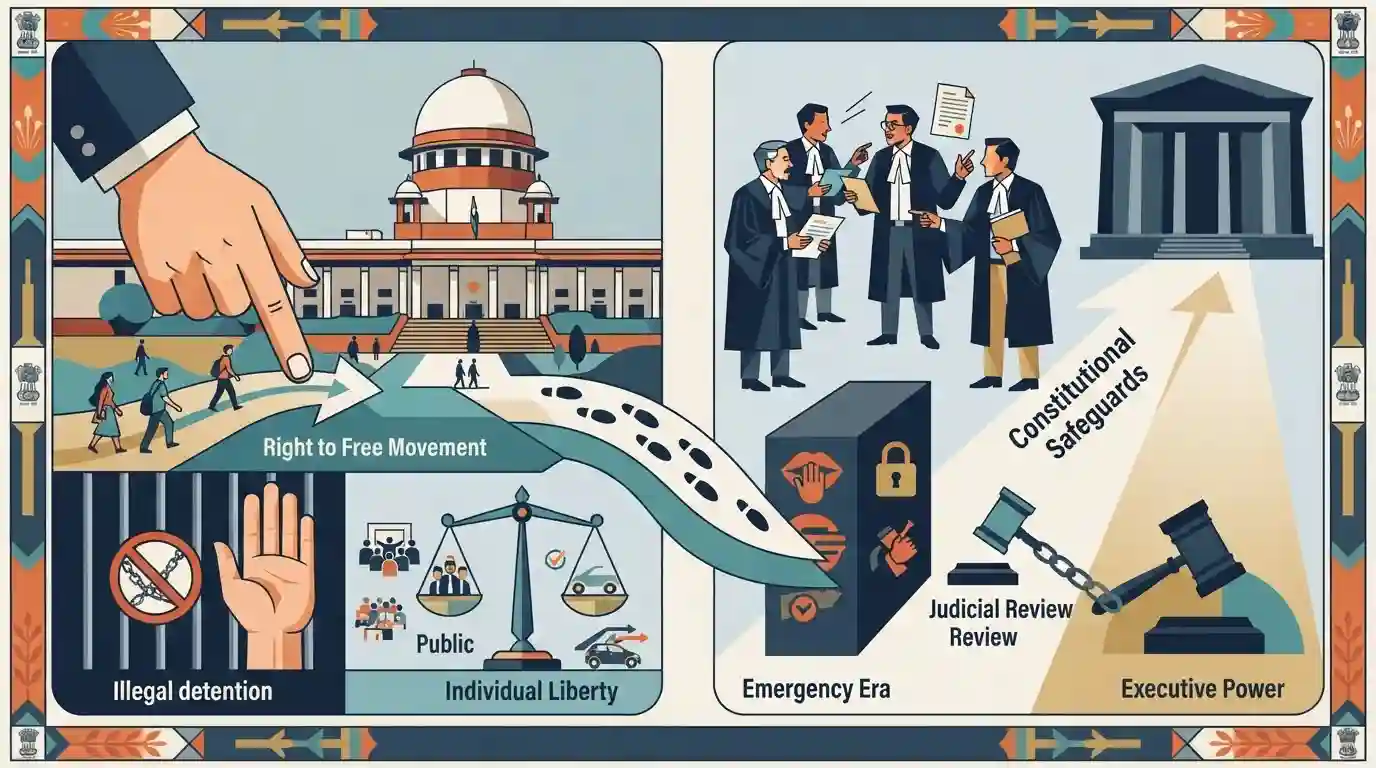
The Supreme Court of India emphasized the fundamental right to free movement and prohibited illegal detentions, highlighting that any restrictions must be strictly bound by public order requirements. During arguments, references to the Emergency era were raised by lawyers to caution against executive overreach and arbitrary deprivation of personal liberty.
Key Points
- The Supreme Court mandated that free movement and protection against illegal detentions must be upheld, subject strictly to public order.
- Lawyers drew parallels during the proceedings to actions reminiscent of the Emergency era, highlighting concerns regarding executive overreach and arbitrary curtailment of liberty.
- The ruling reinforces fundamental rights, emphasizing that restrictions on personal freedom must satisfy constitutional thresholds of legality, necessity, and proportionality.
Important Terms
Supreme Court

The apex judicial body of India, tasked with interpreting the Constitution, protecting fundamental rights, and ensuring executive actions adhere to the rule of law.
UPSC context
UPSC GS Paper II: Judiciary – Role, Judgments, and Judicial Review; tests understanding of judicial oversight over executive actions and protection of civil liberties.
Procedure Established by Law
The constitutional guarantee under Article 21 ensuring that no person shall be deprived of life or personal liberty except according to a fair, just, and non-arbitrary legal process.
UPSC context
UPSC GS Paper II: Indian Constitution — Features, Significance, and Basic Structure; tests core concepts of personal liberty and due process.
Right to Free Movement
The constitutional guarantee under Article 19(1)(d) allowing citizens to move freely throughout the territory of India, subject only to reasonable restrictions in the interest of public order.
UPSC context
UPSC GS Paper II: Fundamental Rights; tests understanding of freedoms, permissible restrictions, and balance with public order.
Emergency Era
A 21-month period of proclaimed national emergency (1975-1977) in India characterized by widespread suspension of civil liberties, executive overreach, and severe curtailment of judicial review.
UPSC context
UPSC GS Paper II: Indian Constitution — Historical Underpinnings and Evolution; tests knowledge of constitutional safeguards against executive authoritarianism.
Static Concepts Connected
What are the constitutional grounds and limitations for restricting the freedom of movement under Article 19?
- Scope: Article 19(1)(d) guarantees citizens the right to move freely throughout the territory of India.
- Restrictions: Reasonable restrictions can be imposed under Article 19(5) only in the interests of the general public or for the protection of any Scheduled Tribe.
- Judicial Test: The Supreme Court has consistently held that any restriction must satisfy the tests of necessity, proportionality, and statutory backing.
Cross-Topic Patterns
Emergency Parallels and Judicial Review Evolution
The Emergency era (1975-77) redefined judicial review, leading to the landmark ADM Jabalpur ruling and its eventual overruling in the Puttaswamy privacy judgment.

Expect a statement-based question combining Article 19(2) public order exceptions, preventive detention limits, and proportionality tests.
Linked PYQs · 3
Linked PYQs · 3
- 2017MainsGS2
Examine the scope of Fundamental Rights in the light of the latest judgement of the Supreme Court on Right to Privacy.
- 2023PrelimsGS1
Consider the following statements: 1. According to the Constitution of India, the Central Government has a duty to protect States from internal disturbances. 2. The Constitution of India exempts the States from providing legal counsel to a person being held for preventive detention. 3. According to the Prevention of Terrorism Act, 2002, confession of the accused before the police cannot be used as evidence. How many of the above statements are correct?
- 2024PrelimsGS1
A Writ of Prohibition is an order issued by the Supreme Court or High Courts to :
