Judges Appointment and Memorandum of Procedure Evolution
Source:Indian Express ↗
Why It Matters
Essential for understanding the checks and balances between the executive and the judiciary, the collegium system, and ongoing governance debates surrounding judicial appointments in India.
Summary
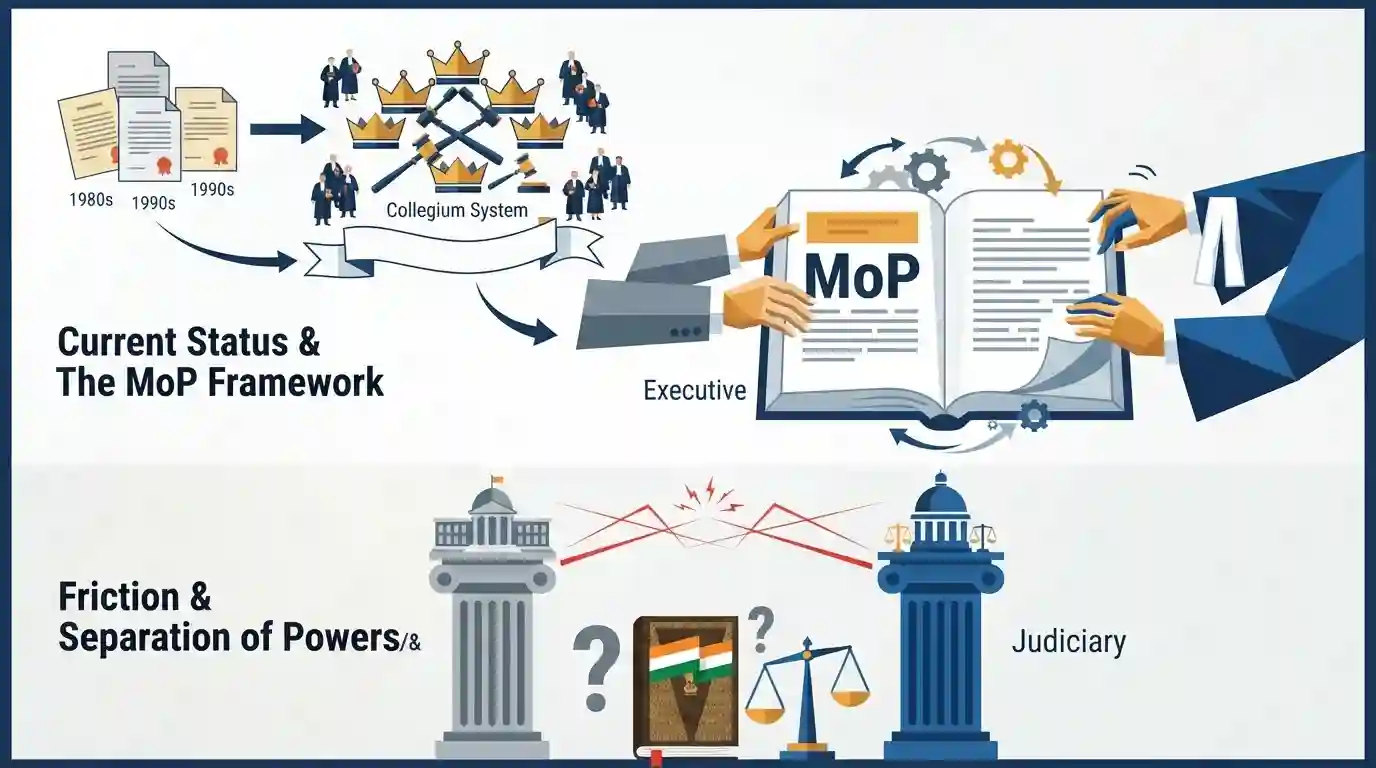
The article details the historical evolution, current status, and controversies surrounding the Memorandum of Procedure (MoP) for appointing judges to higher courts in India, highlighting the friction between the executive and the judiciary since the striking down of the NJAC Act.
Key Points
- The Memorandum of Procedure (MoP) guides the appointment of judges to the Supreme Court and High Courts under the collegium system.
- The MoP has faced protracted delays in finalization due to friction between the judiciary and the executive regarding judicial appointments and transparency.
- The debate stems from the historic 2015 Supreme Court judgment striking down the NJAC Act, where the Court directed the government to finalize an updated MoP.
- Key contentions include the government's security clearance inputs, the timeline for processing recommendations, and the balance of power in judicial appointments.
Important Terms
Memorandum of Procedure for appointment of judges

A document outlining the agreed framework and guidelines for appointing and transferring judges to the Supreme Court and High Courts of India under the collegium system.
UPSC context
GS Paper II (Polity): Important provisions of the Constitution, structure, and functioning of the Judiciary and Executive-Judiciary relations.
National Judicial Appointments Commission Act
A legislative attempt via the 99th Constitutional Amendment to replace the collegium system with a transparent body for appointing higher judiciary judges, struck down as unconstitutional by the Supreme Court.
UPSC context
GS Paper II (Polity): Separation of powers, checks and balances, and judicial review of constitutional amendments.
Supreme Court of India
The apex judicial body of India under the Constitution, serving as the ultimate guardian of fundamental rights and final court of appeal.
UPSC context
GS Paper II (Polity): Structure, organization, and functioning of the Union Judiciary and its constitutional powers.
Prelims Trap
The President can indefinitely withhold assent from a judicial recommendation reiterated by the Supreme Court Collegium.
Aspirants often believe the executive can reject a reiterated recommendation indefinitely. Under current constitutional conventions, if the collegium reiterates unanimously, the executive is bound.
Static Concepts Connected
What are the core principles established by the Three Judges Cases regarding judicial appointments in India?
- First Judges Case: First Judges Case (1981) ruled that primacy rested with the executive, allowing the government to reject judicial recommendations on grounds of public interest.
- Second Judges Case: Second Judges Case (1993) introduced the Collegium system, ruling that 'consultation' with the CJI meant 'concurrence' and giving primacy to the judiciary.
- Third Judges Case: Third Judges Case (1998) expanded the collegium to a body of five (CJI + 4 senior-most judges) and clarified norms for transfers and consultations.
Cross-Topic Patterns
Judicial Appointments and Basic Structure Doctrine
Judicial appointments intersect with Article 50 (Separation of Powers) and judicial independence as a Basic Feature of the Constitution established in Kesavananda Bharati.
Executive-Judiciary Friction and Constitutional Morality
Friction over MoP revision reflects broader executive-legislative-judicial institutional balance issues frequently tested in Polity mains questions.

NJAC judgment + MoP reiteration binding nature is a high-yield trap for statement-based prelims questions.
Linked PYQs · 3
Linked PYQs · 3
- 2025MainsGS2
Discuss the evolution of collegium system in India. Critically examine the advantages and disadvantages of the system of appointment of the Judges of the Supreme Court of India and that of the USA.
- 2017MainsGS2
Critically examine the Supreme Court's judgement on 'National Judicial Appointments Commission Act, 2014' with reference to appointment of judges of higher judiciary in India.
- 2025MainsGS2
"Constitutional morality is the fulcrum which acts as an essential check upon the high functionaries and citizens alike...." In view of the above observation of the Supreme Court, explain the concept of constitutional morality and its application to ensure balance between judicial independence and judicial accountability in India.
