Judicial Appointments Memorandum of Procedure Evolution and Deadlock
Source:Indian Express ↗
Why It Matters
Understanding the Memorandum of Procedure (MoP) and the collegium system is crucial for analyzing the executive-judiciary interface, judicial independence, and structural reforms in appointment mechanisms.
Summary
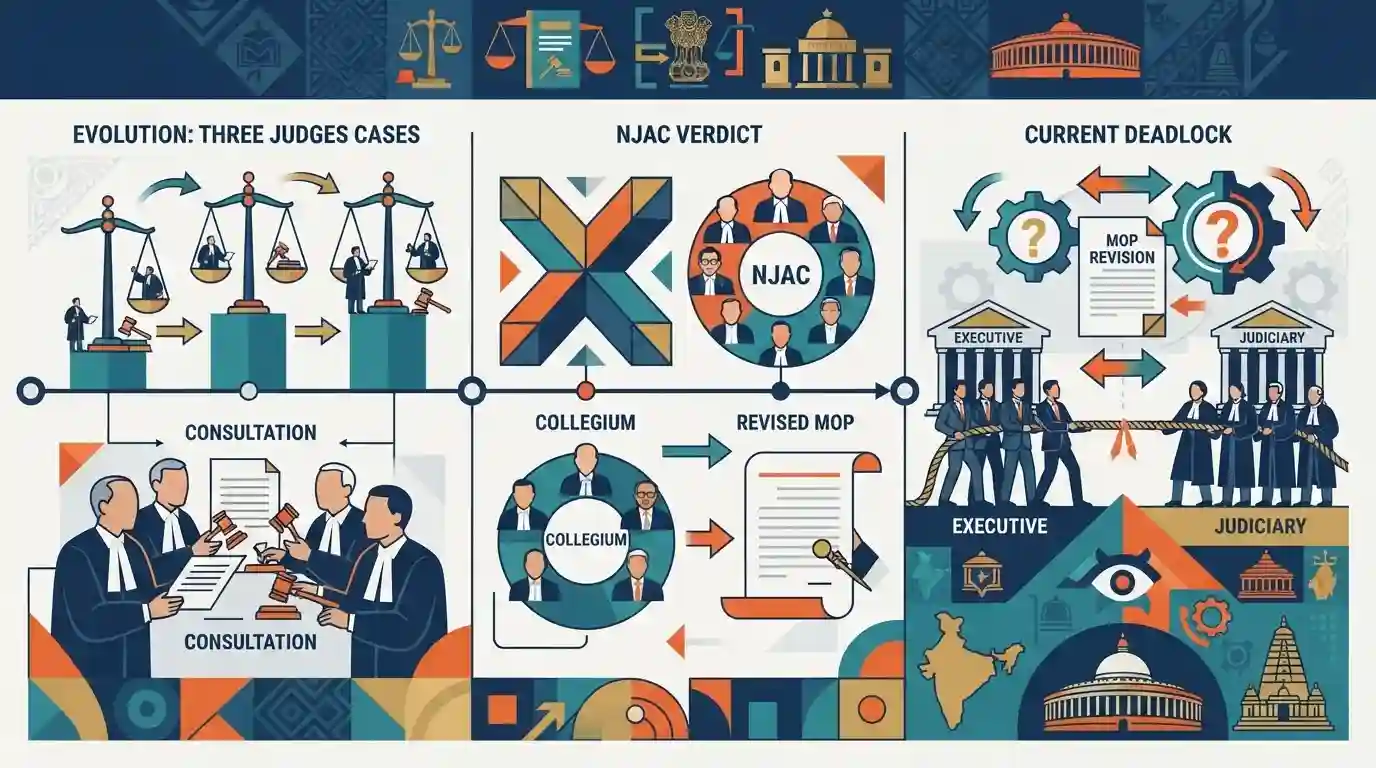
An examination of the Memorandum of Procedure (MoP) for judicial appointments in India, tracing its history from the Three Judges Cases through the NJAC verdict, and highlighting the ongoing deadlock over its revision between the executive and the judiciary.
Key Points
- The Memorandum of Procedure (MoP) governs the appointment and transfer of judges to the Supreme Court and High Courts in India.
- The current MoP has been pending revision since the 2015 Supreme Court judgment that struck down the National Judicial Appointments Commission (NJAC) Act and the 99th Constitutional Amendment.
- In the NJAC judgment, the Supreme Court had itself suggested improving the existing MoP to ensure transparency, but a finalized revised version between the government and the judiciary remains deadlocked over issues like background checks and national security clauses.
- The collegium system continues to function under the older guidelines, leading to ongoing debates regarding judicial independence, transparency, and the separation of powers.
Important Terms
Memorandum of Procedure (MoP)

A set of guidelines outlining the process for appointing, elevating, and transferring judges to the Supreme Court and High Courts in India, operationalized through executive-judiciary conventions.
UPSC context
GS Paper II (Indian Polity): Tests understanding of separation of powers, judicial appointments, and executive-judiciary dynamics.
National Judicial Appointments Commission (NJAC)
A constitutional body proposed via the 99th Amendment Act (2014) to replace the collegium system with a mixed panel of judges, government officials, and eminent persons for judicial appointments.
UPSC context
GS Paper II (Polity): Tests federalism, basic structure doctrine, checks and balances, and structural tensions between Parliament and the judiciary.
Third Judges Case
A 1998 Supreme Court advisory opinion (Presidential Reference) that expanded the collegium to a CJI and four senior-most judges, cementing judicial primacy in appointments.
UPSC context
GS Paper II (Polity): Important for studying the evolution of the collegium system and judicial interpretation of constitutional articles.
Prelims Trap
The Memorandum of Procedure and the Collegium system are statutory mechanisms explicitly mandated under Article 124 of the Constitution.
Aspirants often assume the Collegium system or the Memorandum of Procedure (MoP) are enshrined in the original text of the Constitution or introduced via an explicit constitutional amendment.
Static Concepts Connected
How did the Collegium system evolve through the Three Judges Cases in India?
- S.P. Gupta Case: First Judges Case (1982) ruled that 'consultation' with the Chief Justice of India does not mean 'concurrence', giving primacy to the executive in judicial appointments.
- Second Judges Case: Second Judges Case (1993) introduced the Collegium system, ruling that 'consultation' means 'concurrence' and giving primacy to the CJI and two senior-most judges.
- Third Judges Case: Third Judges Case (1998) expanded the Supreme Court Collegium to a body of the CJI and four senior-most judges, formalizing consultation norms.
Cross-Topic Patterns
Judicial Appointments & Separation of Powers
The executive-judiciary tussle over the MoP intersects directly with the doctrine of separation of powers and judicial review under Article 13/32/226.
National Security Clauses vs. Right to Privacy
Proposals for intelligence vetting in the MoP trigger debates over civil liberties, privacy jurisprudence, and state surveillance limits.

Expect a statement-based Prelims question on whether the MoP or the Collegium system finds explicit mention in the original text of the Constitution.
Linked PYQs · 3
Linked PYQs · 3
- 2025MainsGS2
Discuss the evolution of collegium system in India. Critically examine the advantages and disadvantages of the system of appointment of the Judges of the Supreme Court of India and that of the USA.
- 2023MainsGS2
“Constitutionally guaranteed judicial independence is a prerequisite of democracy.” Comment.
- 2025MainsGS2
"Constitutional morality is the fulcrum which acts as an essential check upon the high functionaries and citizens alike...." In view of the above observation of the Supreme Court, explain the concept of constitutional morality and its application to ensure balance between judicial independence and judicial accountability in India.
