Memorandum of Procedure and Judicial Appointments Controversy
Source:Indian Express ↗
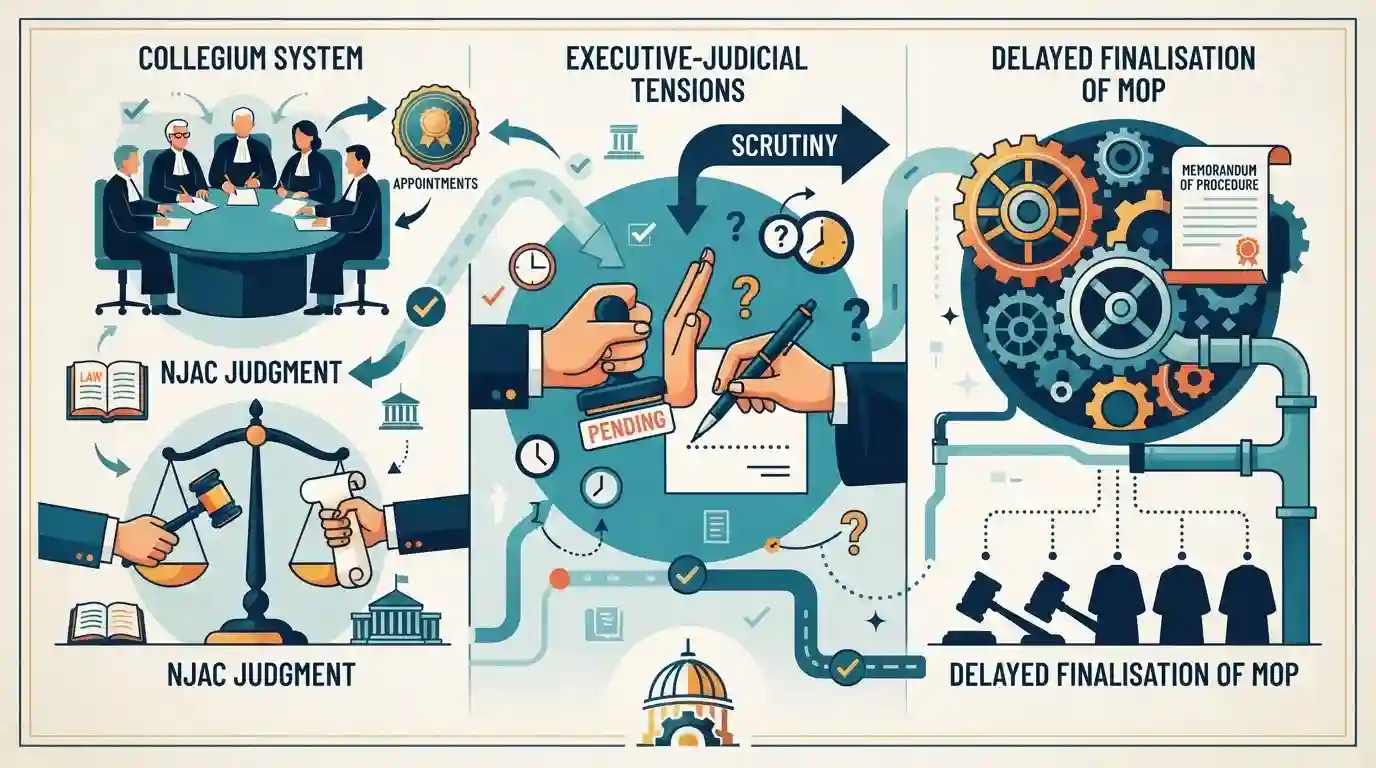
Why It Matters
Crucial for understanding the ongoing executive-judiciary tensions, judicial independence, and reforms in the appointment of higher judiciary judges via the Memorandum of Procedure (MoP).
Summary
An analysis of the Supreme Court's scrutiny regarding the delayed finalisation of the Memorandum of Procedure (MoP) for appointing judges, tracing its background through the Collegium system, the NJAC judgment, and executive-judicial tensions over judicial appointments.
Key Points
- The Supreme Court is examining the delay by the Centre in finalizing the updated Memorandum of Procedure (MoP) for the appointment of judges to the Supreme Court and High Courts.
- The MoP is the crucial document governing the interaction and process between the executive and the judiciary regarding judicial appointments.
- The current friction involves differences over clauses such as a national security veto for the government and institutional accountability mechanisms.
- The controversy stems from the historical evolution starting from the Judges Cases, the Collegium system, and the striking down of the NJAC Act in 2015.
Important Terms
Memorandum of Procedure (MoP)

A written administrative framework that governs the procedure and guidelines for appointing and transferring judges to the Supreme Court and High Courts in India.
UPSC context
GS Paper 2: Structure, Organization and Functioning of the Judiciary. Crucial for understanding executive-judicial tensions and delays in judicial appointments.
National Judicial Appointments Commission (NJAC)
A body proposed through the 99th Constitutional Amendment Act (2014) to replace the Collegium system with a mixed panel of judges, law minister, and eminent persons for appointing judges.
UPSC context
GS Paper 2: Separation of powers, basic structure doctrine, and judicial independence versus executive oversight.
Collegium System
A judicial mechanism evolved through the Supreme Court's Three Judges Cases where the Chief Justice of India and a forum of senior-most judges recommend judge appointments.
UPSC context
GS Paper 2: Organs of the State, judicial accountability, and controversies surrounding judicial appointment mechanisms.
Static Concepts Connected
What are the key judicial pronouncements that shaped the Collegium system for judicial appointments in India?
- First Judges Case: First Judges Case (1981): Held that 'consultation' with the Chief Justice of India does not mean 'concurrence'; gave primacy to the executive in appointments.
- Second Judges Case: Second Judges Case (1993): Overruled the 1981 ruling, ruled that 'consultation' means 'concurrence', and established the Collegium system giving primacy to the judiciary.
- Third Judges Case: Third Judges Case (1998): Clarified the Collegium's composition as the CJI and four senior-most judges for Supreme Court appointments, reinforcing institutional primacy.
Cross-Topic Patterns
Judicial Appointments vs. Doctrine of Separation of Powers
The executive-judicial tussle over the MoP intersects with Article 50 (Separation of Powers), testing the balance between judicial independence and democratic accountability.
Judicial Vacancies and Article 21 Enforcement
Delays in finalizing the MoP and mounting judicial vacancies directly impact the 'Right to Speedy Justice' under Article 21, linking institutional governance with fundamental rights.

Expect a statement-based question linking the Three Judges Cases, the NJAC judgment (2015), and the unresolved status of the MoP.
Linked PYQs · 3
Linked PYQs · 3
- 2025MainsGS2
Discuss the evolution of collegium system in India. Critically examine the advantages and disadvantages of the system of appointment of the Judges of the Supreme Court of India and that of the USA.
- 2017MainsGS2
Critically examine the Supreme Court's judgement on 'National Judicial Appointments Commission Act, 2014' with reference to appointment of judges of higher judiciary in India.
- 2025MainsGS2
"Constitutional morality is the fulcrum which acts as an essential check upon the high functionaries and citizens alike...." In view of the above observation of the Supreme Court, explain the concept of constitutional morality and its application to ensure balance between judicial independence and judicial accountability in India.
