Judges Appointment System and Memorandum of Procedure
Source:Indian Express ↗
Why It Matters
The mechanism for appointing higher judiciary judges touches directly on the core constitutional principle of separation of powers and judicial independence, making it a recurring core topic for GS Paper 2.
Summary
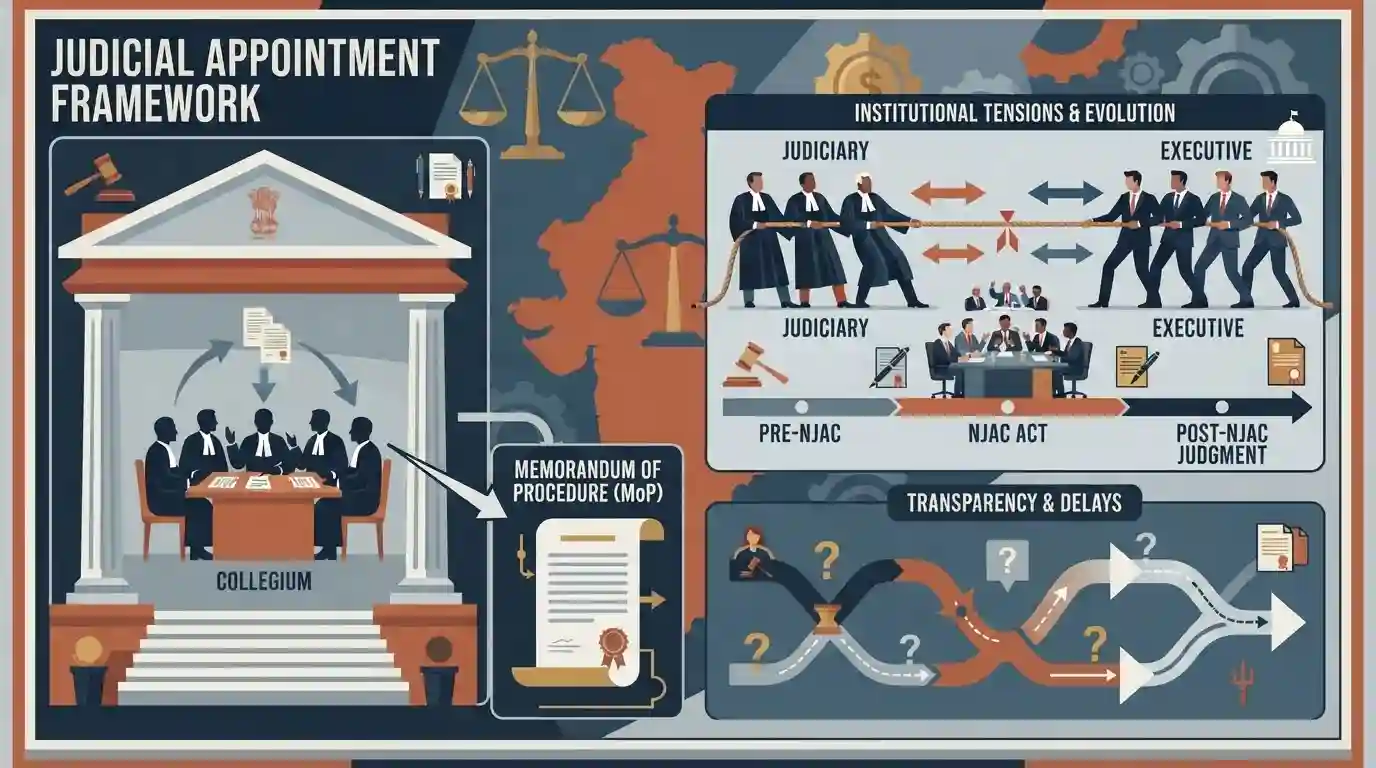
This article explores the legal and institutional framework governing the appointment of judges to the Supreme Court and High Courts in India. It examines the evolution of the Collegium system, the role of the Memorandum of Procedure (MoP), the historical context of the National Judicial Appointments Commission (NJAC) judgment, and the continuous institutional tensions between the executive and the judiciary regarding appointment transparency and delays.
Key Points
- The appointment of judges to the Supreme Court and High Courts in India is governed by the Collegium system, which evolved through three major Supreme Court judgments known as the Three Judges Cases.
- The Memorandum of Procedure (MoP) serves as the detailed framework guiding how the government and the judiciary process the appointment, transfer, and elevation of judges.
- The National Judicial Appointments Commission (NJAC) Act, 2014, enacted to replace the Collegium system, was struck down by the Supreme Court in 2015 as violative of the basic structure of the Constitution (independence of the judiciary).
- Debates persist around transparency, delays in judicial appointments, executive-judiciary checks and balances, and the finalization of a revised MoP.
Important Terms
Memorandum of Procedure MoP

An administrative document that guides the process of appointing and transferring judges to the Supreme Court and High Courts in India, operationalizing the Collegium system.
UPSC context
GS Paper 2: Judiciary, Structure and Functioning, Separation of Powers. Tests understanding of executive-judiciary dynamics in appointments.
National Judicial Appointments Commission NJAC Act
A body proposed by the 99th Constitutional Amendment to replace the Collegium system with a transparent panel, struck down by the Supreme Court in 2015 for violating judicial independence.
UPSC context
GS Paper 2: Basic structure doctrine, judicial review, separation of powers, and institutional checks and balances.
Collegium System
A judicial system for appointing and transferring judges in India, evolved through the Supreme Court's Judges Cases, where the Chief Justice and senior judges make binding recommendations.
UPSC context
GS Paper 2: Structure, Organization and Functioning of the Judiciary. Crucial for questions on judicial accountability versus independence.
Static Concepts Connected
How did the Collegium system evolve through the Three Judges Cases?
- 1981 Ruling: First Judges Case (1981) ruled that 'consultation' does not mean 'concurrence', giving primacy to the executive in judicial appointments.
- 1993 Ruling: Second Judges Case (1993) reinterpreted 'consultation' as 'concurrence', establishing the Collegium system and judicial primacy.
- 1998 Ruling: Third Judges Case (1998) expanded the Collegium to a body of the CJI plus four senior-most judges for Supreme Court appointments.
Cross-Topic Patterns
Basic Structure Doctrine vs Legislative Supremacy
The NJAC ruling sits at the intersection of judicial independence and parliamentary sovereignty, a core theme frequently tested in GS Paper II polity questions.

Expect a statement-based prelims question on the evolution from 'consultation' to 'concurrence' across the Three Judges Cases.
Linked PYQs · 2
Linked PYQs · 2
- 2025MainsGS2
Discuss the evolution of collegium system in India. Critically examine the advantages and disadvantages of the system of appointment of the Judges of the Supreme Court of India and that of the USA.
- 2017MainsGS2
Critically examine the Supreme Court's judgement on 'National Judicial Appointments Commission Act, 2014' with reference to appointment of judges of higher judiciary in India.
