Supreme Court intervenes to secure railway compensation for widow
Source:Indian Express ↗
Why It Matters
This case serves as an excellent case study for GS2 answers on judicial activism, the functioning of tribunals, and the practical challenges marginalized citizens face in accessing justice. It underscores the importance of State Legal Services Authorities in bridging the gap between judicial orders and actual justice delivery.
Summary
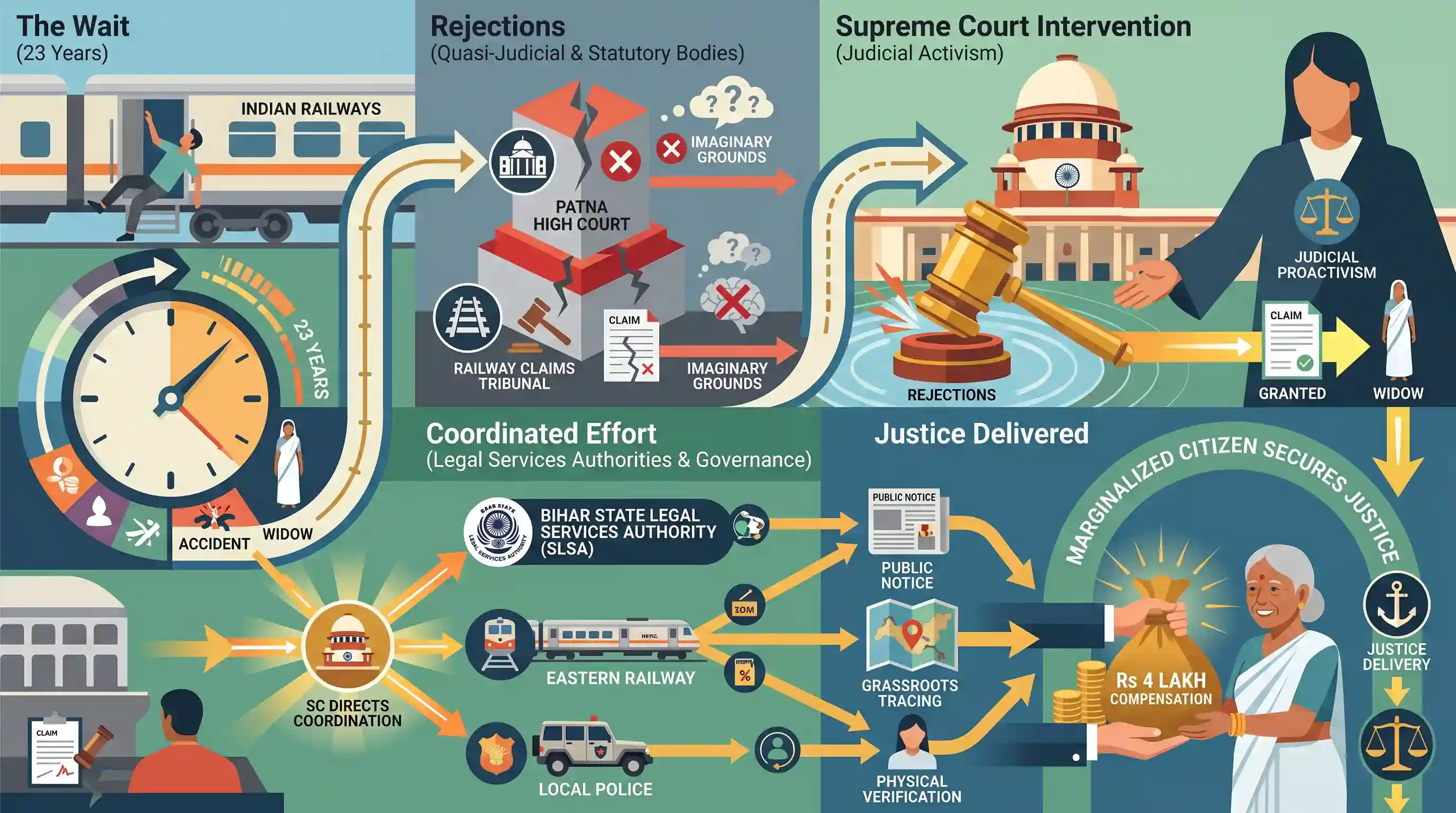
The Supreme Court of India went to extraordinary lengths to ensure that a widow, Saynokta Devi, received her rightful compensation from the Railways 23 years after her husband died in a train accident. Her initial claim was dismissed by the Railway Claims Tribunal and the Patna High Court on "imaginary" grounds, a decision the Supreme Court overturned in 2023. When the Railways failed to locate the claimant to disburse the Rs 4 lakh compensation due to an incorrect address and the death of her local counsel, the apex court directed a coordinated effort involving the Bihar State Legal Services Authority, Eastern Railway, and local police. The successful tracing of the woman showcases the critical role of judicial proactivism and grassroots legal authorities in securing justice for marginalized citizens.
Key Points
- The Supreme Court demonstrated exceptional judicial proactivism to ensure a widow received railway compensation after a 23-year legal struggle.
- The claim was initially rejected by the Railway Claims Tribunal and Patna High Court on arbitrary grounds, highlighting issues with lower-level quasi-judicial and judicial bodies.
- When the Railways could not locate the widow due to incorrect address records and the death of her local counsel, the SC intervened to coordinate a search.
- The Court leveraged the Bihar State Legal Services Authority, Eastern Railway, and local police administration (SSP Nalanda, SHO Bakhtiyarpur) to successfully trace the beneficiary and disburse the funds.
Important Terms
Supreme Court of India

The highest judicial body in India, acting as the final court of appeal and the guardian of the Constitution. It possesses the unique power to ensure "complete justice."
UPSC context
GS Paper II: Judiciary structure and powers; essential for questions on the apex court's role in safeguarding rights.
Railway Claims Tribunal (RCT)
A specialized quasi-judicial body established under the Railway Claims Tribunal Act, 1987, to adjudicate claims for compensation regarding death, injury, or loss of goods during railway transit.
UPSC context
GS Paper II: Statutory and quasi-judicial bodies. Tests knowledge of specialized tribunals intended for speedy justice.
State Legal Services Authority (SLSA)
Statutory bodies created under the Legal Services Authorities Act, 1987, to provide free legal services to weaker sections and implement NALSA policies at the state level.
UPSC context
GS Paper II: Welfare schemes for vulnerable sections; Article 39A. Tests understanding of legal aid mechanisms.
Article 142
A constitutional provision that empowers the Supreme Court to pass any decree or order necessary for doing "complete justice" in any cause or matter pending before it.
UPSC context
GS Paper II: Indian Constitution. Frequently tested in the context of judicial activism and extraordinary court powers.
Judicial Activism
A philosophy where the judiciary takes a proactive role in protecting citizens' rights and ensuring justice, often by stepping in where the executive or legislature has failed.
UPSC context
GS Paper II: Separation of powers; judicial overreach vs activism. Core theme for mains answer writing.
Prelims Trap
"Free legal aid is available to women only if their annual income is below ₹3,00,000."
Section 12 of the Legal Services Authorities Act, 1987, grants free legal services to ALL women and children, regardless of their income or financial status.
Static Concepts Connected
How are State Legal Services Authorities (SLSAs) structured under the 1987 Act?
- Constitutional backing: Article 39A (DPSP) mandates the State to secure equal justice and provide free legal aid to ensure opportunities are not denied by economic disabilities.
- Leadership: The Chief Justice of the respective High Court serves as the Patron-in-Chief of the SLSA.
- Core mandate: They organize Lok Adalats and provide free legal services to eligible classes, including women, SC/STs, and victims of human trafficking.
What is the scope of Article 142 of the Indian Constitution?
- Complete Justice: It allows the Supreme Court to pass any decree or order necessary for doing "complete justice" in any cause or matter pending before it.
- Enforceability: Such orders are enforceable throughout India in such manner as prescribed by Parliament or by the President.
- Limitations: It cannot be used to supplant substantive law, though it is frequently invoked to bridge procedural gaps and offer equitable relief.
Cross-Topic Patterns
Tribunalization vs. Judicial Review
The frequent overruling of tribunals by constitutional courts highlights the tension between speedy quasi-judicial mechanisms and the need for Article 136/142 interventions to correct arbitrary dismissals.
Strict liability in transport and environment
The "no-fault liability" under the Railways Act mirrors the Public Liability Insurance Act 1991 for environmental disasters, shifting the evidentiary burden away from vulnerable victims.

NALSA eligibility rules (income limits vs unconditional access for women/children) are highly likely in a 2026 Prelims statement question.
Linked PYQs · 3
Linked PYQs · 3
- 2023MainsGS2
Who are entitled to receive free legal aid? Assess the role of the National Legal Services Authority (NALSA) in rendering free legal aid in India.
- 2014MainsGS2
Starting from inventing the 'basic structure' doctrine, the judiciary has played a highly proactive role in ensuring that India develops into a thriving democracy. In light of the statement, evaluate the role played by judicial activism in achieving the ideals of democracy.
- 2025MainsGS2
Comment on the need of administrative tribunals as compared to the court system. Assess the impact of the recent tribunal reforms through rationalization of tribunals made in 2021.
