Supreme Court ruling on article 32 writ and fundamental duties
Source:The Hindu ↗
Why It Matters
This case reinforces the constitutional limitations of writ jurisdiction under Article 32, emphasizing that Fundamental Duties (Article 51A) are non-justiciable and cannot replace the requirement of a Fundamental Right violation to seek constitutional remedies. It also touches upon the historical legacy of V.D. Savarkar.
Summary
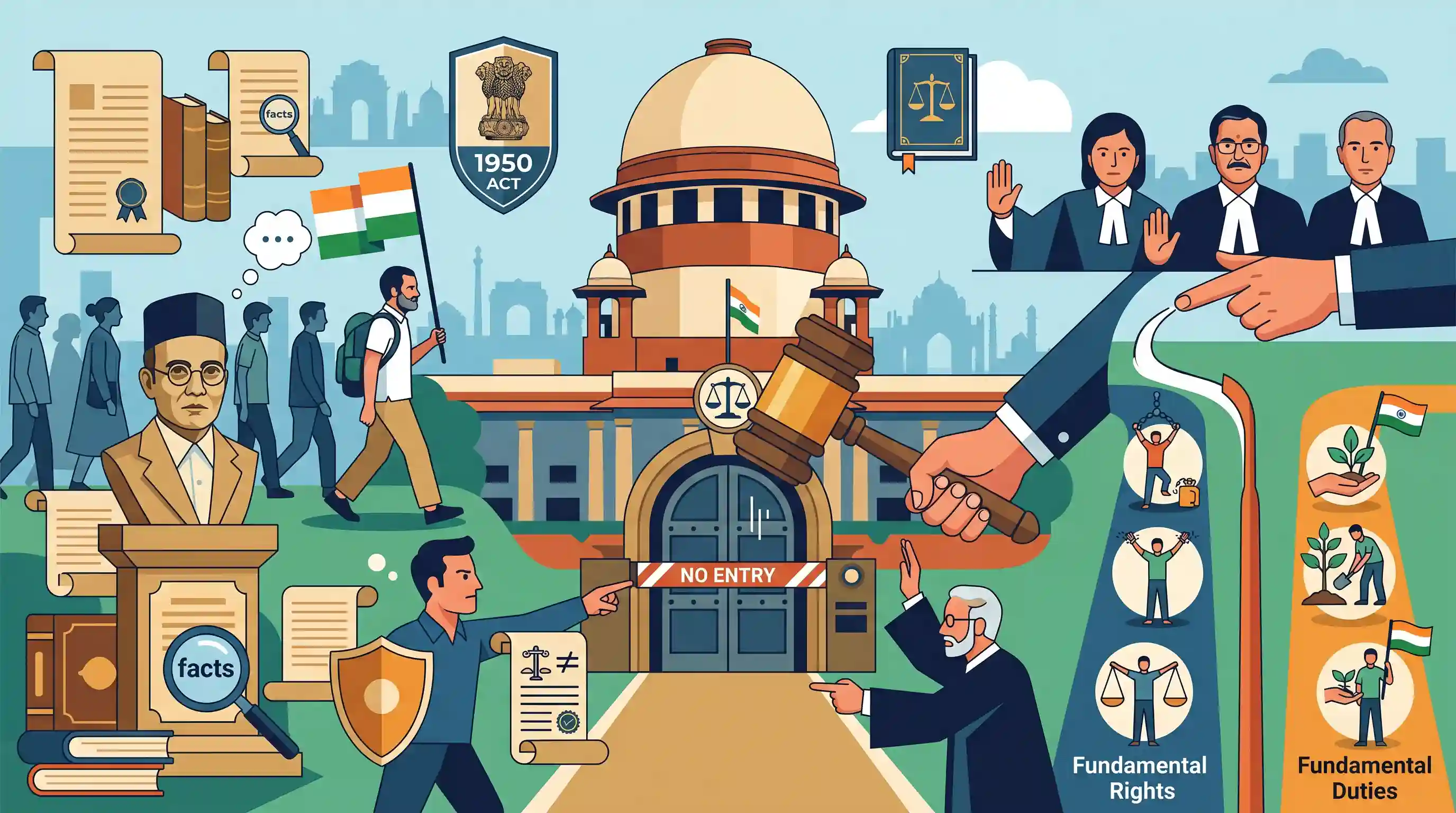
The Supreme Court of India dismissed a writ petition seeking to establish "historical facts" about V.D. Savarkar and protect his name under the Emblems and Names (Prevention of Improper Use) Act, 1950. The Bench, headed by Chief Justice B.R. Gavai, emphasized the constitutional principle that a writ petition under Article 32 can only be entertained when a Fundamental Right is violated. The petitioner had argued that filing the plea was his Fundamental Duty under Article 51A to protect the honor of historical figures. However, the Court reiterated that Fundamental Duties cannot independently form the basis of a writ petition in the absence of a Fundamental Right violation. The plea had also arraigned political leader Rahul Gandhi for his remarks on Savarkar during the Bharat Jodo Yatra.
Key Points
- The Supreme Court dismissed a petition seeking to establish historical facts about freedom fighter V.D. Savarkar to protect his name from misunderstandings.
- The petitioner sought to bring Savarkar's name under the protection of the Emblems and Names (Prevention of Improper Use) Act, 1950.
- The Court ruled that writ petitions under Article 32 can only be entertained if there is a direct violation of a citizen's Fundamental Rights.
- The petitioner’s reliance on Fundamental Duties (Article 51A) as the basis for the writ was rejected, highlighting that duties are non-justiciable and cannot independently invoke writ jurisdiction.
- The controversy stemmed from political remarks made by Congress leader Rahul Gandhi during the Bharat Jodo Yatra regarding Savarkar's clemency petitions to the British.
Important Terms
Emblems and Names (Prevention of Improper Use) Act, 1950

A 1950 law prohibiting unauthorized commercial or professional use of national symbols, names, and emblems (e.g., Mahatma Gandhi, National Flag) listed in its Schedule.
UPSC context
GS Paper II (Governance); tests knowledge of legal safeguards for national honor and executive powers to regulate commercial symbols.
Article 32
Known as the 'Right to Constitutional Remedies,' it empowers citizens to directly approach the Supreme Court to enforce Fundamental Rights via writ petitions.
UPSC context
GS Paper II (Polity); essential for understanding judicial review, the 'Basic Structure,' and the mandatory jurisdiction of the Supreme Court.
Article 51A
Enshrines 11 'Fundamental Duties' of citizens, such as cherishing the national struggle for freedom; unlike Fundamental Rights, these are non-justiciable and cannot be enforced directly.
UPSC context
GS Paper II (Polity); tests the balance between rights and duties and their respective enforceability in constitutional law.
Writ Jurisdiction
The power of the Supreme Court (Article 32) and High Courts (Article 226) to issue commands like Habeas Corpus and Mandamus to protect legal and constitutional rights.
UPSC context
GS Paper II (Polity); critical for comparing the scope of authority between the Supreme Court and High Courts.
Judicial Restraint
A judicial philosophy where courts hesitate to intervene in policy matters or expand legislative lists, sticking strictly to the enforcement of established Fundamental Rights.
UPSC context
GS Paper II (Polity); relevant for discussing the separation of powers and the boundaries of judicial activism in India.
Supreme Court of India
The highest judicial forum and final court of appeal under the Constitution, acting as the ultimate guarantor of Fundamental Rights and interpreter of the law.
UPSC context
GS Paper II (Polity); central to the Indian judicial system, its original, appellate, and advisory jurisdictions are frequently tested.
Prelims Trap
"A writ petition under Article 32 can be filed to enforce a citizen's Fundamental Duties."
Article 32 is strictly limited to the enforcement of Fundamental Rights (Part III). It cannot be invoked independently for Fundamental Duties or statutory rights.
Static Concepts Connected
How does writ jurisdiction under Article 32 differ from Article 226?
- Article 32: The Supreme Court under Art 32 can issue writs only for the enforcement of Fundamental Rights (Part III).
- Article 226: High Courts under Art 226 can issue writs for Fundamental Rights as well as "for any other purpose" (ordinary legal rights).
- Fundamental Right: The right to move the Supreme Court under Article 32 is itself a Fundamental Right, making its invocation mandatory for the court to hear (usually).
What were V.D. Savarkar's key organizational and literary contributions?
- Organizations: Founded Mitra Mela (1899), which evolved into the secret society Abhinav Bharat (1904), and established the Free India Society in London.
- Key Literature: Authored 'The Indian War of Independence 1857', reinterpreting the mutiny as India's first organized freedom struggle.
- Political Role: He served as the president of the Hindu Mahasabha from 1937 to 1943.
Cross-Topic Patterns
Enforcing Duties via Statutes
While Article 51A is non-justiciable directly via Article 32, Parliament enforces duties through statutes like the Emblems Act, 1950, and the Prevention of Insults to National Honour Act, 1971.
Historical Figures in Constitutional Law
UPSC frequently integrates history and polity by testing constitutional provisions (Article 32, Defamation, Freedom of Speech) through the lens of contemporary controversies surrounding modern historical personalities like Savarkar.

Expect a multi-statement prelims question contrasting the non-justiciability of Fundamental Duties with the strict bounds of Article 32.
Linked PYQs · 4
Linked PYQs · 4
- 2024PrelimsGS1
A Writ of Prohibition is an order issued by the Supreme Court or High Courts to :
- 2014PrelimsGS1
The power of the Supreme Court of India to decide disputes between the Centre and the States falls under its
- 2017PrelimsGS1
The mind of the makers of the Constitution of India is reflected in which of the following?
- 2017MainsGS2
Examine the scope of Fundamental Rights in the light of the latest judgement of the Supreme Court on Right to Privacy.
