Judicial Limits under Article 32 Regarding National Education Policy
Source:Indian Express ↗
Why It Matters
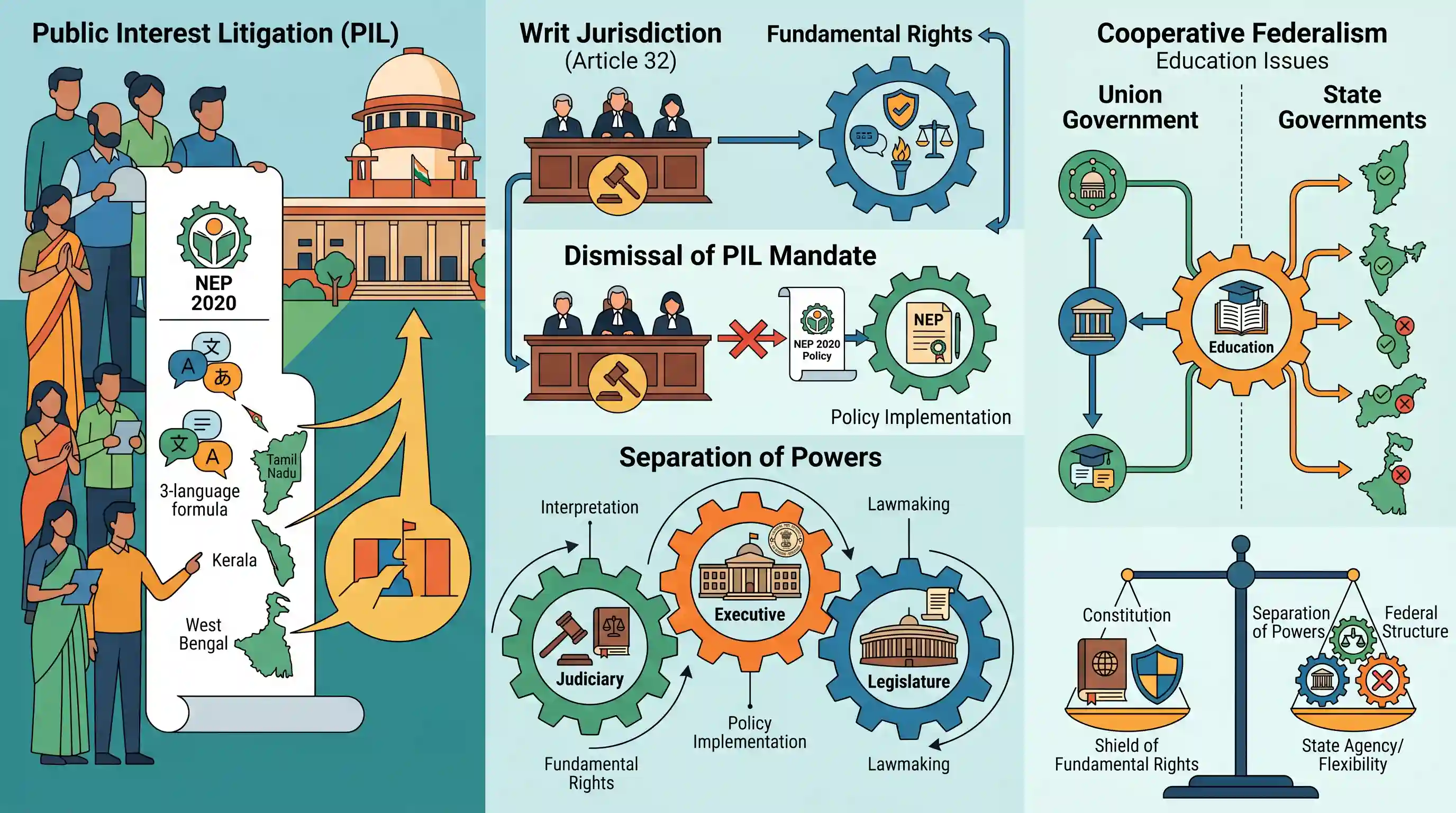
It highlights the constitutional limits of judicial intervention (Article 32) in executive policymaking. It also touches upon Center-State friction regarding the implementation of the National Education Policy and the contentious three-language formula in non-Hindi speaking states.
Summary
The Supreme Court has dismissed a Public Interest Litigation (PIL) that sought to compel states, including Tamil Nadu, Kerala, and West Bengal, to implement the National Education Policy (NEP) 2020 and its three-language formula. The bench clarified the scope of Article 32 of the Constitution, stating that while the Court can issue writs to enforce fundamental rights, it cannot mandate the implementation of government policies. The ruling underscores the separation of powers and respects the federal structure, as education lies in the Concurrent List and states retain agency over adopting broad national policies like the NEP.
Key Points
- The Supreme Court dismissed a PIL seeking directions for states like Tamil Nadu, Kerala, and West Bengal to implement the National Education Policy (NEP) 2020.
- The petitioner specifically sought the implementation of the three-language formula outlined in the NEP.
- The Court ruled that it cannot compel a state to adopt a specific policy like the NEP through a writ petition under Article 32.
- Under Article 32, the Supreme Court's jurisdiction is limited to issuing directives for the protection and enforcement of fundamental rights, which was not established in this policy implementation plea.
- Education is in the Concurrent List, making its implementation a matter of cooperative federalism, and states have historically held varying stances on language policies.
Important Terms
National Education Policy (NEP) 2020

India's 21st-century education framework replacing the 1986 policy. It introduces a 5+3+3+4 structure, aims for universal literacy by 2030, and promotes holistic, multidisciplinary, and flexible learning pathways.
UPSC context
GS Paper II (Social Justice/Governance). Tests understanding of major social sector reforms and their impact on human capital development.
Three-language formula
A policy recommendation (originating from the 1968 NEP) where students learn three languages—typically a regional language, English, and one other Indian language (often Hindi in non-Hindi states).
UPSC context
GS Paper II (Governance/Federalism). Tests knowledge of linguistic diversity, state autonomy, and historic North-South policy tensions.
Article 32 of the Constitution
Known as the 'heart and soul' of the Constitution, it allows citizens to approach the Supreme Court directly to enforce Fundamental Rights via five specific writs.
UPSC context
GS Paper II (Indian Polity). Essential for understanding constitutional remedies and the limits of judicial intervention in executive policy.
Concurrent List (Education)
List III of the Seventh Schedule containing subjects where both Centre and States can legislate. Education was moved here from the State List by the 42nd Amendment (1976).
UPSC context
GS Paper II (Federalism). Tests understanding of the division of legislative powers and the 'Doctrine of Repugnancy'.
Cooperative Federalism
A democratic framework where the Centre and States collaborate to solve common problems and implement national policies while respecting regional autonomy and constitutional boundaries.
UPSC context
GS Paper II (Polity/Federal structure). A core theme testing how national schemes are negotiated between different levels of government.
Prelims Trap
The Supreme Court can issue a writ of mandamus to compel states to implement a Central policy on a Concurrent List subject.
Article 32 strictly enforces Fundamental Rights. Mandamus cannot compel the executive to enforce discretionary guidelines or national policies; it requires a mandatory statutory or constitutional duty.
Static Concepts Connected
What are the key limitations on issuing a Writ of Mandamus?
- Discretionary Duties: Mandamus cannot be issued to compel an authority to perform a duty that is purely discretionary or a matter of policy.
- Mandatory Public Duty: It strictly lies for enforcing mandatory legal or public duties, and generally cannot be issued against private individuals or organizations.
- Separation of Powers: A court cannot use Mandamus to direct a legislature to enact a specific law or an executive to frame a specific policy.
How has the constitutional status of Education evolved in the 7th Schedule?
- Initial Status: Originally, Education was placed in the State List (List II), giving states exclusive legislative and executive control over it.
- 42nd Amendment (1976): The 42nd Constitutional Amendment Act of 1976 shifted Education, along with Forests and Weights & Measures, to the Concurrent List (List III).
- Current Framework: Both Centre and States can legislate on it now, but executive implementation of national frameworks typically relies on cooperative federalism rather than central diktats.
Cross-Topic Patterns
Judicial Restraint in Policy Implementation
The SC frequently refuses to use writ jurisdiction for executive policy matters, reinforcing the strict separation of powers and highlighting the limits of judicial intervention in governance.
Concurrent List & Cooperative Federalism
While the Centre formulates national frameworks like NEP or NEET, executive implementation relies on state cooperation, frequently sparking political friction over federal autonomy and regional language preservation.

A 2026 Prelims question will likely test the limits of Mandamus in enforcing Concurrent List policies versus enforcing Fundamental Rights.
Linked PYQs · 2
Linked PYQs · 2
- 2020MainsGS2
National Education Policy 2020 is in conformity with the Sustainable Development Goal-4 (2030). It intends to restructure and reorient education system in India. Critically examine the statement.
- 2017MainsGS2
Examine the scope of Fundamental Rights in the light of the latest judgement of the Supreme Court on Right to Privacy.
