Mysuru Dasara Invitation and Constitutional Secularism Verdict
Source:The Hindu ↗
Why It Matters
This judicial decision is crucial for UPSC aspirants as it reaffirms the constitutional principle of secularism and clarifies the application of the 'Essential Religious Practices' doctrine. It demonstrates the judiciary's role in ensuring that state-sponsored cultural events uphold constitutional morality and non-discrimination.
Summary
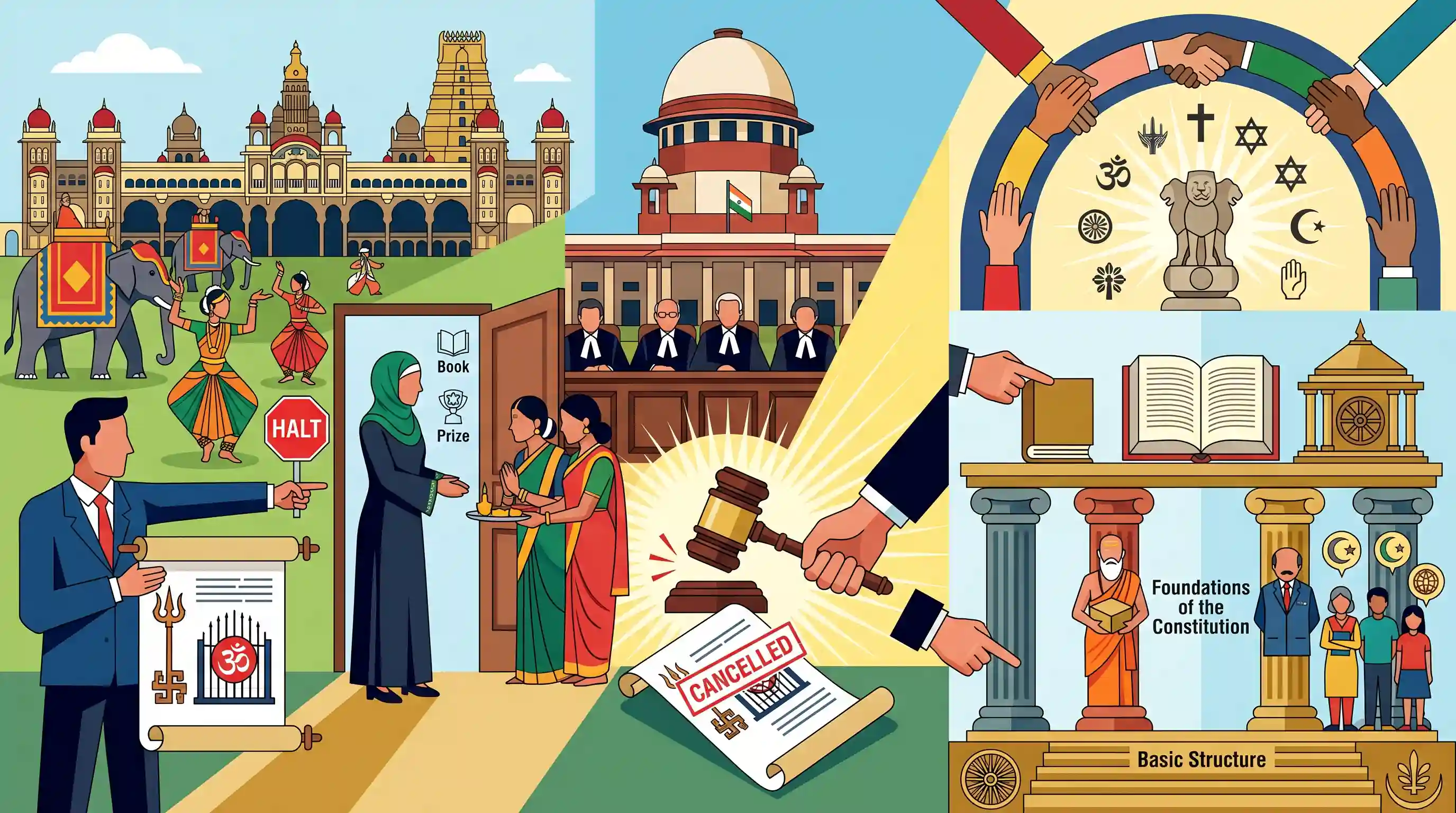
The Supreme Court dismissed a petition that challenged the Karnataka government's decision to invite Banu Mushtaq, a Muslim Booker Prize-winning author, to inaugurate the Mysuru Dasara festival and participate in the pooja at the Chamundeshwari temple. The petitioner argued that such rituals were 'essential religious practices' restricted to Hindus under Article 25. However, the Court highlighted the secular character of the Indian State, noting that state-organized events must remain non-discriminatory. Relying on the Preamble and the Basic Structure Doctrine (citing S.R. Bommai and Kesavananda Bharati), the Court reaffirmed that the State cannot identify with or favor any specific religion.
Key Points
- The Supreme Court dismissed a petition challenging the Karnataka government's invitation to Muslim author Banu Mushtaq to inaugurate the Mysuru Dasara festivities.
- The petitioner claimed that inaugurating the religious ceremony and offering pooja was an 'essential religious practice' protected under Article 25, arguing a non-Hindu could not perform these rituals.
- The Supreme Court emphasized that the State is secular and state-sponsored events cannot discriminate between religions, referencing the Preamble and the Basic Structure Doctrine.
- The Court cited landmark judgments like S.R. Bommai, Kesavananda Bharati, and Ismail Faruqui to reiterate that the State does not patronize any particular religion.
Important Terms
Basic Structure Doctrine

A judicial principle established in 1973 stating that certain core features of the Constitution, such as secularism and democracy, cannot be amended by Parliament.
UPSC context
GS II (Polity); tests the limits of Article 368 and the judiciary's role in protecting constitutional identity.
Essential Religious Practices Doctrine
A legal test used by the Supreme Court to determine which rituals or practices are integral to a religion and thus constitutionally protected.
UPSC context
GS II (Polity); tests the balance between individual religious freedom (Article 25) and state-led social reforms.
Article 25
A fundamental right guaranteeing freedom of conscience and the right to profess, practice, and propagate religion, subject to public order, health, and morality.
UPSC context
GS II (Polity); fundamental for understanding the scope of religious freedom and secular state intervention.
S.R. Bommai vs Union of India (1994)
A landmark 1994 Supreme Court judgment that declared secularism as a 'basic feature' of the Constitution and restricted the arbitrary dismissal of state governments.
UPSC context
GS II (Polity); essential for topics on federalism, secularism, and the misuse of Article 356.
Preamble to the Constitution of India
The introductory statement of the Constitution that outlines its core philosophy, including the commitment to a 'Secular' and 'Democratic' Republic.
UPSC context
GS II (Polity); tests understanding of the Constitution's foundational values and its interpretative significance.
Indian Secularism
A model characterized by 'principled distance' and equal respect for all religions, rather than a rigid separation between church and state.
UPSC context
GS I (Social Issues) & GS II (Polity); tests the unique pluralistic approach compared to Western secular models.
Prelims Trap
"The Constitution prohibits the State from organizing or participating in religious festivals."
India follows 'positive secularism' (principled distance). The State can organize or fund cultural/religious festivals (like Dasara or Kumbh) provided it doesn't discriminate between religions.
Static Concepts Connected
What is the Essential Religious Practices (ERP) Doctrine?
- Origin: Established by the seven-judge bench of the Supreme Court in the Shirur Mutt Case (1954).
- Core Principle: Protects only those practices integral to a religion under Article 25, leaving non-essential or secular practices open to State regulation.
- Recent Applications: Continuously invoked in landmark cases like Sabarimala, Triple Talaq, and the Karnataka Hijab row to determine constitutional protection.
How did S.R. Bommai (1994) shape Indian Secularism?
- Basic Structure: Explicitly reaffirmed that Secularism is an integral part of the Basic Structure of the Indian Constitution.
- State Neutrality: Ruled that the State has no official religion and must treat all religions equally without patronizing any specific faith.
Cross-Topic Patterns
ERP Doctrine + Uniform Civil Code
The state's power to regulate non-essential religious practices is the constitutional bridge allowing the eventual implementation of a Uniform Civil Code (Article 44) over diverse religious personal laws.
Article 25 limitations + Public Order
Freedom of religion under Article 25 is uniquely subject to "public order, morality, health" and other fundamental rights, making it highly susceptible to reasonable state restrictions compared to other rights.

Expect a 2026 Prelims question mixing the Shirur Mutt case (ERP origin), Article 25 limitations, and positive secularism.
Linked PYQs · 4
Linked PYQs · 4
- 2024MainsGS2
Discuss India as a secular state and compare with the secular principles of the US constitution.
- 2021MainsGS2
‘Constitutional Morality’ is rooted in the Constitution itself and is founded on its essential facets. Explain the doctrine of ‘Constitutional Morality’ with the help of relevant judicial decisions.
- 2020PrelimsGS1
The Preamble to the Constitution of India is
- 2020PrelimsGS1
Consider the following statements: 1. The Constitution of India defines its 'basic structure' in terms of federalism, secularism, fundamental rights and democracy. 2. The Constitution of India provides for 'judicial review' to safeguard the citizens' liberties and to preserve the ideals on which the Constitution is based. Which of the statements given above is/are correct?
