Supreme Court Ruling on BC Quota in AP Local Body Polls
Source:newindianexpress ↗
Why It Matters
This ruling has profound significance for state-level reservations, local body governance, and compliance with Supreme Court mandates regarding empirical data collection for backward classes in Andhra Pradesh.
Summary
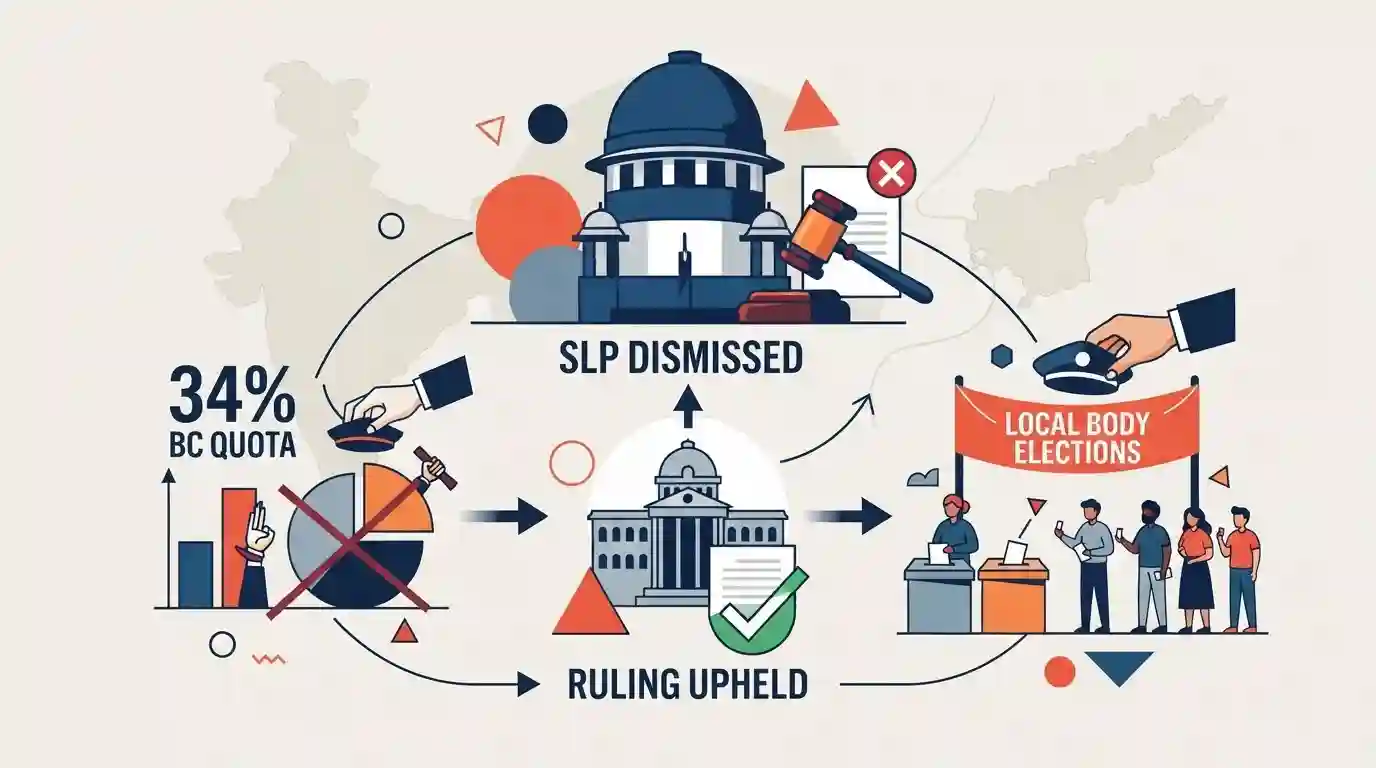
The Supreme Court dismissed the Andhra Pradesh government's special leave petition challenging the High Court's ruling that struck down the 34% BC quota in local body elections, reinforcing judicial parameters on local body reservations.
Key Points
- The Supreme Court dismissed the Andhra Pradesh government's plea challenging the High Court order.
- The High Court had earlier struck down the 34% reservation for Backward Classes (BCs) in local body polls.
- The decision centers around adherence to the overall reservation ceiling limits and legal protocols for empirical data collection (triple test criteria) mandated for local body reservations.
Important Terms
Backward Classes (BC) Quota in Local Body Polls

A policy of reserving specific percentages of seats for Backward Classes in rural and urban local bodies, subject to empirical justification and the 50% overall reservation ceiling.
UPSC context
Important for APPSC Group 1/2 Polity (Devolution of Powers and Local Government governance, social justice, and affirmative action policies).
73rd and 74th Constitutional Amendment Acts
Landmark constitutional amendments that gave constitutional status to Panchayati Raj and Municipal bodies, empowering states to legislate on local body reservations.
UPSC context
Crucial for APPSC Indian Constitution, Federalism, and Decentralization topics, testing knowledge of grassroots democracy and statutory frameworks.
Supreme Court of India
The apex judicial body in India that interprets the Constitution and enforces the rule of law, including setting the 50% ceiling limit for reservations.
UPSC context
Vital for APPSC Polity syllabus under Judiciary, judicial review, and federal structure.
Andhra Pradesh High Court
The highest state court that exercises judicial review over executive orders and state legislation, ensuring state policies comply with constitutional limits.
UPSC context
Important for APPSC questions regarding state-level judicial administration and high court jurisdiction under Article 226.
Prelims Trap
The 50% overall reservation ceiling limit established in the Indra Sawhney judgment applies exclusively to public employment and education, not local body polls.
Aspirants often assume the 50% reservation ceiling applies strictly to public employment and education under Article 16, overlooking that the Supreme Court explicitly extended it to local body elections too.
Static Concepts Connected
What are the mandatory requirements of the 'Triple Test' for local body reservations as per the Supreme Court?
- Empirical Data: Establish a dedicated commission to conduct a rigorous empirical inquiry into the nature and implications of backwardness in local bodies.
- Proportionate Quota: Specify the proportion of reservation required in each local body based on the commission's recommendations.
- 50% Ceiling: Ensure that the aggregate reservation for SCs, STs, and BCs does not exceed the aggregate 50% ceiling limit.
Cross-Topic Patterns
Local Body Quotas + Indra Sawhney Precedent
Local body reservation ceilings must align with fundamental rights scrutiny under Article 14 and 16, just like public employment quotas.
Devolution of Powers + Judicial Review
The implementation of the 73rd and 74th Amendments faces recurring friction between state-level populist mandates and judicial decentralization limits.

Expect a statement-based question combining the Supreme Court's triple test criteria for local bodies and the 50% reservation ceiling limit.
Linked PYQs · 2
Linked PYQs · 2
- 2023APPSC_PRELIMSGS1
Which of the following Amendment(s) provide(s) for reservation in jobs and admissions ?
- 2024APPSC_PRELIMSGS1
Which of the following source/sources of revenue qualifies/qualify for being given to the Panchayats? I. The tax proceeds that are assigned to the States from the Centre may be again re-distributed to the Panchayats as recommended by the Central Finance Commission. II. Loans from the State Government. III. Under Article 243-I of the Constitution of India, the State Government is empowered to devolve its own funds to the Panchayats even in the absence of the State Finance Commission's recommendations. IV. Internal Resource Generation is facilitated only in the case of Panchayats situated in Scheduled Areas as per the Fifth Schedule. Select the correct answer using the codes given below:
