Supreme Court Directives on Regulatory Assets of Power Discoms
Source:The Hindu ↗
Why It Matters
This judgment targets a critical bottleneck in the Indian power sector: the mounting debt and poor financial health of DISCOMs caused by delayed tariff revisions and unrecovered costs (regulatory assets). It is highly relevant for GS Paper 3 (Infrastructure - Energy) and GS Paper 2 (Regulatory Bodies), highlighting the conflict between political pricing of electricity and the commercial viability needed for energy security.
Summary
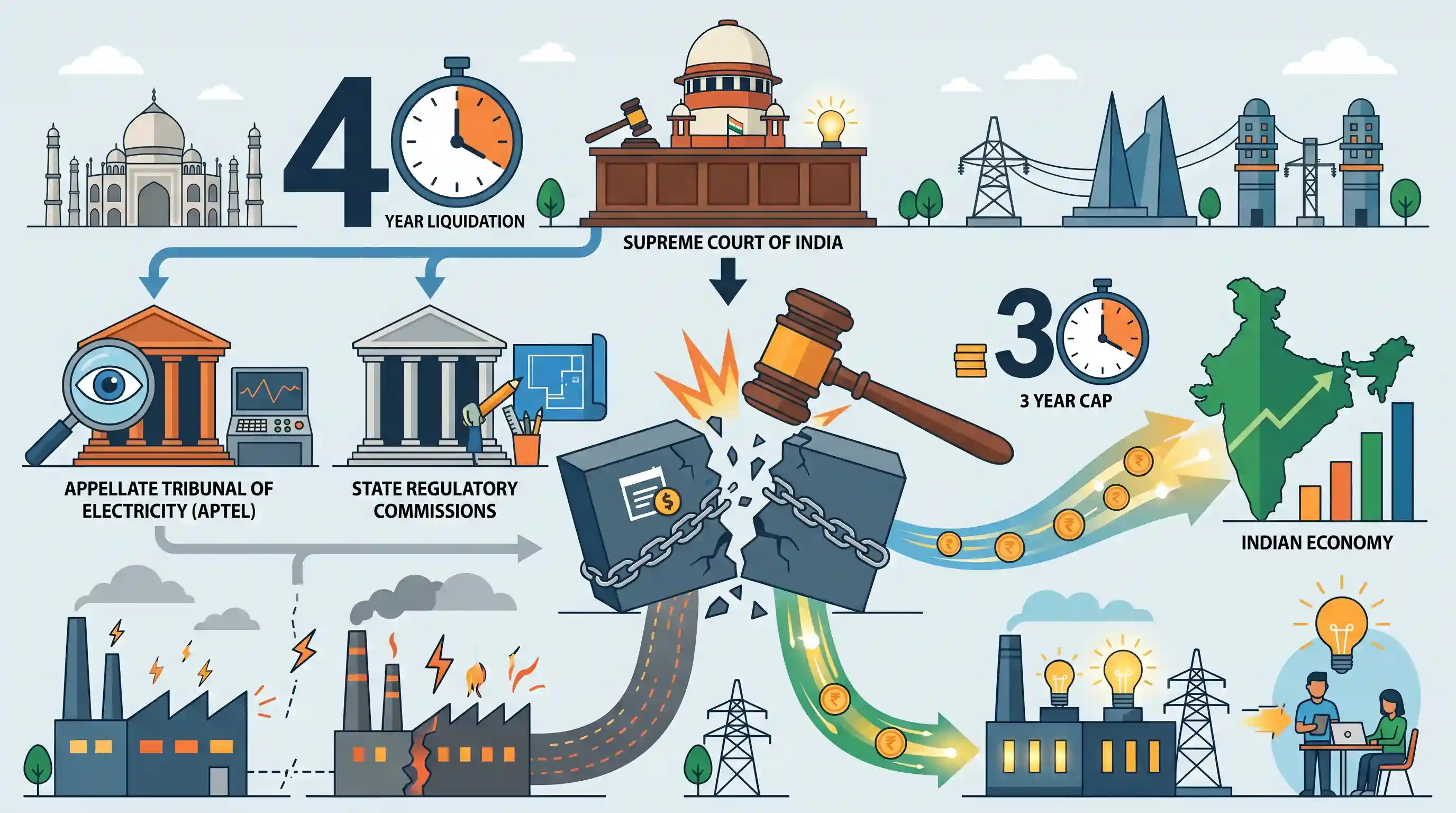
The Supreme Court of India has ordered power distribution companies (discoms) to liquidate their accumulated "regulatory assets" within four years to address the sector's financial distress. The judgment stems from a petition by Delhi discoms against the local regulatory commission. Regulatory assets—deferred costs meant to be recovered via future tariffs—have long strained discom balance sheets. To curb this, the Court set a three-year cap for liquidating any future regulatory assets. Recognizing electricity as a "public good," the Court stressed that financially viable discoms are essential for uninterrupted supply. State commissions must design clear liquidation roadmaps, and the Appellate Tribunal of Electricity (APTEL) will monitor compliance through a suo motu case.
Key Points
- The Supreme Court mandated that power distribution companies (discoms) must liquidate their long-pending 'regulatory assets' over a four-year period starting April 1, 2024.
- Future regulatory assets generated by discoms must be liquidated within a strict three-year maximum timeframe to prevent accumulation of debt.
- Regulatory assets are costs incurred by discoms that are deferred to be recovered from consumers in future electricity tariffs instead of current bills.
- The Court emphasized that electricity is a 'public good', and a continuous, quality power supply relies on the financial health and commercial viability of discoms.
- State Electricity Regulatory Commissions have been ordered to formulate clear roadmaps and trajectories for this liquidation process.
- The Appellate Tribunal of Electricity (APTEL) will register a suo motu case to actively monitor the implementation and liquidation progress across all states.
Important Terms
Regulatory Assets

The unrecovered revenue gap between the cost of supplying power and the actual tariff realized, recorded as deferred costs to avoid sudden consumer price hikes.
UPSC context
GS-3: Infrastructure (Energy) and Economy. Relates to the financial viability of power distribution and fiscal health of states.
Electricity Act, 2003
The cornerstone legislation that consolidated Indian power sector laws, unbundled state boards, deregulated generation, and established independent central and state regulatory commissions.
UPSC context
GS-3: Infrastructure. Tests understanding of the legal framework governing power reforms and the unbundling of utilities.
Appellate Tribunal for Electricity (APTEL)
A statutory body established under the Electricity Act, 2003, to hear appeals against orders from the Central and State Electricity Regulatory Commissions.
UPSC context
GS-2: Statutory, Regulatory, and Quasi-judicial bodies. Important for understanding the dispute resolution mechanism in the energy sector.
State Electricity Regulatory Commissions (SERCs)
Independent state-level authorities responsible for determining retail electricity tariffs, regulating intrastate power transmission, and ensuring service quality standards for consumers.
UPSC context
GS-2: Statutory/Regulatory bodies. Focuses on the decentralization of regulation and the independence of state-level commissions.
DISCOMs (Distribution Companies)
Distribution companies responsible for the last-mile delivery of electricity to consumers; they buy power from generators and manage the billing and collection process.
UPSC context
GS-3: Indian Economy. Key to discussions on AT&C losses, fiscal deficits, and the power sector value chain.
ACS-ARR Gap
The difference between the Average Cost of Supply (ACS) and Average Revenue Realised (ARR); a narrowing gap indicates a move toward cost recovery.
UPSC context
GS-3: Economy. A technical parameter used to measure the operational efficiency and financial sustainability of power utilities.
Prelims Trap
"Regulatory assets refer to the infrastructure and reserve funds owned by statutory bodies like the State Electricity Regulatory Commissions."
Regulatory assets are actually deferred revenue gaps (unrecovered costs) of DISCOMs to be collected via future tariffs, not physical infrastructure or funds belonging to regulatory commissions.
Static Concepts Connected
What are 'Regulatory Assets' in the power sector?
- Definition: It is the deferred revenue gap created when regulators allow DISCOMs to recover uncompensated costs in future electricity tariffs rather than through immediate hikes.
- Purpose: It acts as a buffer to prevent sudden, steep tariff shocks to consumers in a single billing cycle when power generation costs spike.
- Impact: Prolonged accumulation creates massive debt on DISCOM balance sheets, severely impairing their ability to pay power generators (GENCOs) and upgrade local infrastructure.
What is the Appellate Tribunal for Electricity (APTEL)?
- Statutory Origin: It is a statutory body established under the Electricity Act, 2003 to hear appeals against regulatory commissions.
- Dual Jurisdiction: It holds appellate jurisdiction over State/Central Electricity Regulatory Commissions (SERCs/CERC) as well as the Petroleum and Natural Gas Regulatory Board (PNGRB).
- Powers: It functions with the powers of a civil court, and its decisions can be directly appealed to the Supreme Court of India.
Cross-Topic Patterns
DISCOM debt and State Fiscal Health
Discom losses directly impact state finances. Schemes like UDAY allow states to absorb DISCOM debt, linking power sector inefficiencies directly to state fiscal deficit limits (FRBM) and macroeconomic stability.
APTEL's expanding Suo Motu role
The SC directive for APTEL to register a suo motu case shifts the tribunal from a purely appellate body to an active, pan-India monitor of state-level regulatory compliance.
Public Good vs. Commercial Viability
The Supreme Court's ruling underscores a core welfare economics principle: securing electricity as a "public good" requires ensuring the commercial viability of its providers, rather than endlessly subsidizing consumers.

APTEL's dual jurisdiction (electricity + PNGRB) and the exact definition of 'regulatory assets' are ripe for a 2026 prelims statement Q.
Linked PYQs · 1
Linked PYQs · 1
- 2016PrelimsGS1
Which one of the following is a purpose of 'UDAY', a scheme of the Government?
