Supreme Court Directive on Pennaiyar River Water Tribunal
Source:The Hindu ↗
Why It Matters
The creation of a new water dispute tribunal underscores the recurring challenges in federalism regarding resource sharing. It highlights the importance of Article 262, the Inter-State River Water Disputes Act of 1956, and the geographical knowledge of river systems (Pennaiyar and its tributaries) for both Prelims and Mains.
Summary
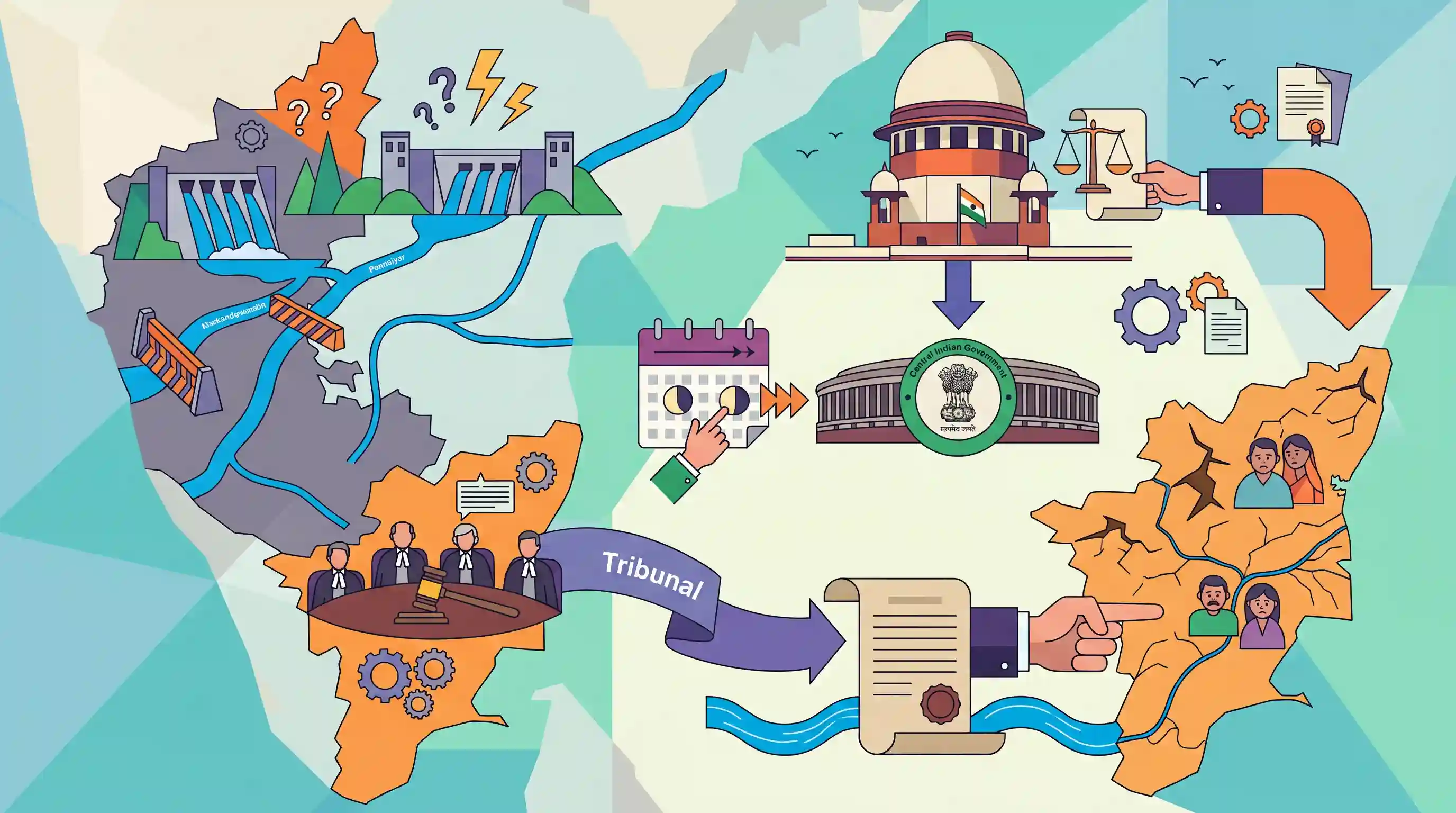
The Supreme Court has ordered the Centre to constitute a tribunal under the Inter-State River Water Disputes Act, 1956, to resolve the Pennaiyar river dispute between Tamil Nadu and Karnataka. Tamil Nadu approached the court in 2018, opposing Karnataka's construction of dams and diversion structures on the river, notably on the Markandeyanadhi tributary. Citing an 1892 agreement, Tamil Nadu argues that such constructions illegally obstruct the natural flow of water. The Centre has committed to issuing a notification for the tribunal's formation within a month.
Key Points
- The Supreme Court has directed the Union Government to establish a tribunal within a month to resolve the Pennaiyar river water dispute between Tamil Nadu and Karnataka.
- The dispute centers on Tamil Nadu's objection to Karnataka building dams and diversion structures on the river, particularly affecting its major tributary, Markandeyanadhi.
- Tamil Nadu invokes an 1892 agreement, arguing that Karnataka cannot undertake projects that block the natural water flow without its consent.
- The tribunal will be constituted under the Inter-State River Water Disputes Act, 1956, highlighting the formal constitutional mechanism for adjudicating such center-state and inter-state conflicts.
Important Terms
Inter-State River Water Disputes Act, 1956

Enacted under Article 262, this Act empowers the Central Government to establish ad-hoc tribunals for resolving disputes regarding the use, distribution, or control of inter-state river waters.
UPSC context
GS Paper II: Important for federalism and inter-state relations; tests knowledge of statutory resolution mechanisms.
Article 262 of the Indian Constitution
A constitutional provision empowering Parliament to adjudicate disputes relating to inter-state rivers and river valleys while specifically allowing for the exclusion of Supreme Court jurisdiction in such matters.
UPSC context
GS Paper II: Fundamental to Indian federalism and the constitutional framework for resource sharing between states.
1892 River Water Agreement
A pre-independence accord between the Madras Presidency and the Kingdom of Mysore regulating water rights; Tamil Nadu currently invokes it as legally binding for the Pennaiyar river basin.
UPSC context
GS Paper II: Relates to historical inter-state agreements and their contemporary legal/political enforceability in federal disputes.
Pennaiyar River
An inter-state river originating in Karnataka (Nandidurg Hills) and flowing into Tamil Nadu; it is central to the current dispute over check dam construction.
UPSC context
GS Paper I: Geography of Indian river systems; crucial for mapping and drainage system questions.
Markandeyanadhi
A major tributary of the Pennaiyar river; Karnataka’s construction of a reservoir on this stream near Yargol is the primary trigger for the current legal conflict.
UPSC context
GS Paper I & II: Tests specific geographical knowledge of river basins and associated infrastructure conflicts.
Original Jurisdiction
The Supreme Court's power to hear disputes directly between two or more states, or between the Union and states, as provided under Article 131.
UPSC context
GS Paper II: Vital for understanding the judiciary's role in the federal structure and center-state disputes.
Prelims Trap
The Supreme Court adjudicates inter-state river water disputes under its original jurisdiction (Article 131).
Under Article 262 and the 1956 Act, Parliament explicitly excludes inter-state river disputes from SC jurisdiction. The SC only directs the Centre to form a tribunal; it does not adjudicate the water share itself.
Static Concepts Connected
How does the Constitution manage inter-state river water disputes?
- Article 262: Empowers Parliament to provide for the adjudication of disputes regarding the use, distribution, or control of inter-state rivers.
- Entry 17 vs Entry 56: Water is primarily a State List subject, but it is subject to the Union List regarding the regulation and development of inter-state rivers.
- ISRWD Act 1956: Enacted under Art 262, this Act enables the Centre to establish ad-hoc tribunals and legally bars the Supreme Court from directly adjudicating the dispute.
What is the geographical profile of the Pennaiyar River?
- Origin: It rises in the Nandi Hills in the Chikkaballapura district of Karnataka.
- Drainage: It is a major east-flowing peninsular river that travels through Karnataka and Tamil Nadu before draining into the Bay of Bengal.
- Tributaries: Key tributaries include the Markandeyanadhi, Chinnar, and Vaniyar.
Cross-Topic Patterns
Colonial-era treaties in modern federal disputes
The Pennaiyar conflict heavily invokes an 1892 agreement, mirroring the Cauvery dispute (1892 and 1924 agreements). Aspirants should note how colonial-era riparian treaties continue to dictate modern peninsular water sharing.
Infrastructure vs. Downstream Riparian Rights
State-level infrastructure projects (like Karnataka's check dams on the Markandeyanadhi) frequently trigger downstream riparian rights conflicts, linking environmental infrastructure directly to Centre-State federalism.

Expect a multi-statement prelims question linking Peninsular river tributaries (Pennaiyar-Markandeyanadhi) with Article 262 provisions.
Linked PYQs · 1
Linked PYQs · 1
- 2022PrelimsGS1
Gandikota canyon of South India was created by which one of the following rivers ?
