Supreme Court Directs Free Legal Aid for Manipur Violence Victims
Source:The Hindu ↗
Why It Matters
The issue highlights practical challenges in administering justice for victims of mass systemic violence. It is crucial for UPSC as it bridges the constitutional mandate of Free Legal Aid (Article 39A/NALSA), the fundamental right to a fair trial, and the jurisdictional/investigative role of the CBI when cases are shifted inter-state.
Summary
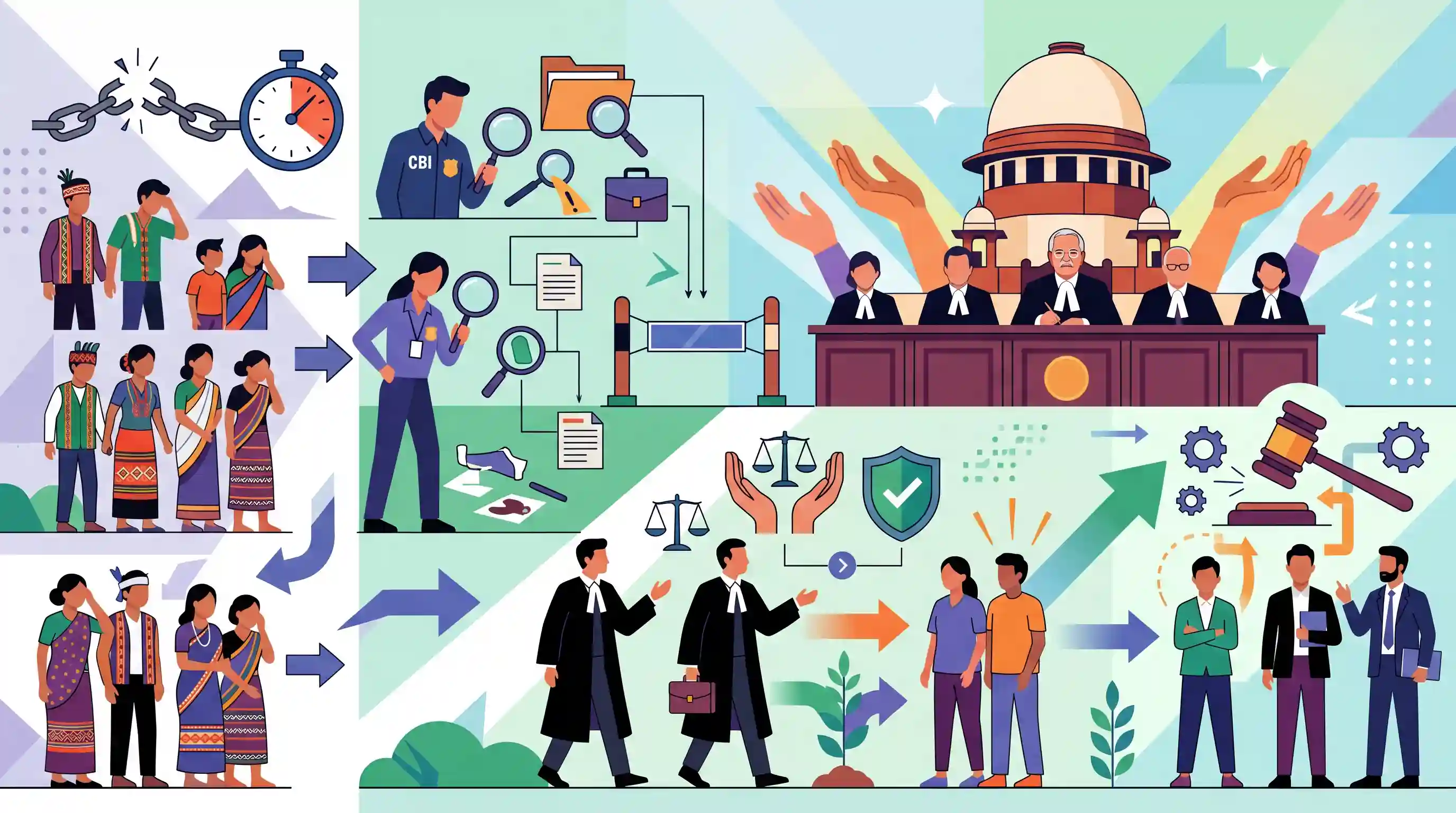
The Supreme Court of India has taken serious note of the delay by Manipur and Assam authorities in appointing legal aid lawyers for victims of the 2023 Manipur ethnic violence. With sensitive cases being investigated by the CBI and their trials shifted to Assam, the Court stressed that no victim should be left unrepresented. A Bench led by Justice Surya Kant directed swift coordination to provide necessary legal aid, reaffirming the constitutional mandate for access to justice and fair trial for vulnerable sections.
Key Points
- The Supreme Court mandated the immediate appointment of legal aid counsel for victims of the 2023 Manipur ethnic violence, strongly criticizing administrative delays by the state authorities.
- Trials for cases investigated by the CBI have been shifted to Assam, which poses geographical and financial barriers for victims seeking legal representation.
- The Court's directive emphasizes the state's constitutional obligation to provide free legal aid and ensure the right to a fair trial (under Article 21 and Article 39A).
Important Terms
Article 39A

A Directive Principle of State Policy (DPSP) requiring the State to provide free legal aid and ensure equal justice for citizens regardless of economic or other disabilities.
UPSC context
GS Paper II (Polity); tests understanding of DPSPs and constitutional mandates for social justice.
Article 21
Guarantees the right to life and personal liberty. The Supreme Court interprets this to include the right to a fair trial and free legal aid as essential procedural requirements.
UPSC context
GS Paper II (Fundamental Rights); critical for questions on judicial activism and the expansion of personal liberties.
Central Bureau of Investigation (CBI)
India's premier investigating agency that probes complex crimes, corruption, and sensitive cases (like the Manipur violence) referred by the State, Center, or Judiciary.
UPSC context
GS Paper II (Governance/Statutory Bodies); focuses on the agency's jurisdiction and its role in federal investigations.
State Legal Services Authority (SLSA)
Statutory bodies established under the Legal Services Authorities Act, 1987, to provide free and competent legal services to vulnerable sections and organize Lok Adalats.
UPSC context
GS Paper II (Social Justice/Polity); concerns the institutional framework for delivering legal aid to the poor.
Chargesheet
A final report prepared by an investigating officer after completing a probe, detailing the evidence and accusations against suspects, essential for initiating a court trial.
UPSC context
GS Paper II (Criminal Justice System); relates to fair trial rights and transparency in judicial proceedings.
Manipur Ethnic Violence
The 2023 sectarian conflict between the Meitei and Kuki-Zo communities triggered by issues of land, identity, and Scheduled Tribe status demands.
UPSC context
GS Paper III (Internal Security); vital for understanding ethnic fault lines and the role of the state in conflict management.
Prelims Trap
"Free legal aid is solely a Directive Principle (Article 39A) and is therefore non-justiciable by courts."
Free legal aid is also an enforceable Fundamental Right under Article 21 (Hussainara Khatoon) and a statutory guarantee under the Legal Services Authorities Act, 1987.
Static Concepts Connected
How is free legal aid legally guaranteed in India?
- DPSP (Constitutional): Article 39A directs the State to provide free legal aid to ensure equal justice is not denied due to economic disabilities.
- Fundamental Right: The SC elevated speedy trial and free legal aid to a fundamental right under Article 21 (Right to Life/Liberty) in Hussainara Khatoon (1979).
- LSA Act 1987: Section 12 grants specific vulnerable groups (victims of ethnic violence, women, SC/STs) an absolute statutory right to free legal services.
What are the SC's powers to transfer criminal trials inter-state?
- Statutory Power: Under Sec 406 CrPC (now Sec 446 BNSS), the Supreme Court can transfer cases from one State's court to another to serve the ends of justice.
- CBI Jurisdiction: The SC or High Courts can direct the CBI to investigate a crime anywhere in India, overriding the requirement for State government consent under the DSPE Act.
Cross-Topic Patterns
Judicial powers in internal security
The shift of Manipur trials to Assam demonstrates how extraordinary judicial mechanisms (transfer of cases) are deployed to neutralize local biases and ensure fair trials in deeply fractured conflict zones.
DPSP operationalization via Article 21
Like the Right to Education, free legal aid exemplifies a recurring UPSC theme: non-justiciable DPSPs (Art 39A) becoming enforceable Fundamental Rights (Art 21) via Supreme Court activism.

Expect a multi-statement prelims question linking the specific statutory beneficiaries of the LSA Act, 1987 with Articles 39A and 21.
Linked PYQs · 3
Linked PYQs · 3
- 2023MainsGS2
Who are entitled to receive free legal aid? Assess the role of the National Legal Services Authority (NALSA) in rendering free legal aid in India.
- 2021MainsGS2
The jurisdiction of the Central Bureau of Investigation (CBI) regarding lodging an FIR and conducting probe within a particular State is being questioned by various States. However, the power of the States to withhold consent to the CBI is not absolute. Explain with special reference to the federal character of India.
- 2017MainsGS3
The North-East region of India has been infested with insurgency for a very long time. Analyze the major reasons for the survival of armed insurgency in this region.
