Supreme Court Hierarchy of Culpability Governs Bail Jurisprudence
Source:The Hindu ↗
Why It Matters
The Supreme Court's individualized approach to bail in complex conspiracy cases sets an important precedent for protecting Article 21 rights against arbitrary and prolonged pre-trial detention, directly relevant to GS Paper 2 (Constitutional Law and Judiciary).
Summary
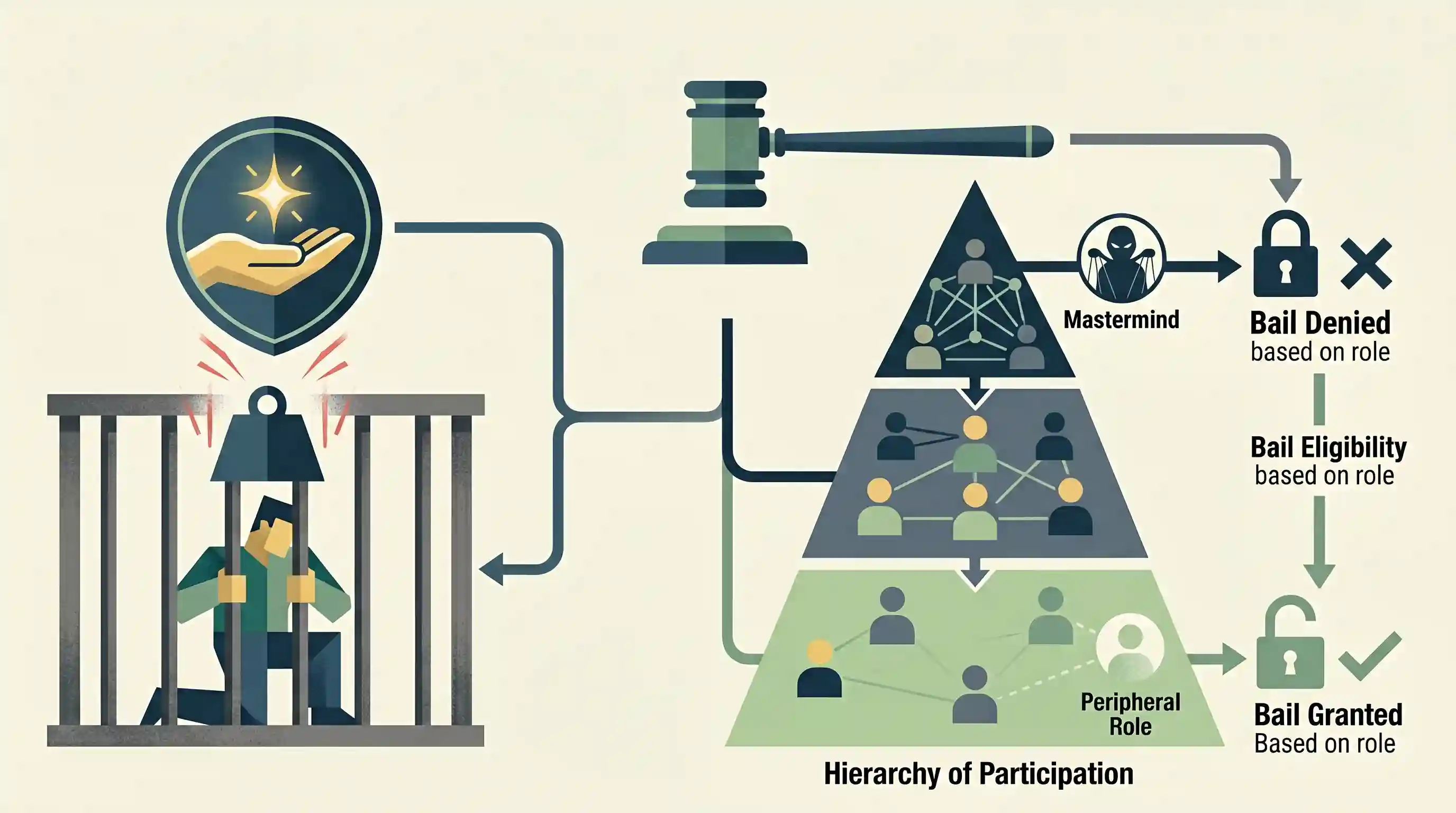
The Supreme Court has articulated a 'hierarchy of participation' to determine bail eligibility in the Delhi riots larger conspiracy case. By assessing the individual roles of the accused, the Court justified denying bail to those deemed masterminds, like Umar Khalid and Sharjeel Imam, while granting it to those with peripheral involvement. The Bench emphasized that treating all accused identically in pre-trial detention would effectively turn it into a punitive measure, violating the fundamental right to life and liberty under Article 21 of the Constitution.
Key Points
- The Supreme Court employed a 'hierarchy of participation' or culpability to distinguish between accused individuals in the Delhi riots conspiracy case for granting bail.
- Bail was denied to Umar Khalid and Sharjeel Imam (deemed 'alleged masterminds' with direct evidence against them), while others with associative or peripheral roles, like Gulfisha Fatima, were granted bail.
- The Court ruled that a homogenous approach to pre-trial detention for all accused in a conspiracy risks turning it into a punitive mechanism, thereby violating Article 21.
- An individualistic assessment of each accused's role and the evidentiary strength against them is essential to determine the necessity of their continued detention.
Important Terms
Hierarchy of Participation

A judicial metric assessing an accused's relative role (e.g., 'mastermind' vs. 'facilitator') in a conspiracy to determine bail eligibility and ensure proportionate detention.
UPSC context
GS Paper II (Judiciary). Tests understanding of individual culpability and judicial discretion in complex conspiracy trials.
Article 21
Fundamental Right guaranteeing that no person shall be deprived of life or personal liberty except by law; the primary constitutional safeguard against arbitrary detention.
UPSC context
GS Paper II (Constitution). Fundamental for questions on civil liberties, judicial review, and the "right to a speedy trial."
Section 43D(5) of UAPA
A stringent clause in the Unlawful Activities (Prevention) Act that prohibits bail if accusations are "prima facie true," significantly raising the bar for personal liberty.
UPSC context
GS Paper III (Internal Security) and GS II (Laws). Key for discussing the balance between national security and fundamental rights.
Bail Jurisprudence
The legal principles and precedents governing the grant of bail, traditionally rooted in the maxim "bail is the rule, jail is the exception."
UPSC context
GS Paper II (Judiciary). Essential for analyzing criminal justice reforms and the rights of undertrials.
Pre-trial Detention
Incarceration of an accused person before trial completion. The Supreme Court warns that prolonged detention without trial must not transform into punitive measures.
UPSC context
GS Paper II (Social Justice/Governance). Relates to prison reforms and the high percentage of undertrials in Indian jails.
Prelims Trap
Prolonged incarceration automatically entitles an accused to bail under Article 21, overriding the statutory embargo of UAPA.
The SC ruled that trial delay is not an automatic "trump card" to bypass UAPA's strict bail embargo for accused holding a central, mastermind role.
Static Concepts Connected
How does Section 43D(5) of UAPA alter standard Indian bail jurisprudence?
- Standard Rule: Normally, "bail is the rule, jail is an exception" under the CrPC/BNSS, flowing from Article 21 guarantees.
- Statutory Embargo: Section 43D(5) reverses this, mandating the denial of bail if the court finds the police chargesheet to be "prima facie true."
- Burden of Proof: The burden shifts heavily onto the accused to demonstrate from the chargesheet that the allegations are legally improbable.
Is the right to a speedy trial a Fundamental Right?
- Article 21 Implication: Yes, recognized by the SC in the Hussainara Khatoon case as an integral part of the Right to Life and Liberty.
- K.A. Najeeb Exception: In Union of India v. K.A. Najeeb, the SC held that constitutional courts can grant bail if a speedy trial is compromised, even bypassing UAPA.
Cross-Topic Patterns
Twin conditions in UAPA & PMLA bail
Both UAPA and PMLA (Section 45) impose stringent reverse-burden conditions for bail. UPSC frequently tests these statutory exceptions to Article 21 liberty under special anti-terror and economic offense laws.
Judicial innovation in criminal doctrines
Similar to the "rarest of rare" doctrine for capital punishment, the SC's new "hierarchy of participation" test creates a judicial scale to balance state security priorities with individual liberty.

Expect a multi-statement Prelims question comparing UAPA Sec 43D(5) bail embargoes with standard bail rules and Article 21 exceptions.
Linked PYQs · 3
Linked PYQs · 3
- 2023MainsGS2
“The Constitution of India is a living instrument with capabilities of enormous dynamism. It is a constitution made for a progressive society.” Illustrate with special reference to the expanding horizons of the right to life and personal liberty.
- 2024PrelimsGS1
Under which of the following Articles of the Constitution of India, has the Supreme Court of India placed the Right to Privacy ?
- 2021PrelimsGS1
'Right to Privacy' is protected under which Article of the Constitution of India?
