Supreme Court Defers Hearing on NEET-UG Re-Test Plea
Source:The Hindu ↗
Why It Matters
The recurrent issue of exam paper leaks exposes critical vulnerabilities in India's public examination infrastructure. It highlights the urgent need for institutional accountability, statutory frameworks to prevent unfair means, and the integration of advanced technologies like AI and digital encryption to restore trust in the education and evaluation system.
Summary
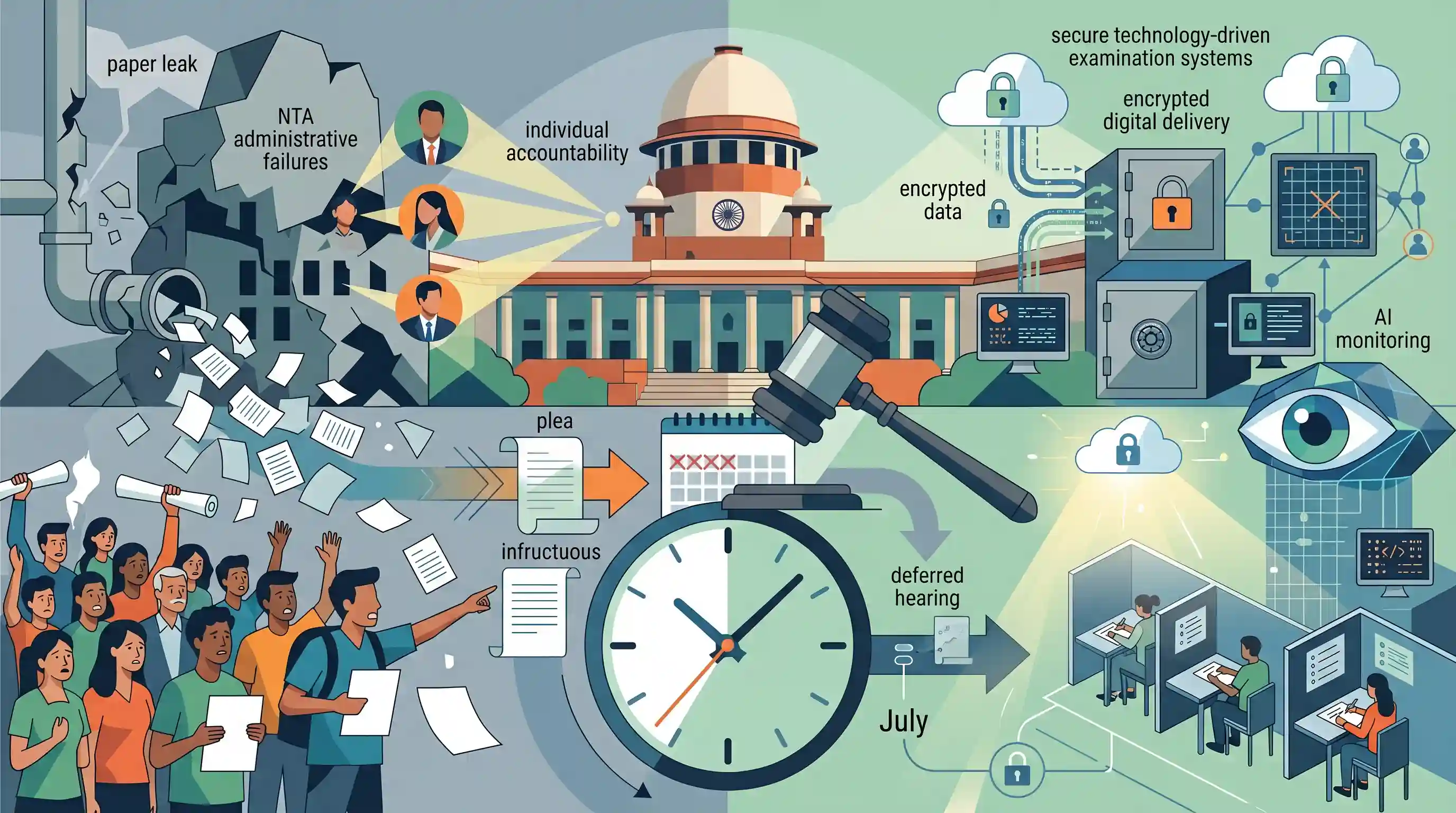
The Supreme Court has deferred the hearing of a plea challenging the National Testing Agency's (NTA) decision to conduct a nationwide re-test for NEET-UG 2026 to July. With the re-test scheduled for June 21 and the bench not sitting until July 13, the plea is likely rendered infructuous. The petitioner argues that cancelling the exam due to a paper leak unfairly punishes millions of bona fide students for the NTA's administrative failures. The plea calls for the implementation of secure, technology-driven examination systems, including AI monitoring and encrypted digital delivery. The Court had previously stressed the necessity of fixing individual accountability for such institutional lapses.
Key Points
- The Supreme Court deferred a plea challenging the NTA's decision to hold a NEET-UG 2026 re-test to July, effectively after the scheduled June 21 exam date.
- The original NEET-UG exam was cancelled on May 12 after paper leak allegations, triggering a CBI probe and a mandate for a nationwide re-test for 22 lakh candidates.
- The petitioner argued that a blanket cancellation unfairly penalizes legitimate students for the institutional and administrative failures of the NTA.
- The plea advocates for technology-driven reforms in national exams, including encrypted digital question delivery, AI-assisted monitoring, and biometric authentication.
- The Supreme Court previously emphasized the need to identify specific duty-bearers to ensure actual accountability for the lapses that led to the exam's cancellation.
Important Terms
National Testing Agency (NTA)

An autonomous, self-sustained testing organization under the Ministry of Education (registered as a society) established to conduct standardized, transparent, and international-standard entrance examinations for higher educational institutions in India.
UPSC context
GS Paper 2 (Polity & Governance); relevant for issues related to the development and management of the Education sector and institutional reforms.
Supreme Court
The highest judicial authority in India, serving as the final interpreter of the Constitution and protector of fundamental rights; it reviews administrative actions and institutional lapses through its writ and appellate jurisdictions.
UPSC context
GS Paper 2 (Polity); tests the structure and functioning of the Judiciary and its role in ensuring executive accountability.
NEET-UG
A single-window nationwide entrance examination for students seeking admission to undergraduate medical (MBBS), dental (BDS), and allied courses in government and private colleges across India, managed by the NTA.
UPSC context
GS Paper 2 (Social Justice/Education); focuses on issues in medical education and the challenge of maintaining merit and transparency in large-scale exams.
e-Governance
The application of information and communication technology (ICT)—such as AI monitoring and digital encryption—to enhance the efficiency, transparency, and security of government processes and public service delivery.
UPSC context
GS Paper 2 (Governance); specifically relates to e-governance applications, successes, and the potential of technology to curb administrative malpractices.
Institutional Accountability
The principle that public institutions must be answerable for their administrative performance and failures; it requires establishing clear responsibility for lapses in public trust, such as examination paper leaks.
UPSC context
GS Paper 2 (Polity & Governance); tests the ability to analyze transparency and ethical conduct within government agencies and statutory bodies.
Prelims Trap
"The National Testing Agency (NTA) is a statutory body constituted under the Ministry of Education."
NTA is neither a constitutional nor a statutory body. It is an autonomous testing organization registered as a Society under the Societies Registration Act, 1860.
Static Concepts Connected
What is the administrative status of the National Testing Agency (NTA)?
- Legal Status: It is registered as a Society under the Societies Registration Act, 1860. It is not created by an Act of Parliament.
- Nodal Ministry: It operates as an autonomous, self-sustained testing organization under the Ministry of Education.
What are the key features of the Public Examination (Prevention of Unfair Means) Act, 2024?
- Nature of Offense: Makes paper leaks and organized exam fraud cognizable, non-bailable, and non-compoundable offenses with up to 10 years in prison.
- Coverage: Applies specifically to centralized public examinations conducted by bodies like UPSC, SSC, RRB, IBPS, and the NTA.
Cross-Topic Patterns
E-Governance vs Administrative Failure
Highlights the syllabus intersection of administrative accountability and e-governance applications, specifically using AI monitoring and encrypted question delivery to prevent institutional leaks.
Judicial Review & Article 14/16
Connects to the 'Doctrine of Severability', where courts analyze if tainted exam candidates can be segregated to protect the fundamental rights (Articles 14 and 16) of untainted students.

Expect a 2026 Prelims multi-statement question mixing NTA's legal status (Society, not statutory) with the Public Examination Act 2024.
Linked PYQs · 1
Linked PYQs · 1
- 2024MainsGS2
What are the aims and objects of recently passed and enforced, The Public Examination (Prevention of Unfair Means) Act, 2024? Whether University/State Education Board examinations, too, are covered under the Act ?
