Supreme Court Collegium Recommends Judge for Madhya Pradesh High Court
Source:scc-online ↗
Why It Matters
Understanding the appointment procedure of High Court judges, constitutional provisions (Articles 217 and 222), and state judiciary configurations is crucial for both national and state public service commission examinations, specifically concerning the Madhya Pradesh High Court's jurisdiction and personnel.
Summary
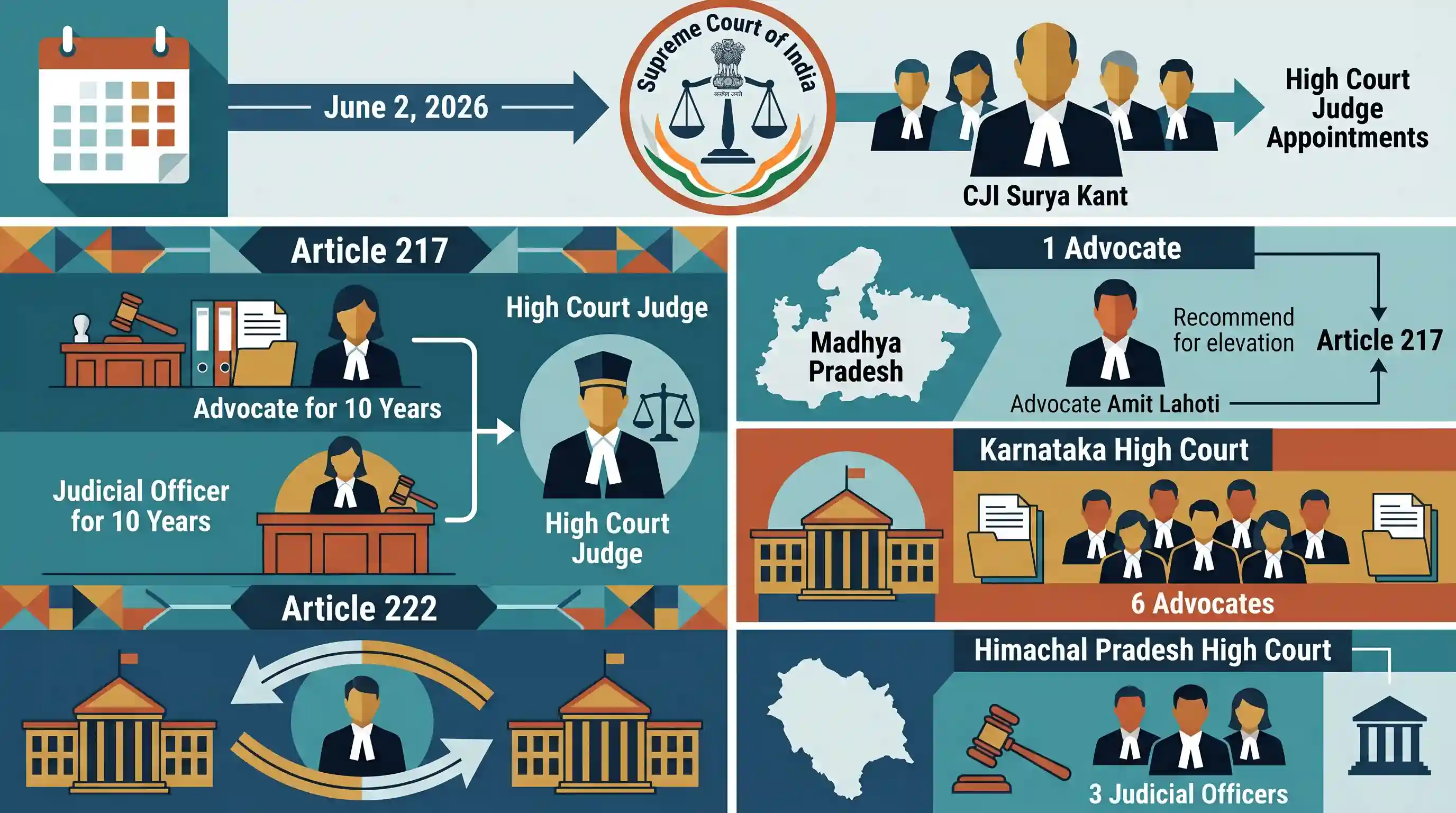
On June 2, 2026, the Supreme Court Collegium, headed by CJI Surya Kant, recommended several appointments for three High Courts. It recommended Advocate Amit Lahoti for elevation to the Madhya Pradesh High Court, six advocates for the Karnataka High Court, and three judicial officers for the Himachal Pradesh High Court. This highlights key Indian polity concepts regarding judicial appointments, the Collegium system, and state-level judiciaries.
Key Points
- On June 2, 2026, the Supreme Court Collegium, led by Chief Justice of India (CJI) Surya Kant, recommended the elevation of 7 advocates and 3 judicial officers as High Court judges.
- For the Madhya Pradesh High Court, Advocate Amit Lahoti was recommended for judgeship.
- For the Karnataka High Court, the Collegium recommended six advocates: Raghavendra Seetharam Srivatsa, Hema Kulkarni, Subramanya Rangarao, Thadagavadi Prakash Vivekananda, Bakkeswara Pramod, and Hombe Gowda Shanthi Bhushan.
- For the Himachal Pradesh High Court, three judicial officers were recommended: Chirag Bhanu Singh, Bhupesh Sharma, and Yogesh Jaswal.
- Under Article 217 of the Constitution of India, High Court judges are appointed by the President of India in consultation with the Chief Justice of India and the Governor of the state.
- The Collegium system, which evolved through the Three Judges Cases, governs the recommendation and appointment process for the higher judiciary in India.
Important Terms
Collegium System

A unique judicial mechanism in India where a committee of the senior-most judges recommends appointments, elevations, and transfers of judges to the High Courts and Supreme Court. It is not mentioned in the Constitution.
UPSC context
Important for GS Paper II (Polity & Governance) regarding the separation of powers and judicial independence.
Supreme Court Collegium
A five-member body headed by the Chief Justice of India and four senior-most judges of the Supreme Court. It makes binding recommendations for appointing Supreme Court judges and approving High Court elevations.
UPSC context
Tested in GS Paper II under Indian Polity, focusing on judicial appointments, judicial primacy, and checks and balances.
Supreme Court of India
The apex judicial body in India established under Article 124 of the Constitution. It serves as the ultimate court of appeal, the guardian of the Constitution, and protector of fundamental rights.
UPSC context
A core topic in GS Paper II (Indian Polity) testing judicial structure, jurisdictions, and powers of the apex court.
Madhya Pradesh High Court
The highest judicial authority in Madhya Pradesh, established in 1936 as the Nagpur High Court and reorganized in 1956. Its principal seat is in Jabalpur, with benches in Gwalior and Indore.
UPSC context
Relevant for state polity, federal judicial structure, and High Court jurisdiction under GS Paper II.
Karnataka High Court
The highest state-level judicial body in Karnataka, established in 1884 (formerly the Mysore High Court). It functions from Bengaluru, with permanent benches at Dharwad and Kalaburagi.
UPSC context
Relevant for state polity and state judiciary topics in GS Paper II (Indian Polity).
Himachal Pradesh High Court
The state-level judicial authority in Himachal Pradesh, established in 1971. It operates from the state capital, Shimla, with a sanctioned strength of judges and jurisdiction over state matters.
UPSC context
Part of the state judiciary syllabus under GS Paper II (Indian Polity and Governance).
Prelims Trap
High Court judges are appointed by the Governor of the state in which the High Court is located.
Under Article 217, High Court judges are appointed solely by the President of India. The Governor is only consulted and administers the oath of office under Article 219.
Static Concepts Connected
How does the Collegium composition differ for Supreme Court vs. High Court appointments?
- SC Appointments: The Supreme Court Collegium consists of the CJI and four senior-most Supreme Court judges.
- HC Appointments: The Supreme Court Collegium consists of the CJI and two senior-most Supreme Court judges.
- HC Proposal Initiation: The initial proposal is sent by the Chief Justice of the concerned High Court along with its two senior-most colleagues.
What are the eligibility criteria for High Court judges under Article 217?
- Qualifications: Must be an Indian citizen with 10 years of judicial office in India or 10 years as an advocate in a High Court.
- No Distinguished Jurist: Unlike Supreme Court appointments, there is no provision for appointing a 'distinguished jurist' to a High Court.
Cross-Topic Patterns
Collegium System vs. Basic Structure
The primacy of the judiciary in appointments, established via the Three Judges Cases, directly safeguards judicial independence as part of the Basic Structure doctrine.
Federalism and Unified Judiciary
While High Courts head state-level judiciaries, their appointment process is strictly centralized under the President and Union, reflecting India's integrated judicial character.

Expect a multi-statement question contrasting the appointment authority, collegium size, and oath administration for SC vs. HC judges.
Linked PYQs · 2
Linked PYQs · 2
- 2020MPPSC_PRELIMSGS1
Who among the following Chief Justice of Madhya Pradesh High Court has not been the Judge at Supreme Court of India?
- 2022MPPSC_PRELIMSGS1
According to which Article of the Indian Constitution, can the President of India (in consultation with the Chief Justice) transfer a Judge of a High Court from one court to another?
