Supreme Court collegium advance transfer policy for high court judges
Source:The Hindu ↗
Why It Matters
The functioning and reforms of the Supreme Court Collegium are highly relevant for GS Paper 2 (Polity and Governance). This particular development highlights ongoing internal procedural adaptations by the judiciary to improve administrative efficiency, reduce friction during leadership changes in High Courts, and ensure timely delivery of justice.
Summary
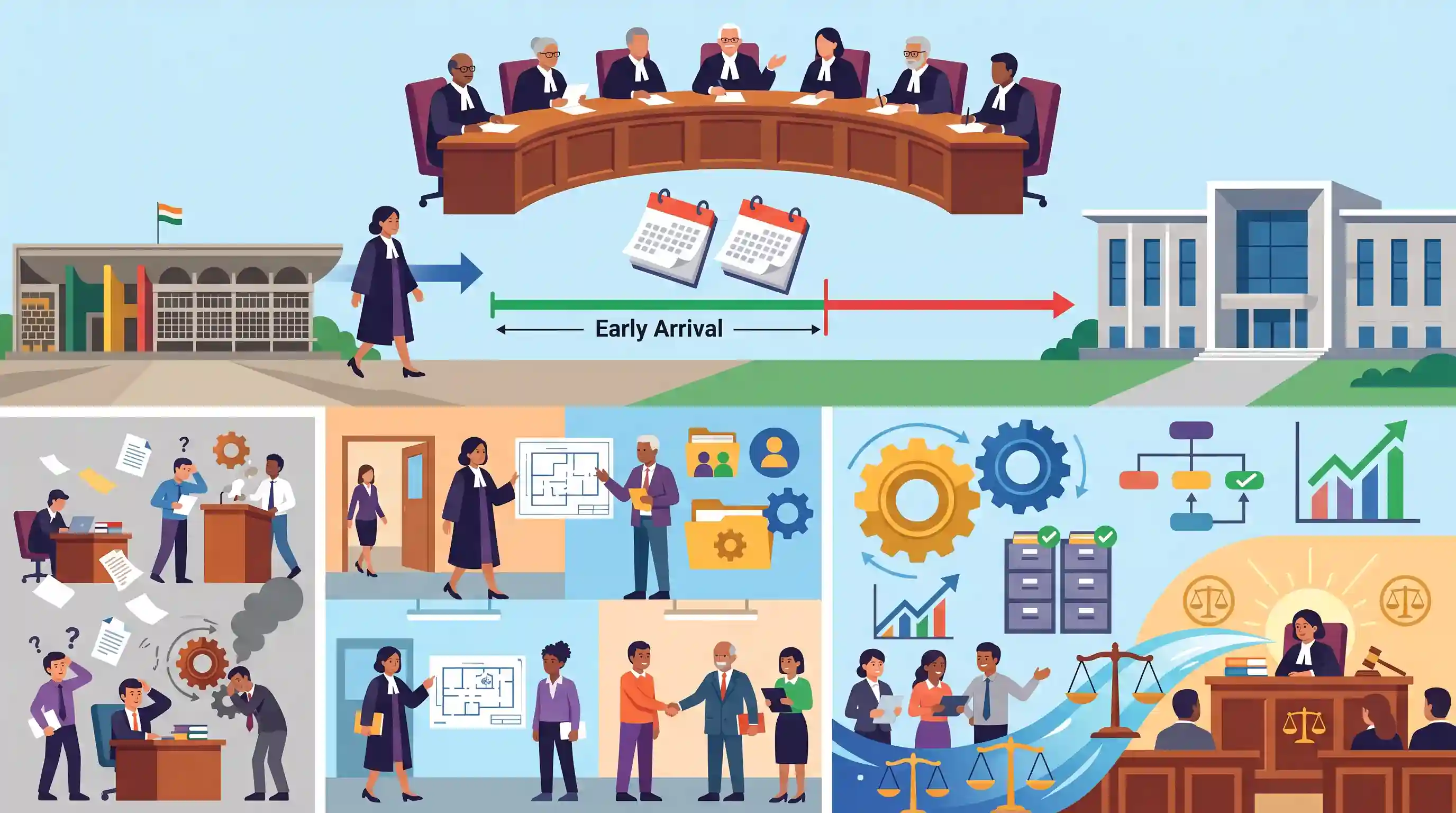
The Supreme Court Collegium has introduced a procedural reform to transfer judges designated to become Chief Justices of High Courts to their prospective courts well in advance. This proactive measure, ideally implemented two months before a vacancy arises, is designed to give incoming Chief Justices adequate time to acclimate to the court's administrative functions and local dynamics. Justice Lisa Gill's transfer from the Punjab and Haryana High Court to the Andhra Pradesh High Court is the inaugural instance of this policy, which seeks to minimize leadership transition friction and enhance the overall efficiency of justice administration.
Key Points
- The Supreme Court Collegium has decided to transfer High Court judges who are proposed to become Chief Justices to their respective new High Courts well in advance.
- The recommended timeframe is preferably two months before the anticipated vacancy of the Chief Justice position arises.
- The policy aims to allow incoming Chief Justices to familiarize themselves with the administrative affairs, local issues, and roster management of the new High Court.
- Justice Lisa Gill's transfer to the Andhra Pradesh High Court serves as the first implementation of this new proactive transfer policy.
- This reform is expected to ensure a smooth transition of leadership and improve the overall efficiency and quality of justice administration.
Important Terms
Supreme Court Collegium

A judicial system for appointing and transferring judges, consisting of the Chief Justice of India and four senior-most judges. It evolved via judicial rulings rather than specific constitutional text.
UPSC context
GS Paper II (Judiciary); critical for understanding judicial independence, the appointment process, and the 'Three Judges Cases' evolution.
Article 222
A constitutional provision empowering the President to transfer a judge from one High Court to another after consultation with the Chief Justice of India.
UPSC context
GS Paper II (Indian Constitution); relates to the administration of justice and the procedural nuances of judicial transfers.
Memorandum of Procedure (MoP)
A formal agreement and guidebook between the Judiciary and the Executive detailing the specific steps and criteria for the appointment and transfer of higher judiciary judges.
UPSC context
GS Paper II (Governance/Judiciary); central to debates on transparency, judicial reforms, and the friction between the Executive and Judiciary.
Three Judges Cases
A series of Supreme Court judgments (1981, 1993, 1998) that shifted the power of judicial appointments from the Executive to the Judiciary, establishing the Collegium system.
UPSC context
GS Paper II (Judiciary); fundamental for explaining the historical shift toward judicial primacy and 'concurrence' over 'consultation.'
Chief Justice of High Court
The highest judicial officer of a state High Court, appointed by the President under Article 217, usually following a seniority-based policy from outside the concerned state.
UPSC context
GS Paper II (Constitutional Posts); tests knowledge of state judiciary structures and the constitutional requirements for high-ranking judicial roles.
Prelims Trap
"The Collegium for transferring High Court judges consists of the Chief Justice of India and the two senior-most judges of the Supreme Court."
The transfer Collegium requires the CJI and the four senior-most SC judges (like SC appointments). Only HC appointments use the smaller CJI + 2 configuration.
Static Concepts Connected
What is the constitutional procedure for transferring a High Court judge?
- Constitutional Basis: Under Article 222, the President is empowered to transfer a judge from one High Court to another after consultation with the Chief Justice of India.
- Collegium Composition: Requires the CJI plus the 4 senior-most SC judges, along with the views of the Chief Justices of both the transferring and receiving High Courts.
- Consent & Review: Transfers are executed in the public interest, do not require the judge's consent, and are subject to strictly limited judicial review.
What does the "Master of the Roster" doctrine entail?
- Administrative Supremacy: The Chief Justice of a court holds the exclusive administrative prerogative to constitute Benches and allocate cases to sibling judges.
- Primus Inter Pares: Despite administrative control, the Chief Justice is "first among equals" (primus inter pares) and possesses identical judicial powers to any other judge on the bench.
Cross-Topic Patterns
Collegium timelines vs Executive delays
The 2-month advance transfer policy assumes rapid executive clearance, contrasting with frequent delays in the Memorandum of Procedure (MoP) implementation by the Union Law Ministry.
All-India Judicial Service (AIJS) debate
Early acclimatization of CJs to "local dynamics" highlights the regional complexities of justice delivery, a major argument often raised against implementing a centralized All-India Judicial Service (AIJS).

Expect a 2026 Prelims multi-statement question contrasting the exact Collegium compositions for HC appointments versus HC transfers.
Linked PYQs · 4
Linked PYQs · 4
- 2025MainsGS2
Discuss the evolution of collegium system in India. Critically examine the advantages and disadvantages of the system of appointment of the Judges of the Supreme Court of India and that of the USA.
- 2017MainsGS2
Critically examine the Supreme Court's judgement on 'National Judicial Appointments Commission Act, 2014' with reference to appointment of judges of higher judiciary in India.
- 2012PrelimsGS1
What is the provision to safeguard the autonomy of the Supreme Court of India? 1. While appointing the Supreme Court Judges, the President of India has to consult the Chief Justice of India. 2. The Supreme Court Judges can be removed by the Chief Justice of India only. 3. The salaries of the Judges are charged on the Consolidated Fund of India to which the legislature does not have to vote. 4. All appointments of officers and staffs of the Supreme Court of India are made by the Government only after consulting the Chief Justice of India. Which of the statements given above is/are correct?
- 2021PrelimsGS1
With reference to Indian judiciary, consider the following statements : 1. Any retired judge of the Supreme Court of India can be called back to sit and act as a Supreme Court judge by the Chief Justice of India with prior permission of the President of India. 2. A High Court in India has the power to review its own judgement as the Supreme Court does. Which of the statements given above is/are correct?
