OBC Creamy Layer Ruling Prospective Application Supreme Court
Source:The Hindu ↗
Why It Matters
This ruling is critical for understanding the judicial interpretation of affirmative action, the prospective operation of constitutional bench rulings, and administrative stability regarding service seniority and allocations in public employment.
Summary
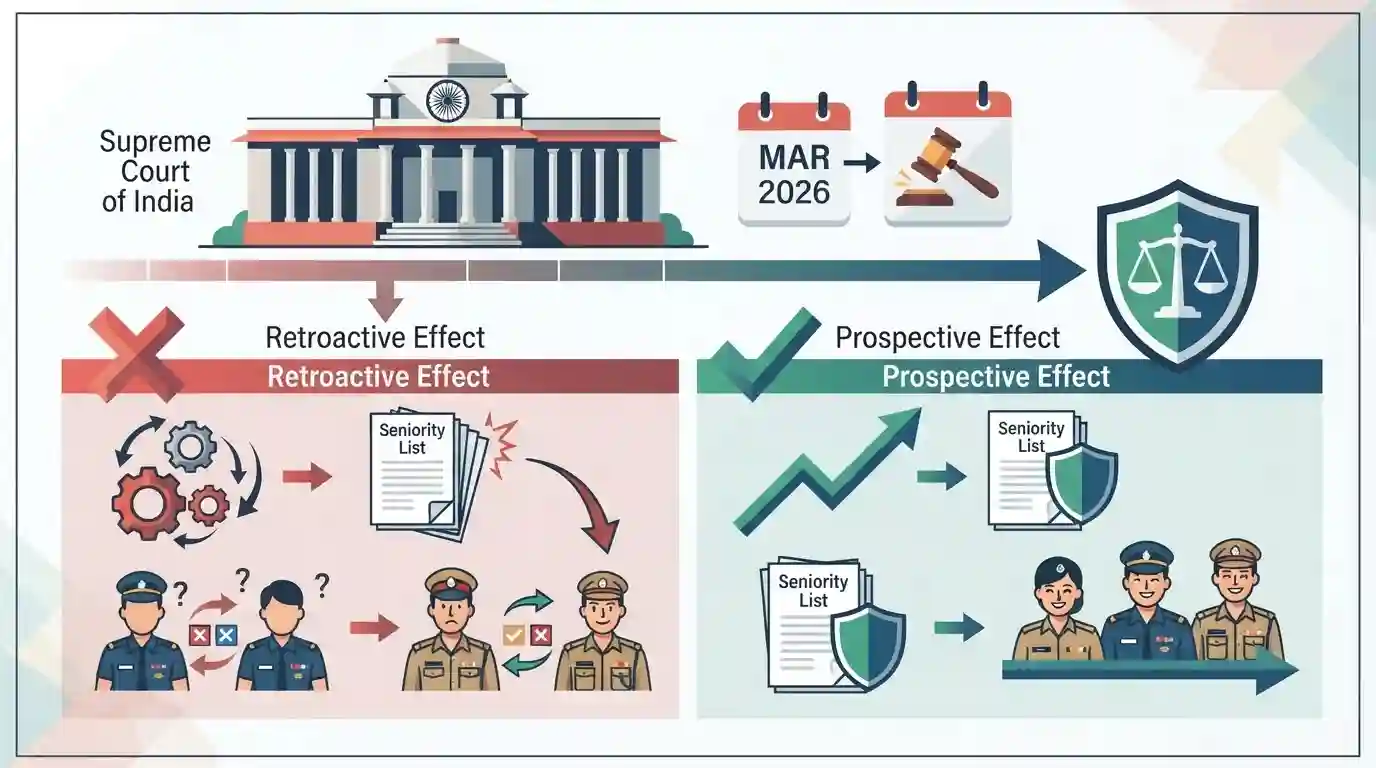
The Supreme Court of India clarified that its March 2026 ruling concerning the Other Backward Classes (OBC) creamy layer policy will operate prospectively. It ruled that the judgment does not mandate a blanket revision of prior service allocations, promotions, or seniority lists, thereby safeguarding administrative stability.
Key Points
- The Supreme Court clarified that its March 2026 verdict on the OBC creamy layer policy will not apply retrospectively.
- The Court emphasized that the judgment does not constitute a blanket revision of past service allocations, promotions, or seniority.
- The clarification protects past administrative actions and prevents widespread disruption in public employment seniority lists.
Static Concepts Connected
What is the doctrine of Prospective Overruling in Indian constitutional jurisprudence?
- Origin & Meaning: Origin in Golaknath case (1967), holding that a court decision applies only to future cases and spares past actions to avoid chaos.
- Purpose: Invoked by the Supreme Court to protect settled administrative actions, financial transactions, and vested rights from retrospective invalidation.
- Effect: Distinguished from normal retroactive effect where a declared law is deemed to have been void ab initio.
Cross-Topic Patterns
Judicial Review vs Executive Reservation Policy
The balance between judicial review of equity and executive discretion in reservation policy mirrors past debates on the 103rd Amendment and sub-categorization.

OBC creamy layer criteria, prospective overruling doctrine, and Article 16 reservation limits frequently appear in matching or statement sets.
Linked PYQs · 3
Linked PYQs · 3
- 2022MainsGS2
Discuss the role of the National Commission for Backward Classes in the wake of its transformation from a statutory body to a constitutional body.
- 2020PrelimsGS1
In India, Legal Services Authorities provide free legal services to which of the following type of citizens? 1. Person with an annual income of less than ₹ 1,00,000 2. Transgender with an annual income of less than ₹ 2,00,000 3. Member of Other Backward Classes (OBC) with an annual income of less than ₹ 3,00,000 4. All Senior Citizens Select the correct answer using the code given below:
- 2023PrelimsGS1
Consider the following organizations/bodies in India: 1. The National Commission for Backward Classes 2. The National Human Rights Commission 3. The National Law Commission 4. The National Consumer Disputes Redressal Commission How many of the above are constitutional bodies?
