Supreme Court Questions Civic Bodies Over Unauthorised Urban Buildings
Source:The Hindu ↗
Why It Matters
This development underscores the governance deficit in urban local bodies (ULBs), issues with fire safety enforcement under the National Building Code, and the judiciary's increasing role in monitoring municipal compliance to safeguard Article 21 (Right to Life) in the face of human-made urban disasters.
Summary
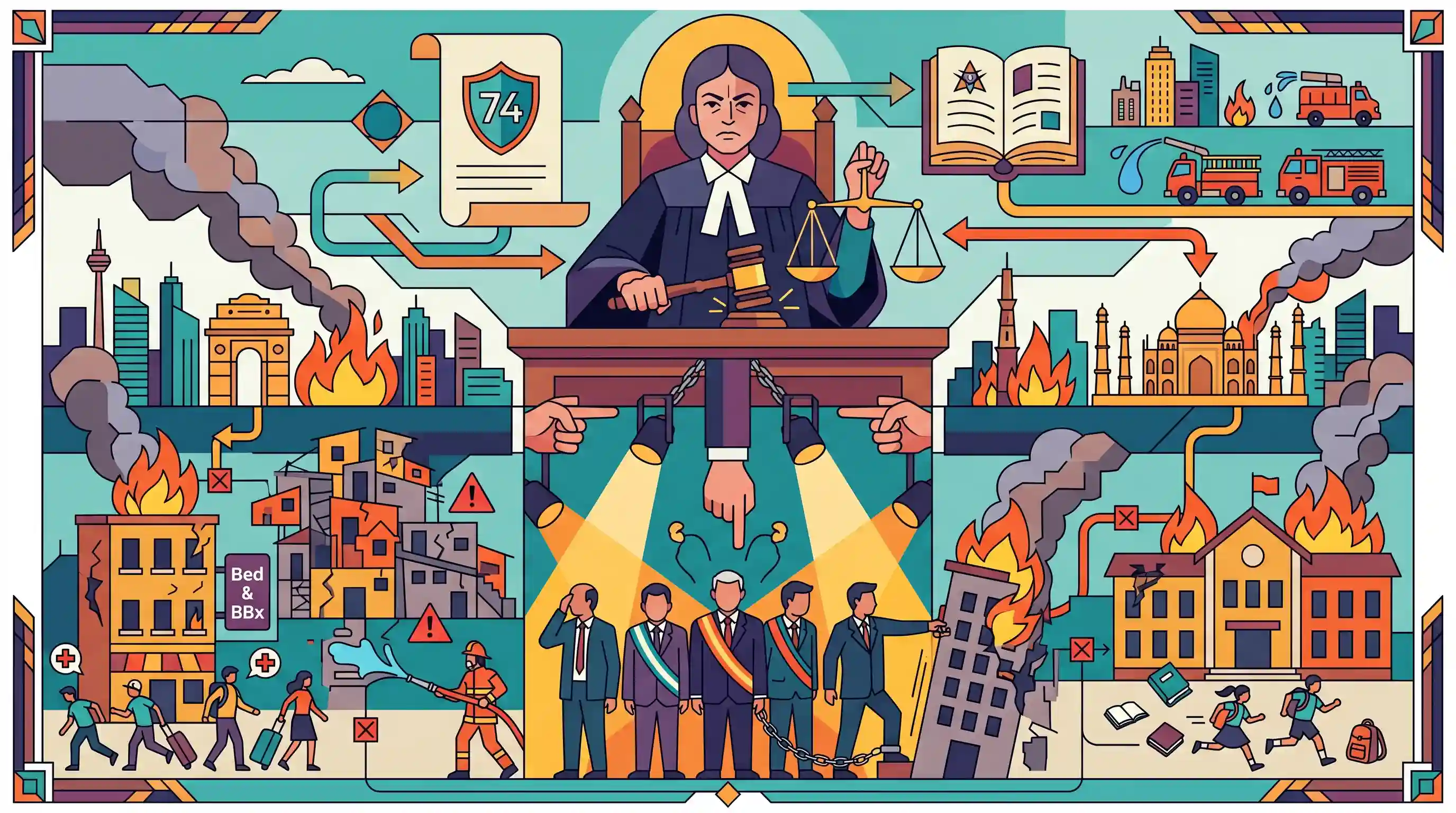
The Supreme Court has warned municipal and civic authorities of personal liability over their 'slackness' in tackling unauthorised constructions, linking illegal building clusters in Delhi, Lucknow, and Gurugram to recent fatal fire incidents. The court highlighted the complete breakdown of building safety compliance—such as a report indicating that 93% of buildings in Gurugram fail fire norms—and demanded rigorous enforcement reports, noting that non-compliance with judicial safety directives compromises citizens' right to life.
Key Points
- The Supreme Court (Bench of Justices Ahsanuddin Amanullah and R. Mahadevan) strongly reprimanded civic authorities for 'slackness' and non-compliance with court orders in regulating unauthorised constructions in Delhi, Gurugram, and Lucknow.
- The SC linked illegal/congested construction clusters directly to devastating, fatal fires: specifically, the Malviya Nagar/Hauz Rani fire in Delhi (June 3, 2026; 23 deaths) and the Aliganj fire in Lucknow (June 22, 2026; 15 deaths, mostly students).
- A significant number of victims in the Delhi fire were foreign nationals from countries like Nigeria, Mozambique, Somalia, Liberia, Bangladesh, Afghanistan, and Turkmenistan, who were residing in the 'Flourish Stay B&B' near hospitals for medical treatment.
- Amicus curiae Ajit Sinha highlighted how commercial establishments (such as bed-and-breakfasts with ground-floor restaurants) operate illegally inside narrow, multi-storey buildings within highly congested urban villages (like Hauz Rani), obstructing rescue efforts during disasters.
- The court warned that top administrative heads of municipal and development authorities would face personal liability if effective ground-level action against unauthorised constructions is not taken.
- A media report cited by the court revealed that 93% of buildings in Gurugram fail to comply with basic fire safety norms, leading the court to order the executive head of the Gurugram civic body to present an action-taken report.
Important Terms
National Building Code of India (NBC)

A comprehensive model code published by the Bureau of Indian Standards providing standardized national guidelines to regulate building construction, structural design, maintenance, and fire safety across India.
UPSC context
GS Paper 3 (Disaster Management) and GS Paper 2 (Urban Governance), testing public safety norms and municipal building bylaws.
74th Constitutional Amendment Act
A landmark 1992 legislative amendment that granted constitutional status to Urban Local Bodies in India by inserting Part IXA and the Twelfth Schedule to promote democratic decentralisation.
UPSC context
GS Paper 2 (Polity and Governance), testing municipal governance, democratic decentralisation, and devolution of urban planning powers.
Article 21 of the Constitution of India
A fundamental right in the Indian Constitution guaranteeing that no person shall be deprived of their life or personal liberty except according to procedure established by law.
UPSC context
GS Paper 2 (Polity), testing fundamental rights, judicial activism, and the constitutional expansion of human dignity and public safety.
Municipal Corporation of Delhi (MCD)
The unified primary civic body responsible for local administration, urban planning, and enforcement of building bylaws across approximately 96 percent of Delhi’s territory.
UPSC context
GS Paper 2 (Urban Governance), testing administrative restructuring of local bodies, municipal accountability, and union territory administrative dynamics.
Prelims Trap
The National Building Code (NBC) is a statutory law automatically binding on all municipal corporations in India.
The NBC is a model code prepared by the Bureau of Indian Standards (BIS) and is recommendatory. It only gains legal force if adopted by states into building bye-laws.
Static Concepts Connected
What is the constitutional and administrative framework for fire services in India?
- Twelfth Schedule: Listed under Entry 7 of the Twelfth Schedule (Article 243W), designating fire services as a legitimate municipal function.
- State Subject: Fire services fall under the State List of the Seventh Schedule, leaving states responsible for enacting regulatory legislation.
- Devolution Gap: Despite constitutional backing, actual administrative and financial devolution of fire services to urban local bodies remains highly uneven.
What is the National Building Code (NBC) of India and how does it function?
- BIS Formulation: A comprehensive national instrument formulated by the Bureau of Indian Standards (BIS) providing guidelines for regulating building construction.
- Advisory Status: It is recommendatory in nature and must be formally integrated into local building bye-laws by state governments to become legally enforceable.
- Part 4 Focus: Part 4 of the NBC specifically outlines strict safety standards, evacuation protocols, and active/passive fire protection systems.
Cross-Topic Patterns
Medical Tourism meets Urban Vulnerability
Unregulated commercial structures housing medical tourists highlight how poor local zoning and municipal failures can directly undermine India's high-value medical tourism and soft-power objectives.
Judicial Activism vs Administrative Inertia
The Court's use of Article 142 to impose personal financial liability on municipal heads shifts accountability from institutional blame to individual bureaucratic deterrence.

GS-2/GS-3 link: Devolution under the 74th Amendment vs municipal fire safety failures will likely frame 2026 urban governance questions.
Linked PYQs · 3
Linked PYQs · 3
- 2020MainsGS2
Judicial Legislation is antithetical to the doctrine of separation of powers as envisaged in the Indian Constitution. In this context justify the filing of large number of public interest petitions praying for issuing guidelines to executive authorities.
- 2024MainsGS2
Analyse the role of local bodies in providing good governance at local level and bring out the pros and cons merging the rural local bodies with the urban local bodies.
- 2020MainsGS3
Discuss the recent measures initiated in disaster management by the Government of India departing from the earlier reactive approach.
