Constitutional Challenges to Places of Worship Act
Source:Indian Express ↗
Why It Matters
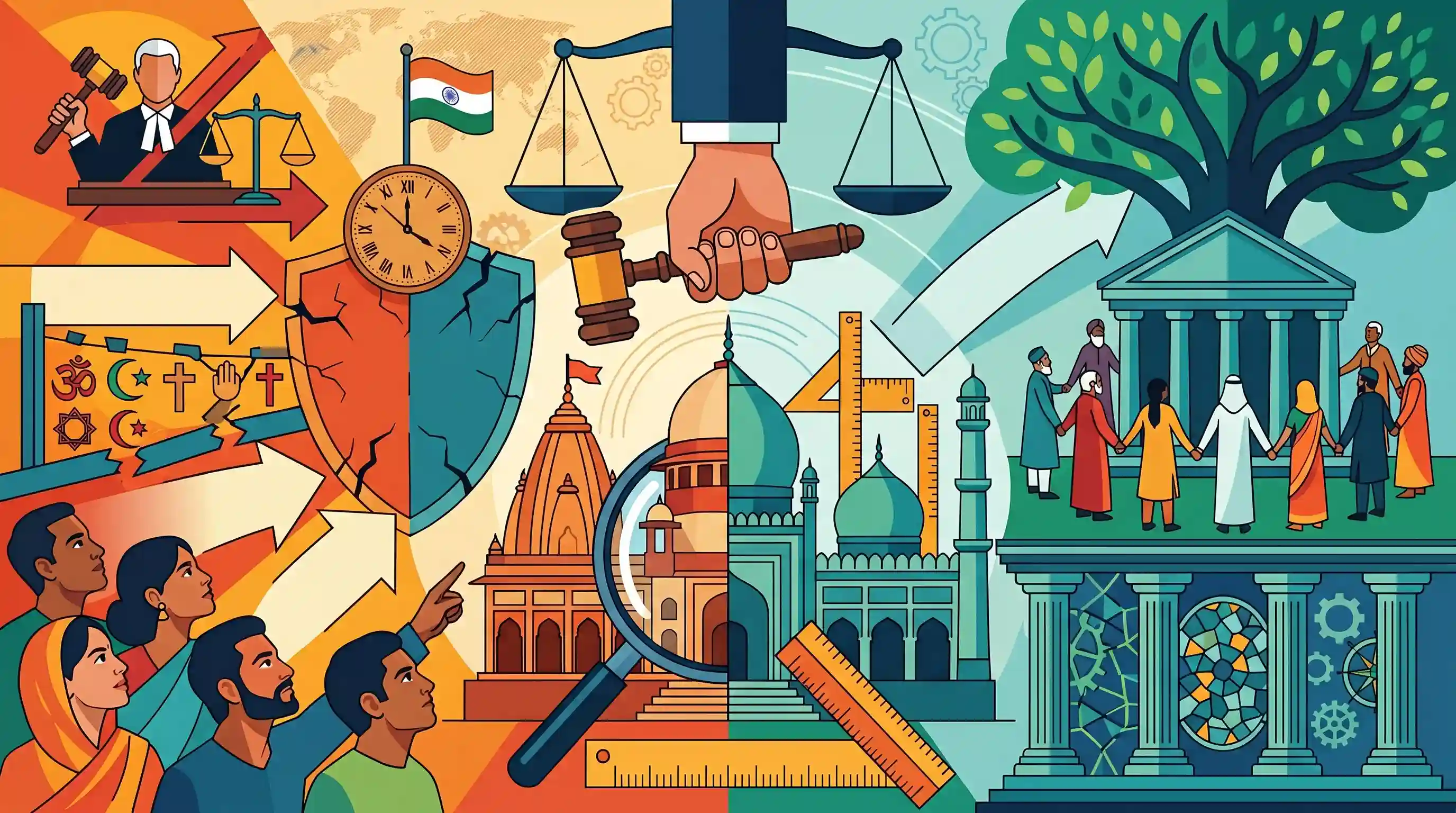
The constitutional challenges to the Places of Worship Act, 1991, and the ongoing ASI surveys will significantly impact India's secular framework, inter-faith harmony, and the application of judicial review regarding historical religious disputes.
Summary
The Supreme Court's refusal to halt the Archaeological Survey of India (ASI) survey at the Bhojshala complex in Madhya Pradesh highlights a critical juncture for the Places of Worship (Special Provisions) Act, 1991. The 1991 Act mandates that the religious character of a place of worship must remain the same as it was on August 15, 1947. However, recent legal interpretations differentiating between "converting" a religious site and merely "ascertaining its religious character" have paved the way for surveys in contentious sites like Bhojshala, Gyanvapi, and Shahi Idgah. This has intensified constitutional challenges against the 1991 Act, with petitioners arguing that it arbitrarily restricts judicial review and violates fundamental rights to religion. Conversely, proponents defend the Act as a crucial protection for India's secular fabric and constitutional basic structure. The ongoing legal battles signify a crucial test for balancing historical grievances with the preservation of communal harmony and secularism.
Key Points
- The Supreme Court declined to halt the Archaeological Survey of India (ASI) survey at the contested Bhojshala complex in Madhya Pradesh.
- The Places of Worship (Special Provisions) Act, 1991, which freezes the religious character of places of worship as they existed on August 15, 1947, is facing multiple constitutional challenges.
- Petitioners argue that the 1991 Act violates the right to religion and bars judicial review, while proponents defend it as a necessary safeguard for secularism, a basic feature of the Constitution.
- The Supreme Court's nuance that "ascertaining the religious character" of a site does not inherently violate the 1991 Act has allowed scientific surveys at sites like Bhojshala and Gyanvapi to proceed, marking a turning point in the Act's jurisprudence.
Important Terms
Places of Worship (Special Provisions) Act, 1991

A 1991 law that freezes the religious character of places of worship as of August 15, 1947, prohibiting conversion and barring most legal suits over their status.
UPSC context
GS II (Governance); tests understanding of laws preserving communal harmony and the tension between historical redressal and status quo.
Archaeological Survey of India (ASI)
A government agency under the Ministry of Culture responsible for archaeological research and the conservation and preservation of ancient monuments and historical sites.
UPSC context
GS I (Art and Culture); significant for site conservation and the use of scientific methods to determine historical religious character.
Basic Structure Doctrine
A judicial principle established in the Kesavananda Bharati case (1973) stating that Parliament cannot amend the core, essential features of the Indian Constitution.
UPSC context
GS II (Polity); crucial for evaluating if secularism—and by extension the 1991 Act—is an unalterable feature of the Constitution.
Judicial Review
The power of the judiciary to examine and invalidate legislative acts or executive orders that are found to be inconsistent with the Constitution.
UPSC context
GS II (Judiciary); relevant to arguments that the 1991 Act's bar on legal proceedings unconstitutionally restricts the power of courts.
Secularism (Indian Context)
The Indian principle of 'Sarva Dharma Sambhava,' requiring the state to maintain a principled distance from religion while giving equal respect to all faiths.
UPSC context
GS I (Social Issues) and GS II (Polity); central to the debate over whether the 1991 Act protects or violates religious equality.
Article 25 and 26
Articles guaranteeing individuals the freedom to profess, practice, and propagate religion, and religious denominations the right to manage their own religious affairs.
UPSC context
GS II (Fundamental Rights); tests the balance between individual/denominational religious freedom and legislative restrictions for public order.
Prelims Trap
The Places of Worship Act 1991 freezes the religious character of all historical religious structures in India.
This is false. Section 5 explicitly exempts ancient and historical monuments covered by the AMASR Act, 1958. It also explicitly exempted the Ram Janmabhoomi dispute.
Static Concepts Connected
What are the core provisions of the Places of Worship Act, 1991?
- Cut-off date: It mandates that the religious character of a place of worship remains exactly as it existed on August 15, 1947.
- Bar on jurisdiction: It abates pending legal proceedings and bars courts from entertaining new suits regarding the conversion of such places.
- Key exemptions: Excludes the Ram Janmabhoomi-Babri Masjid site and any ancient/historical monument governed by the AMASR Act, 1958.
Who was Raja Bhoja and what is his cultural legacy?
- Paramara Dynasty: He was a prominent 11th-century ruler of the Paramara dynasty who ruled the Malwa region in central India.
- Literary contributions: A celebrated polymath, he authored numerous Sanskrit texts on philosophy, poetry, medicine, and architecture (e.g., Samarangana Sutradhara).
- Bhojshala Complex: He established the Bhojshala in Dhar as a major center for Sanskrit studies, originally dedicated to Goddess Vagdevi (Saraswati).
Cross-Topic Patterns
Judicial Review vs. Legislative Mandates
The argument that the 1991 Act arbitrarily bars civil suits intersects with the doctrine of Judicial Review (a Basic Structure element), echoing historical debates over tribunals and the L. Chandra Kumar case.
AMASR Act and Heritage Management
The legal distinction between a functional 'place of worship' and a 'protected monument' connects fundamental rights (Article 25) with ASI's conservation mandate under the AMASR Act 1958.

Expect a multi-statement Prelims question linking the Places of Worship Act exemptions with ASI’s mandate under the AMASR Act in 2026.
Linked PYQs · 2
Linked PYQs · 2
- 2024MainsGS2
Discuss India as a secular state and compare with the secular principles of the US constitution.
- 2019MainsGS1
What are the challenges to our cultural practices in the name of secularism?
