Supreme Court Ruling on Recruitment Integrity in West Bengal
Source:Indian Express ↗
Why It Matters
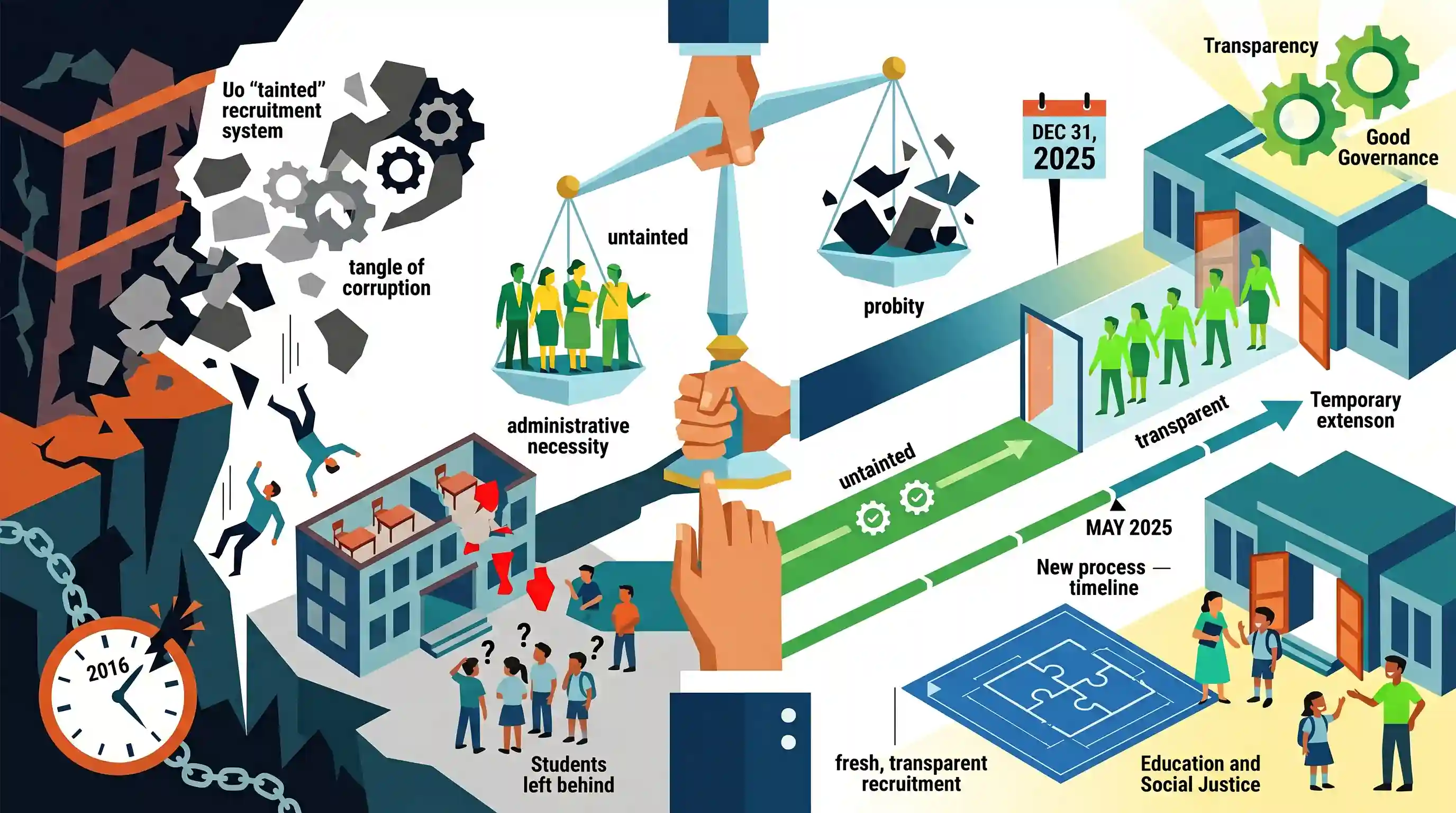
This case exemplifies the intersection of judicial review and administrative functioning. It demonstrates how constitutional courts manage the fallout of systemic corruption in public recruitment by issuing executive guidelines (judicial activism) to ensure continued public service delivery (education) without compromising long-term probity.
Summary
The Supreme Court granted an extension until December 31, 2025, for "untainted" assistant teachers (Classes 9-12) employed under West Bengal's controversial 2016 school recruitment process. Recognizing that sudden mass terminations would leave state-run schools severely understaffed and harm students' education, the Court balanced administrative necessities with the need for probity. It mandated the state government to formulate rules and advertise for fresh, transparent recruitment by May 2025, effectively intervening in the executive domain to rectify systemic corruption that had rendered previous appointments "tainted beyond resolution."
Key Points
- The Supreme Court conditionally extended the services of "untainted" assistant teachers (Classes 9-12) recruited through the WBSSC 2016 process until December 31, 2025.
- The Court directed the West Bengal government to formulate rules and publish an advertisement for fresh recruitment by May 31, 2025, completing the exams by the end of 2025.
- The extension aims to prevent severe understaffing in state-run schools, reflecting judicial balancing between ensuring probity and administrative pragmatism.
- Earlier, the SC had upheld a Calcutta High Court order invalidating over 25,000 teaching and non-teaching appointments, terming the selection process "tainted beyond resolution".
- Grade C and D employees are explicitly excluded from this service extension.
Important Terms
West Bengal School Service Commission (WBSSC)

A statutory body responsible for recruiting teaching and non-teaching staff in government-aided schools in West Bengal; currently under scrutiny for systemic irregularities in its 2016 selection process.
UPSC context
GS2: Statutory bodies; GS4: Institutional integrity and ethics in governance. Relevant for governance-related questions on recruitment bodies.
Tainted vs. Untainted Candidates
Legal classification distinguishing candidates recruited through genuine merit from those whose appointments involved fraud, such as OMR tampering or rank manipulation, in a corrupted selection process.
UPSC context
GS2: Judiciary; GS4: Ethical concerns in public employment and the principle of 'purity of process' over individual interest.
Separation of Powers
The constitutional principle that the three branches of government—Legislature, Executive, and Judiciary—operate independently to prevent the concentration of power and ensure checks and balances.
UPSC context
GS2: Basic Structure; tests the limits of judicial intervention in executive functions like recruitment and administrative policy.
Judicial Intervention
The exercise of power by the judiciary to review and sometimes direct executive or legislative actions, often justified to protect fundamental rights or address systemic administrative failures.
UPSC context
GS2: Indian Judiciary; specifically relevant to discussions on judicial activism versus overreach in administrative matters.
Probity in Governance
The quality of having strong moral principles, honesty, and decency in public administration, particularly in ensuring merit-based and transparent recruitment to maintain public trust.
UPSC context
GS4: Ethics and Integrity; a core concept for questions on corruption in public services and administrative reforms.
Systemic Fraud
Large-scale, organized malpractice that compromises the entire integrity of a recruitment or administrative process, rendering it 'vitiated' and legally unsustainable under Articles 14 and 16.
UPSC context
GS2: Governance; GS4: Ethics in public service. Tests understanding of how widespread corruption invalidates administrative actions.
Prelims Trap
"If a recruitment process is ruled unconstitutional, mandatory salary recovery applies to all appointees."
Courts often use equitable jurisdiction to waive salary recovery for "untainted" candidates who genuinely rendered services, despite the broader process being voided.
Static Concepts Connected
What are the core provisions of Article 16 regarding public employment?
- General Rule: Guarantees equality of opportunity for all citizens in matters relating to employment or appointment to any office under the State.
- Non-discrimination: Prohibits discrimination on grounds only of religion, race, caste, sex, descent, place of birth, residence, or any of them.
- Exceptions: Parliament can prescribe residence requirements (Art 16(3)), and the State can reserve posts for backward classes inadequately represented (Art 16(4)).
How does Article 142 empower the Supreme Court in complex governance disputes?
- Complete Justice: It allows the Supreme Court to pass any decree or order necessary for doing "complete justice" in any cause or matter pending before it.
- Equitable Relief: Courts use it to provide equitable relief to innocent parties (like untainted teachers) caught in the collateral damage of enforcing strict statutory rules.
- Inherent Limitations: While powerful, the Supreme Court has clarified that Article 142 cannot be used to entirely supplant or ignore substantive statutory provisions.
Cross-Topic Patterns
Judicial timelines vs Executive domain
SC dictating specific recruitment dates (May/Dec 2025) highlights the blurring line between judicial review and executive administration, frequently tested in GS2 Mains as 'judicial overreach' versus 'judicial activism'.
Utilitarianism in educational governance
Retaining 'invalidly hired' but innocent teachers to prevent school collapse illustrates utilitarian ethics (maximizing student welfare) overriding strict deontological adherence. Excellent GS4 case study material on administrative pragmatism.

Expect a GS2 Mains question on how courts balance Article 14 (equality) with Article 142 (complete justice) in systemic state failures.
Linked PYQs · 3
Linked PYQs · 3
- 2020MainsGS2
Judicial Legislation is antithetical to the doctrine of separation of powers as envisaged in the Indian Constitution. In this context justify the filing of large number of public interest petitions praying for issuing guidelines to executive authorities.
- 2019MainsGS4
What do you understand by probity in governance ? Based on your understanding of the term, suggest measures for ensuring probity in government.
- 2022MainsGS2
The Right of Children to Free and Compulsory Education Act, 2009 remains inadequate in promoting incentive-based system for children's education without generating awareness about the importance of schooling. Analyse.
