Supreme Court bans construction near Jojari river in Rajasthan
Source:the-print ↗
Why It Matters
The Luni river and its tributaries (Jojari, Bandi) form the most crucial drainage system in the arid and semi-arid regions of western Rajasthan (Rajasthan Bagar). Environmental degradation, textile dyeing pollution in Balotra/Pali, and illegal encroachments are key regional issues directly relevant to RPSC RAS Geography and Environment syllabi.
Summary
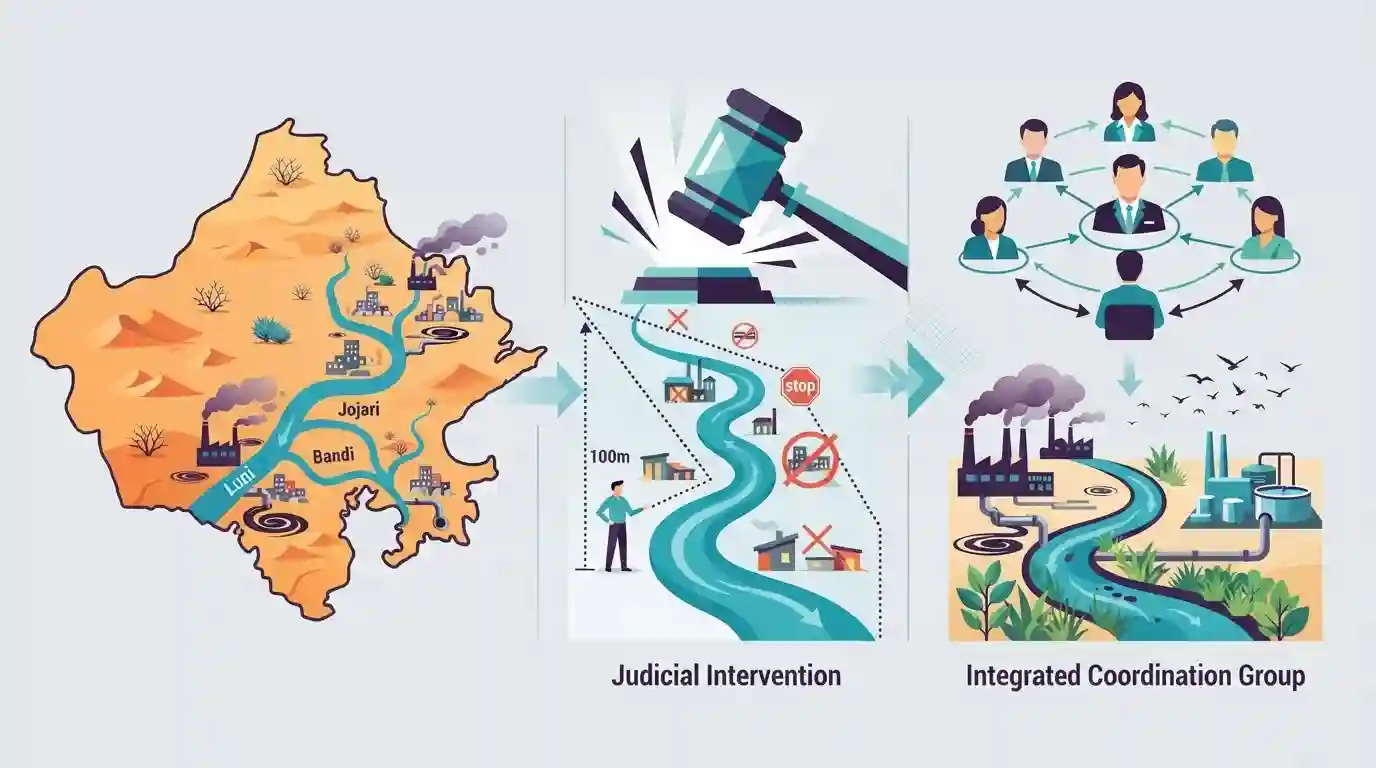
The Supreme Court has banned all construction and development activities within 100 metres of the Jojari river in Rajasthan to tackle severe contamination and encroachment. The directive, which originated from a suo motu case, was extended to include the Bandi and Luni rivers. The court also ordered the Rajasthan government to establish an Integrated Coordination Group (ICG) led by the Chief Secretary to systematically address the pollution plaguing these critical arid-region river systems.
Key Points
- The Supreme Court has imposed a blanket ban on any construction or development activity within 100 metres from the edge of the Jojari river in Rajasthan.
- The restriction also extends to the Bandi river (Pali) and Luni river (Balotra), aiming to curb severe pollution and unauthorized encroachments on riverbeds.
- The court directed the Rajasthan government to form an Integrated Coordination Group (ICG) headed by the Chief Secretary to address contamination issues across these rivers.
- The Jojari river flows through Jodhpur, while Bandi flows through Pali. Both are significant tributaries that eventually merge into the Luni river system near Balotra.
Important Terms
Jojari River

A seasonal river in Rajasthan originating in Nagaur district. It is a key right-bank tributary of the Luni River, severely polluted by untreated industrial effluents from Jodhpur's textile industries, prompting an SC construction ban.
UPSC context
Tested in RAS Pre/Mains (Rajasthan Geography & Environment). Crucial for questions on drainage systems, industrial pollution, and SC interventions.
Integrated Coordination Group
A state-level body mandated by the Supreme Court in 2026, headed by the Rajasthan Chief Secretary. It coordinates government departments to implement restoration plans for the severely polluted Jojari, Bandi, and Luni river systems.
UPSC context
Relevant for RAS Mains (Public Administration & Current Affairs) concerning state administrative bodies and judicial interventions in environmental governance.
Luni River
The largest river system in the Thar Desert, originating in the Aravalli Range and draining into the Rann of Kutch. It turns saline at Balotra and forms Rajasthan's most critical inland drainage basin.
UPSC context
Highly significant for RAS Prelims and Mains (Geography of Rajasthan), specifically focusing on physical features and inland drainage systems.
Rajasthan State Pollution Control Board
A statutory authority established in 1975 under the Water Act, 1974. It monitors industrial compliance, regulates effluent discharges, issues No Objection Certificates (NOCs), and enforces environmental conservation laws across Rajasthan.
UPSC context
Important for RAS Mains (Environment & Ecology) regarding the institutional and statutory frameworks for pollution control in the state.
Bandi River
A significant tributary of the Luni River flowing through Rajasthan's Pali district. It is heavily contaminated by local textile industry effluents, making it a central focus of the Supreme Court's recent river restoration directives.
UPSC context
Essential for RAS Geography and Environment sections, frequently tested regarding industrial water pollution and the Luni river basin.
Prelims Trap
"Like other tributaries of the Luni, the Jojari river originates in the Aravalli ranges and joins from the left."
Jojari is unique: it is the only major tributary of the Luni that joins from the right bank, and the only one that does NOT originate in the Aravalli hills (it originates in Nagaur).
Static Concepts Connected
What are the unique geographical characteristics of the Luni river system?
- Origin and Course: Originates in the Naga Hills (Pushkar, Ajmer) and flows into the Rann of Kutch, forming the primary inland drainage system of western Rajasthan.
- Water Quality: Often called 'Lavanvari'. Its water remains sweet up to Balotra (Barmer) but becomes saline downstream due to salt-rich surface soils.
- Tributary Pattern: Major left-bank tributaries include Bandi, Sukri, Jawai, and Guhiya. Jojari is the sole major right-bank tributary.
Why are the Bandi and Luni rivers severely polluted in Pali and Balotra?
- Textile Dyeing Industry: Pali (on Bandi) and Balotra (on Luni) are massive hubs for textile dyeing and block printing, which release highly alkaline and toxic chemical effluents.
- Treatment Failures: Common Effluent Treatment Plants (CETPs) in these areas are often inadequate or non-compliant, leading to untreated discharge directly into dry riverbeds.
Cross-Topic Patterns
Inland Drainage & Textile Economy
Environmental pollution in western Rajasthan’s inland drainage is directly tied to the economic geography of Pali and Balotra, which are major hubs for the textile dyeing and printing industries.
Judicial Activism in Environmental Governance
The Supreme Court mandating an Integrated Coordination Group under the Chief Secretary underscores a continuing trend of judicial intervention compensating for enforcement failures by the Rajasthan State Pollution Control Board.

Expect a multi-statement question combining Luni’s right/left tributaries, their origins (Jojari vs Aravallis), and Balotra's pollution.
Linked PYQs · 2
Linked PYQs · 2
- 2024RPSC_PRELIMSGS1
Which of the following is correct regarding Rajasthan Bharatpur – Rajasthan Berger? A. Luni Basin and Southwest Rajasthan Border are part of Rajasthan Berger. B. Ghagghar Plain covers mainly the North Rajasthan. C. Rajasthan Plain does have salty lakes and inland drainage. D. Bhilwara district is a part of all the above things of Rajasthan. Select the correct answer using the codes given below:
- 2025RPSC_PRELIMSGS1
Consider the following statements: A. Luni Basin and Shekhawati region are sub-regions of Bhangar in Rajasthan. B. The Ghaggar plain is mostly spread in Hanumangarh and Ganganagar districts. C. Nagaur Uplands have saline lakes and internal drainage. D. The Aravalli ranges are rich in all types of minerals. Select the correct answer from the code given below: Code:
