Aravalli Conservation Committee Rajasthan Visit And Ecological Impact
Source:new-indian-express ↗
Why It Matters
The Aravalli Range is a core component of Rajasthan's geography. Any changes in its physical definition or conservation status carry profound ecological and legal implications, heavily impacting issues like desertification, wildlife conservation (e.g., Sariska), and climate. RPSC frequently targets questions around the Aravallis, making this Supreme Court intervention highly relevant for Prelims.
Summary
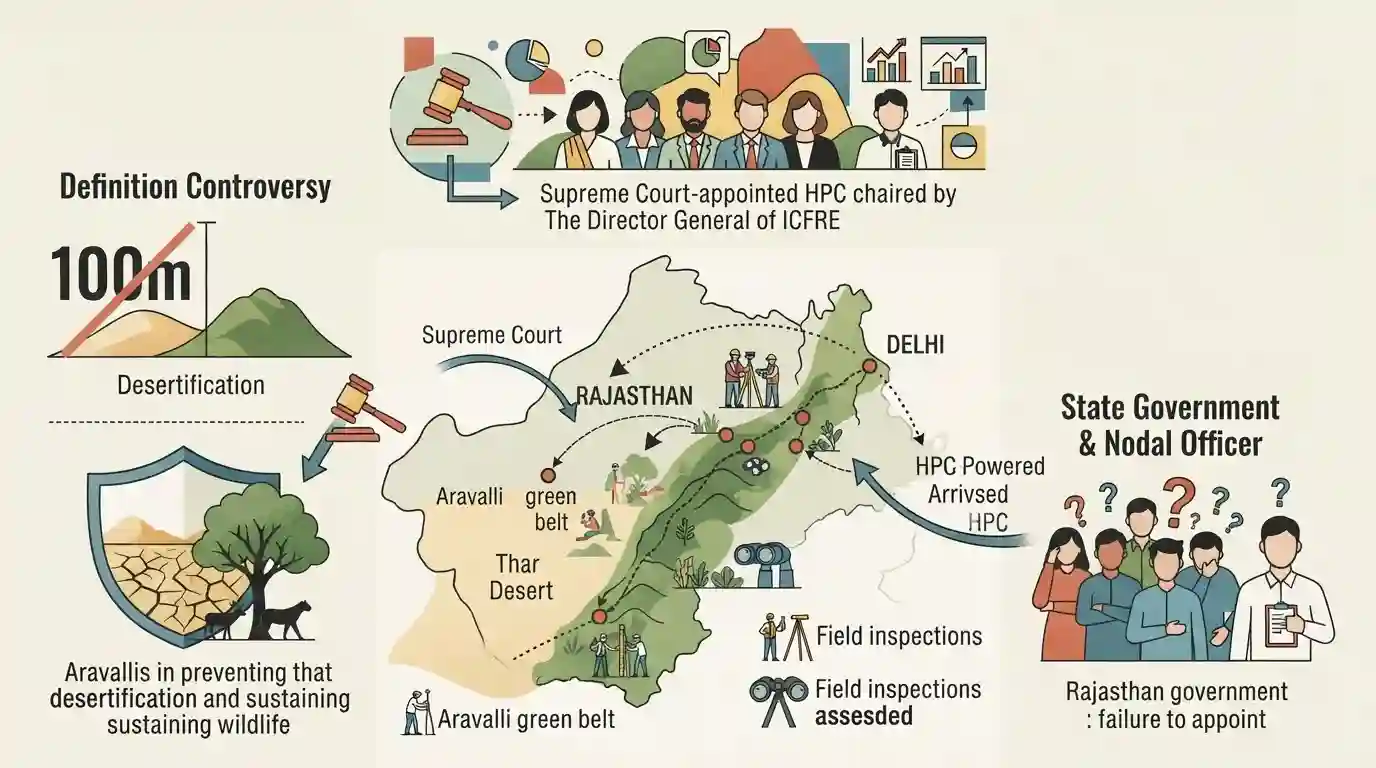
A High-Powered Committee (HPC) appointed by the Supreme Court to assess the definition, conservation, and ecological integrity of the Aravalli mountain range is scheduled to visit Rajasthan, Haryana, and Delhi. The committee, chaired by the Director General of the Indian Council of Forestry Research and Education (ICFRE), will inspect 11 locations in Rajasthan. The state government has faced criticism for failing to promptly appoint a nodal officer. The HPC's formation follows a controversial November 2025 definition that strictly classified only hills rising 100 meters above surrounding terrain as Aravallis, a move that the Supreme Court later stayed due to the range's critical role in preventing desertification and sustaining wildlife.
Key Points
- A Supreme Court-appointed High-Powered Committee, led by the Director General of ICFRE, will visit Rajasthan starting August 7 to study the Aravalli range's conservation and ecological integrity.
- The committee will inspect 11 critical regions across Rajasthan, including Sariska, Jaipur, Ajmer, Udaipur, and Mount Abu.
- The Rajasthan government, headed by Chief Minister Bhajanlal Sharma, has drawn criticism for delaying the appointment of a nodal officer to facilitate the committee's visit.
- The Aravalli range acts as an essential geographical barrier preventing the expansion of the Thar Desert and plays a key role in the region's rainfall, water availability, and wildlife.
- The committee was formed after the Supreme Court stayed a controversial late-2025 definition that restricted the 'Aravalli' classification only to landforms rising at least 100 meters above the surrounding terrain.
Important Terms
Supreme Court of India

The apex judicial body in India. It frequently intervenes to protect fragile ecosystems, recently staying a controversial physical definition of the Aravalli Range to prevent unregulated mining and regional desertification.
UPSC context
GS Paper 2 & 3. Highlights judicial activism and environmental jurisprudence in balancing regional development and ecology.
Indian Council of Forestry Research and Education (ICFRE)
An autonomous apex organization under the Ministry of Environment, Forest and Climate Change, headquartered in Dehradun. It directs nationwide forestry research, education, and extension services.
UPSC context
GS Paper 3. Tests knowledge of environmental institutions. Its Director General currently chairs the SC-appointed Aravalli review committee.
Rajasthan Government
The state executive authority. It recently faced criticism for delaying the appointment of a nodal officer to assist the SC-appointed High-Powered Committee in assessing the Aravalli range's conservation status.
UPSC context
GS Paper 2. Illustrates center-state-judiciary coordination challenges in implementing national environmental directives and sustainable governance.
Aravalli Mountain Range
One of the world's oldest fold mountain systems running through northwestern India. It acts as a critical ecological barrier preventing the eastward expansion of the Thar Desert into fertile plains.
UPSC context
GS Paper 1 & 3. Vital for understanding regional climate regulation, groundwater recharge, and impacts of mining.
100-Metre Rule
A controversial November 2025 definition, currently stayed by the Supreme Court, classifying only landforms rising at least 100 meters above surrounding terrain as protected Aravalli hills.
UPSC context
GS Paper 3 (Environment). A key case study on defining ecological zones and balancing mining interests with habitat protection.
Prelims Trap
"The Supreme Court has mandated that only hills rising at least 100 meters above surrounding terrain are classified as the Aravallis."
This 100-meter definition was a controversial 2025 state-level proposal that the Supreme Court actively stayed, not mandated, to protect the region's ecological integrity.
Static Concepts Connected
What is the geographical and ecological significance of the Aravalli Range?
- Geological age: It is one of the world's oldest fold mountain systems (relict mountains), originating in the Proterozoic Era.
- Climatic barrier: Acts as a crucial physical barrier preventing the eastward expansion of the Thar Desert into the fertile Indo-Gangetic plains.
- Water divide: Separates the Ganga and Indus drainage systems, acting as a primary source for regional rivers like the Luni, Banas, and Sahibi.
What is the Indian Council of Forestry Research and Education (ICFRE)?
- Autonomous body: It is an apex autonomous organization functioning under the Ministry of Environment, Forest and Climate Change (MoEFCC).
- Headquarters & mandate: Headquartered in Dehradun, it oversees forestry research, technologies, and advises the government on forest conservation strategies.
Cross-Topic Patterns
Aravalli Green Wall & UNCCD commitments
Relates to India's commitment under UNCCD to combat desertification, notably the 'Aravalli Green Wall Project' aiming to create a 5km buffer to arrest the Thar Desert's expansion.
Environmental Jurisprudence & Judicial Activism
Connects to the broader theme of SC's judicial activism in environmental protection, mirroring the landmark T.N. Godavarman case where the judiciary intervened to establish the definition of 'forests'.

Expect a 2026 Prelims question mixing Aravalli's geological age (relict fold), its role as a water divide, and recent SC interventions.
Linked PYQs · 2
Linked PYQs · 2
- 2025RPSC_PRELIMSGS1
Consider the following statements: A. Luni Basin and Shekhawati region are sub-regions of Bhangar in Rajasthan. B. The Ghaggar plain is mostly spread in Hanumangarh and Ganganagar districts. C. Nagaur Uplands have saline lakes and internal drainage. D. The Aravalli ranges are rich in all types of minerals. Select the correct answer from the code given below: Code:
- 2023RPSC_PRELIMSGS1
According to the India State Forest Report 2021, the forest area, in terms of forest cover, is 16,654 sq km, which is ___ percent of Rajasthan's geographical area.
