Supreme Court Examines Plea for Disability Sensitive Insurance
Source:The Hindu ↗
Why It Matters
Understanding the intersection of insurance/financial security and disability rights is crucial for GS2. It illustrates the role of the judiciary (PILs) in expanding the scope of Articles 14 and 21 to ensure practical inclusion and humane treatment of vulnerable sections by public institutions like LIC.
Summary
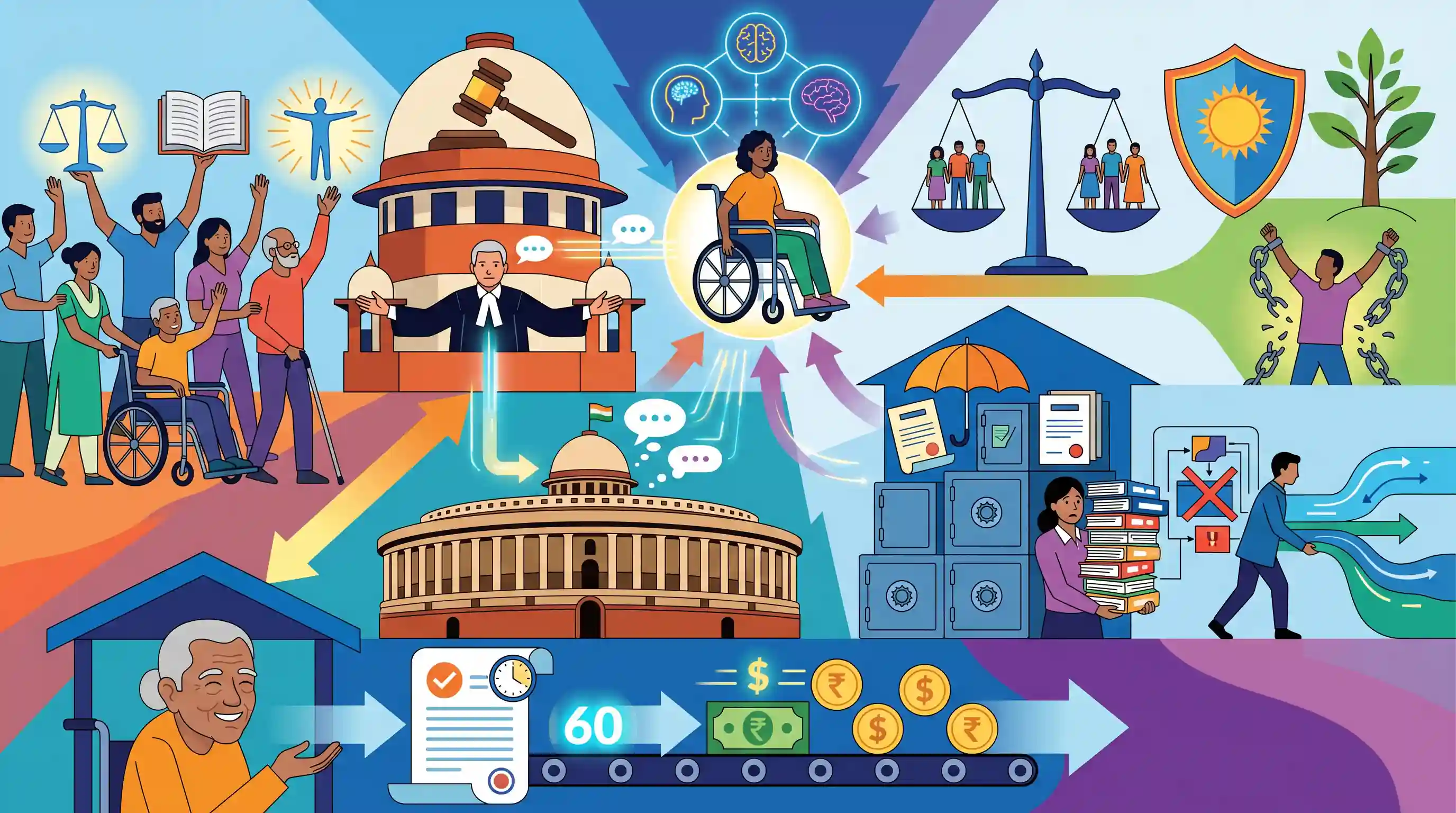
The Supreme Court has sought responses from the Centre and the Life Insurance Corporation of India (LIC) regarding a plea to establish disability-sensitive guidelines for welfare insurance schemes. Focusing on LIC's 'Jeevan Aadhar' policy, the petition advocates for case-by-case, humane claims processing for individuals with intellectual and mental disabilities. The plea emphasizes that current implementations must conform to fundamental rights guarantees under Articles 14 (equality) and 21 (right to life and liberty), and requests automatic annuity payouts once policyholders turn 60.
Key Points
- The Supreme Court has agreed to hear a petition demanding disability-sensitive guidelines for welfare insurance schemes to ensure compliance with Articles 14 and 21 of the Constitution.
- The plea specifically targets the LIC's 'Jeevan Aadhar' policy, which provides life insurance coverage for handicapped dependants under Section 80DDA of the Income Tax Act.
- The petition urges that claims involving beneficiaries with intellectual, mental, or congenital disabilities be adjudicated on a case-by-case, humane, and reasoned basis rather than mechanically.
- The plea also seeks an automatic commencement of the annuity under the 'Jeevan Aadhar' policy when the policyholder attains 60 years of age.
Important Terms
Article 14 of the Constitution

A constitutional provision guaranteeing equality before the law and equal protection of laws within India, preventing arbitrary state action and ensuring fair treatment for all individuals.
UPSC context
GS Paper II (Polity). Key for analyzing the non-discriminatory implementation of welfare schemes and fundamental rights.
Article 21 of the Constitution
Protects the right to life and personal liberty. The judiciary interprets this to include the 'right to live with dignity,' encompassing social and financial security.
UPSC context
GS Paper II (Polity). Crucial for evaluating the state's obligation to provide life-sustaining support to vulnerable populations.
Jeevan Aadhar policy
A specialized LIC insurance plan for parents or guardians of persons with disabilities, providing a mix of lump sum and annuity benefits to the dependent.
UPSC context
GS Paper II (Social Justice). Relates to welfare schemes for vulnerable sections and financial inclusion for the disabled.
Section 80DDA (Income Tax Act)
A provision in the Income Tax Act, 1961, allowing tax deductions for premiums paid toward insurance schemes designed for the maintenance of a handicapped dependent.
UPSC context
GS Paper III (Economy) and GS II. Examines fiscal incentives for social security and disability welfare.
Life Insurance Corporation of India (LIC)
India’s premier state-owned statutory insurance body, established in 1956, responsible for mobilizing savings and providing social security through various life insurance products.
UPSC context
GS Paper II (Statutory Bodies). Tests the role of public sector enterprises in achieving social welfare goals.
Public Interest Litigation (PIL)
Legal action initiated in a court to protect the interests of the public or marginalized groups, often used to seek judicial intervention for social justice.
UPSC context
GS Paper II (Judiciary). Fundamental for understanding judicial activism and the Supreme Court's role in policy oversight.
Prelims Trap
Tax deductions under Section 80DD are claimed directly by the Person with Disability for their own medical expenses.
Under Section 80DD, the tax deduction is granted to the caregiver (resident individual or HUF) for expenses or insurance premiums paid for a disabled dependent, not the disabled person.
Static Concepts Connected
What are the key shifts introduced by the RPwD Act, 2016?
- Rights-based model: Shifts from a charity-based medical model to an empowering rights-based framework, aligning India with the UN Convention on the Rights of Persons with Disabilities (UNCRPD).
- Expanded categories: Increases the number of recognized disabilities from 7 (under the 1995 Act) to 21, including mental illnesses, autism spectrum, and blood disorders.
- Enhanced reservation: Increases the reservation quota for PwDs from 3% to 4% in government jobs and from 3% to 5% in higher educational institutions.
What is the 'Doctrine of Reasonable Accommodation' in Indian Constitutional law?
- Substantive equality: Interpreted under Article 14, it requires the state and institutions to make necessary adjustments to ensure PwDs can effectively and equally exercise their rights.
- Discrimination per se: The Supreme Court has firmly ruled that the failure or refusal to provide reasonable accommodation to a person with disabilities amounts to discrimination per se.
Cross-Topic Patterns
Financial inclusion as Fundamental Right
Welfare schemes by PSUs like LIC are increasingly facing judicial scrutiny under Articles 14 and 21, blurring the line between commercial insurance contracts and enforceable social justice mandates.
Taxation as a care-economy tool
Provisions like Section 80DD demonstrate the intersection of fiscal policy and social welfare, using tax incentives to sustain and encourage family-based care ecosystems for vulnerable populations.

Judicial interpretations of 'reasonable accommodation' under Article 14 and the RPwD Act are highly probable for a 2026 Polity MCQ.
Linked PYQs · 3
Linked PYQs · 3
- 2017MainsGS2
Does the Rights of Persons with Disabilities Act, 2016 ensure effective mechanism for empowerment and inclusion of the intended beneficiaries in the society? Discuss.
- 2023MainsGS2
“Development and welfare schemes for the vulnerable, by its nature, are discriminatory in approach.” Do you agree? Give reasons for your answer.
- 2023MainsGS2
“The Constitution of India is a living instrument with capabilities of enormous dynamism. It is a constitution made for a progressive society.” Illustrate with special reference to the expanding horizons of the right to life and personal liberty.
