Supreme Court Examines Criminal Case Withdrawal Against Lawmakers
Source:The Hindu ↗
Why It Matters
This issue highlights the crucial judicial safeguard against the arbitrary withdrawal of criminal cases against politicians by state governments. It underscores the ongoing efforts by the Supreme Court to fast-track cases against lawmakers and ensure executive accountability, making it highly relevant for GS2 topics on governance, polity, and the criminal justice system.
Summary
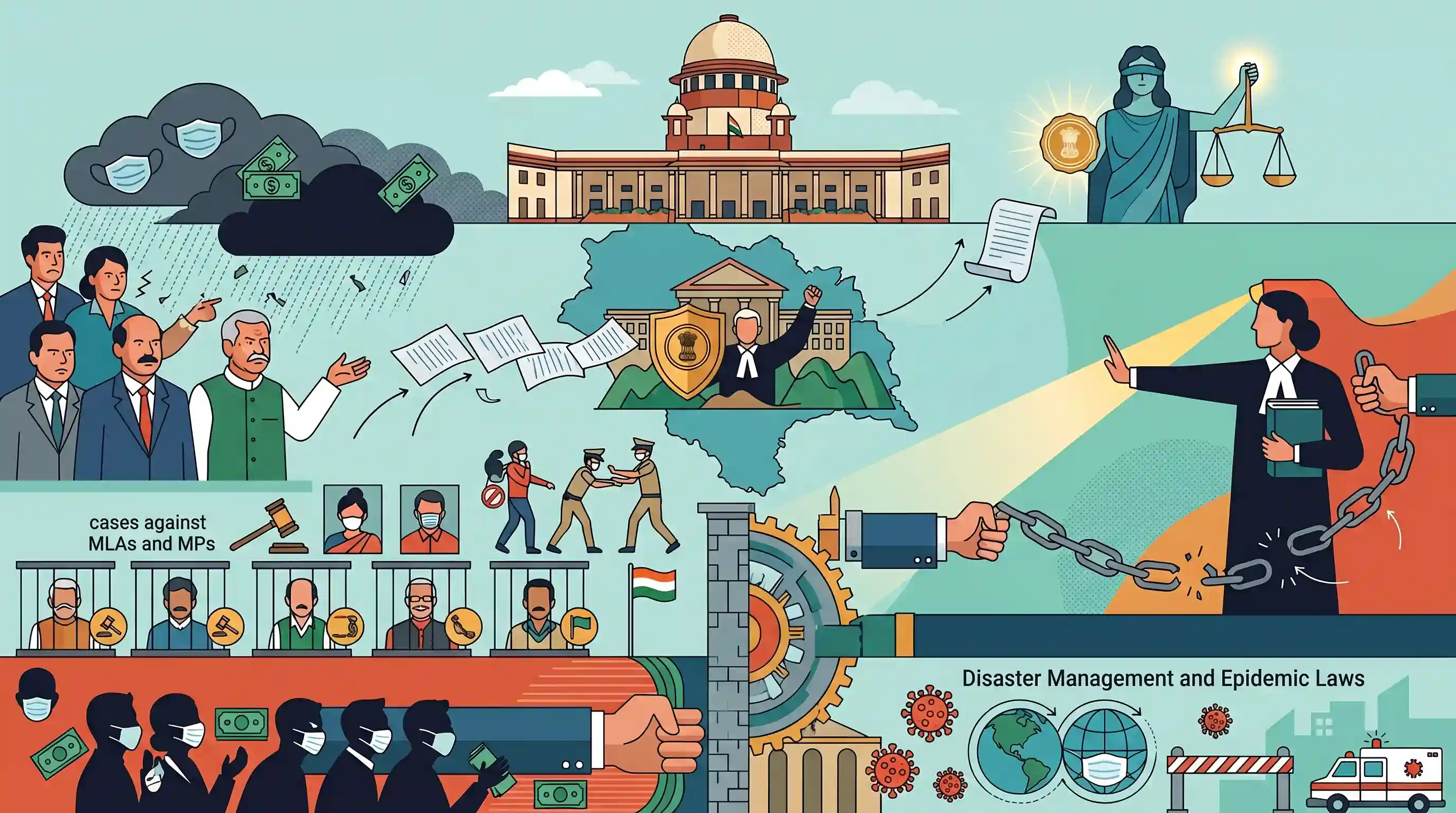
The Supreme Court of India has agreed to hear a petition by the Himachal Pradesh government against a State High Court order that denied the withdrawal of 45 criminal cases against sitting and former MLAs and MPs. The cases, largely registered during the COVID-19 pandemic under the previous BJP government, include charges of violating pandemic protocols (IPC 269) and assaulting public servants (IPC 353). The High Court justified its refusal by citing the Supreme Court's directive in the Ashwani Kumar Upadhyay case, which made High Court consent mandatory for withdrawing prosecution against lawmakers to check the criminalization of politics. The State contends the cases were politically motivated, while the judiciary maintains that Public Prosecutors must exercise independent judgment and not succumb to executive dictates when invoking Section 321 of the CrPC.
Key Points
- The Supreme Court will examine the Himachal Pradesh government's plea challenging the State High Court's refusal to withdraw criminal cases against sitting and former MPs and MLAs.
- The State High Court had permitted the withdrawal of only 15 out of 65 recommended cases, rejecting those involving charges like assaulting public servants (IPC 353) and negligent acts likely to spread infection (IPC 269) during the COVID-19 pandemic.
- The High Court's refusal was based on the Supreme Court's ruling in the Ashwani Kumar Upadhyay case, which mandates High Court permission before withdrawing criminal cases against lawmakers under Section 321 of the CrPC.
- The Himachal Pradesh government argued the cases were politically motivated, filed by the previous BJP administration against Congress workers protesting during the pandemic.
- The judiciary emphasized that the Public Prosecutor must form an independent opinion on withdrawing cases in the public interest, rather than acting solely on government instructions.
Important Terms
Section 321 of the CrPC

Empowers the Public Prosecutor to withdraw from a criminal case before judgment, provided the Court grants consent. It requires the prosecutor to exercise independent judgment in the interest of public justice.
UPSC context
GS-II: Separation of Powers and Independence of Judiciary. Tests the check on executive influence over criminal trials.
Ashwani Kumar Upadhyay Case
A 2021 Supreme Court ruling that prohibits State governments from withdrawing criminal cases against sitting or former MPs and MLAs without mandatory permission from the respective High Court.
UPSC context
GS-II: Criminalization of Politics. Important for judicial interventions to ensure accountability of lawmakers.
Section 269 of the IPC
Penalizes any negligent act likely to spread infection of a disease dangerous to life. It was extensively used during the COVID-19 pandemic to enforce public health protocols.
UPSC context
GS-II/III: Health Governance and Disaster Management. Relevant for penal provisions used during public health emergencies.
Disaster Management Act, 2005
The primary legal framework for managing disasters (including pandemics) in India. It grants the Centre and States overriding powers to issue directions for public safety.
UPSC context
GS-III: Disaster Management. Frequently tested for its impact on federalism during national emergencies.
Epidemic Diseases Act, 1897
A colonial-era law providing special powers to state governments to contain dangerous epidemic diseases. It was recently amended to provide enhanced protection for healthcare workers.
UPSC context
GS-II: Federalism. Highlights the state's prerogative versus central authority in health emergencies.
Section 353 of the IPC
Criminalizes assault or the use of criminal force to deter a public servant from discharging their official duty, intended to protect government officials from intimidation.
UPSC context
GS-II: Role of Public Servants. Relates to legal protections for civil servants against political interference.
Prelims Trap
"State Governments hold the absolute executive power to unilaterally withdraw criminal prosecutions against sitting MLAs or MPs."
Withdrawal requires the Public Prosecutor's independent judgment and the trial court's consent. Crucially, withdrawing cases against lawmakers mandates prior permission from the State High Court.
Static Concepts Connected
What are the conditions for withdrawing a prosecution under criminal procedural law?
- Who initiates?: Only the Public Prosecutor or Assistant Public Prosecutor in charge of a specific case can apply for withdrawal.
- Court's consent: Withdrawal is not automatic; it requires the explicit, objective consent of the court to ensure it serves the broader administration of justice.
- Independent judgment: The Public Prosecutor cannot act merely as a 'post-box' for the government; they must apply an independent legal mind.
What is the Ashwani Kumar Upadhyay (2021) ruling regarding lawmakers?
- High Court veto: Trial courts cannot allow the withdrawal of criminal cases against sitting or former MPs and MLAs without prior leave of the respective State High Court.
- Core objective: The ruling aims to check the criminalization of politics by preventing ruling parties from shielding their legislators from malicious or serious criminal charges.
Cross-Topic Patterns
Criminalization of politics & Special Courts
Connect the executive push to withdraw criminal cases with the Representation of the People Act, 1951 (Section 8) and the Supreme Court's mandate for Special MP/MLA courts to expedite pending trials.
Separation of powers & PP independence
The friction between state governments issuing withdrawal orders and the judiciary protecting the Public Prosecutor's statutory independence exemplifies checks and balances in the criminal justice system.

Expect a Prelims statement linking Section 321 CrPC (now BNSS equivalent) to the mandatory High Court consent for cases against MPs/MLAs.
Linked PYQs · 3
Linked PYQs · 3
- 2020MainsGS2
Indian Constitution exhibits centralising tendencies to maintain unity and integrity of the nation. Elucidate in the perspective of the Epidemic Diseases Act, 1897; The Disaster Management Act, 2005 and recently passed Farm Acts.
- 2020MainsGS2
There is a need for simplification of procedure for disqualification of persons found guilty of corrupt practices under the Representation of Peoples Act". Comment.
- 2020PrelimsGS1
Consider the following statements: 1. According to the Constitution of India, a person who is eligible to vote can be made a minister in a State for six months even if he/she is not a member of the Legislature of that State. 2. According to the Representation of People Act, 1951, a person convicted of a criminal offence and sentenced to imprisonment for five years is permanently disqualified from contesting an election even after his release from prison. Which of the statements given above is/are correct?
