Himachal Pradesh MLA Criminal Case Withdrawal Plea in Supreme Court
Source:The Hindu ↗
Why It Matters
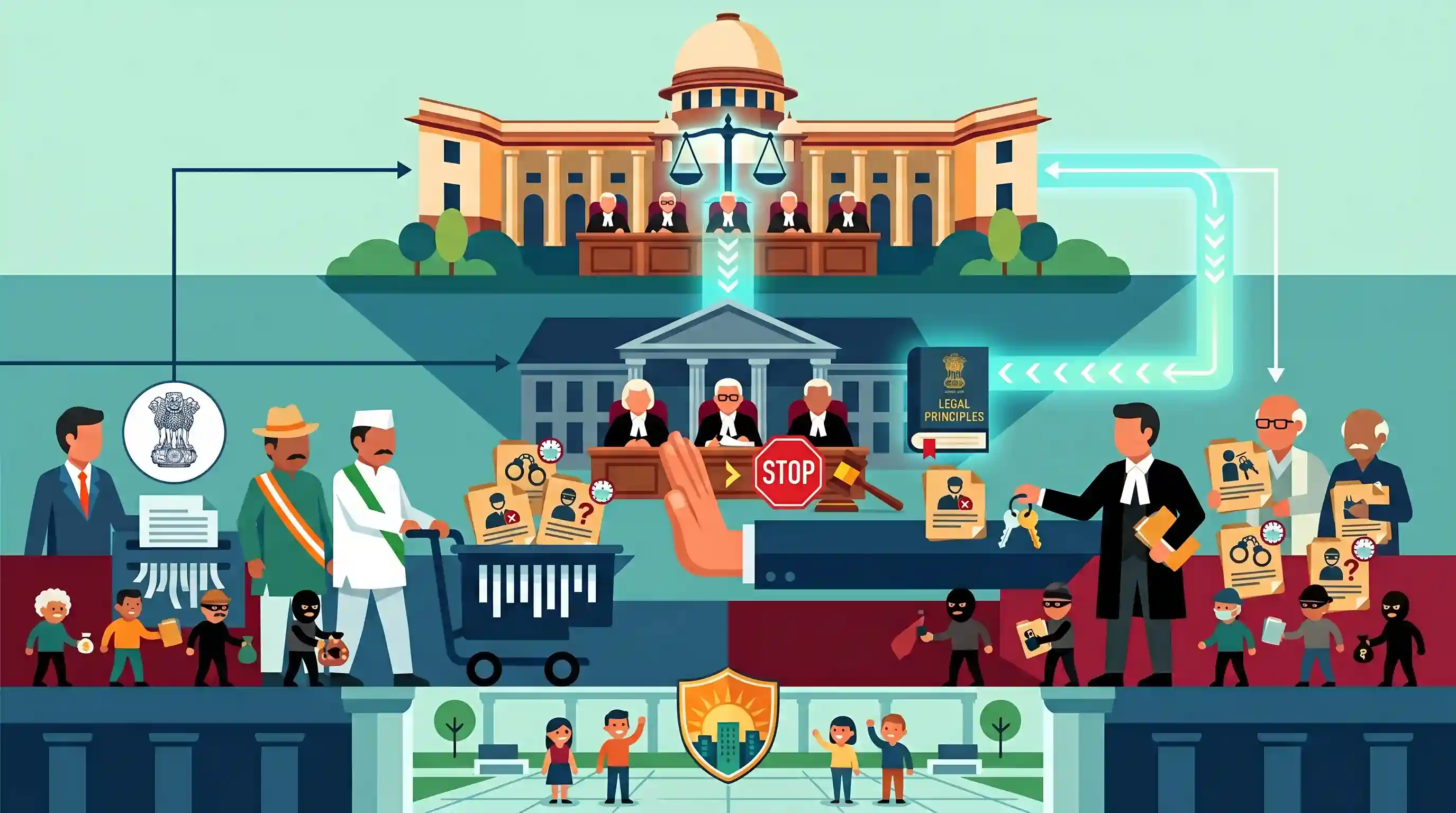
It illustrates the critical role of judicial oversight in preventing the misuse of executive power to drop criminal charges against politicians. The issue ties directly to the broader themes of the criminalisation of politics, the independence of the criminal justice system, and the separation of powers between the executive and the judiciary.
Summary
The Supreme Court has agreed to review the Himachal Pradesh government's petition challenging a High Court order that denied permission to withdraw 45 criminal cases against MPs and MLAs. The cases primarily involve political workers booked during the COVID-19 pandemic under the state's previous administration. The legal framework surrounding this issue centers on Section 321 of the CrPC, which governs the withdrawal of prosecution by public prosecutors. However, following the Supreme Court's landmark 2020 judgment in the Ashwani Kumar Upadhyay case, explicit consent from the relevant High Court is mandatory before state governments can withdraw criminal proceedings against lawmakers. This judicial oversight is designed to ensure that prosecutors act independently and primarily in the public interest, thereby preventing political interference in the criminal justice system and checking the criminalisation of politics.
Key Points
- The Supreme Court has agreed to examine the Himachal Pradesh government's plea seeking to withdraw criminal cases against sitting and former MPs and MLAs.
- The High Court of Himachal Pradesh had earlier refused to allow the withdrawal of 45 such cases, which largely involved Congress workers booked during the previous BJP government's tenure amid the COVID-19 pandemic.
- Under Section 321 of the CrPC, public prosecutors hold the power to withdraw prosecution; however, the Supreme Court's 2020 ruling in the Ashwani Kumar Upadhyay case made the High Court's permission mandatory for withdrawing cases against lawmakers.
- The 2020 judgment aims to curb political interference by requiring public prosecutors to formulate an independent opinion demonstrating that withdrawing a case serves the public interest, rather than political agendas.
Important Terms
Criminalisation of Politics

The infiltration of individuals with criminal backgrounds or pending criminal cases into the political arena and legislative bodies.
UPSC context
GS II: Governance/Polity; critical for discussions on electoral reforms, the rule of law, and the integrity of legislatures.
Section 321 of the CrPC
Legal provision allowing a Public Prosecutor to withdraw from a prosecution at any stage before judgment, strictly subject to the Court's consent.
UPSC context
GS II: Criminal Justice System. Important to note its replacement by Section 360 of the Bharatiya Nagarik Suraksha Sanhita (BNSS), 2023.
Ashwani Kumar Upadhyay v. Union of India
A 2021 Supreme Court ruling mandating that no criminal cases against MPs or MLAs (sitting or former) be withdrawn without explicit High Court permission.
UPSC context
GS II: Judiciary. Tests knowledge of judicial safeguards against executive interference in cases involving political figures.
Public Prosecutor
A statutory officer of the court responsible for conducting prosecutions; they must act independently of executive pressure to serve the public interest.
UPSC context
GS II: Statutory Bodies. Relevant for questions on prosecutorial discretion and the separation of the prosecution from the executive.
Judicial Oversight
The constitutional mechanism where the judiciary monitors executive actions (like case withdrawals) to ensure they are not arbitrary or politically motivated.
UPSC context
GS II: Separation of Powers. Central to the "checks and balances" theme in the Indian Constitution.
Prelims Trap
Criminal cases against sitting MPs or MLAs can be withdrawn with the sole consent of the trial court.
Following the 2020 Ashwani Kumar Upadhyay ruling, explicit prior permission from the respective High Court is mandatory, overriding normal CrPC 321 provisions.
Static Concepts Connected
What are the legal consequences of withdrawing prosecution under Section 321 of CrPC?
- Before framing charges: If withdrawal is permitted before charges are framed, it results in the discharge of the accused.
- After framing charges: If withdrawal is permitted after charges have been framed, it results in an acquittal.
- Independent opinion: The prosecutor must apply an independent mind based on public interest, not merely act as the state's post office.
What judicial safeguards prevent politically motivated withdrawal of cases against lawmakers?
- High Court nod: State governments cannot withdraw cases against sitting or former MPs/MLAs without explicit prior approval from the State High Court.
- Tenure security: Judges presiding over Special Courts assigned to try lawmakers cannot be transferred without the High Court's approval.
Cross-Topic Patterns
Epidemic Act + Political Protests
Many cases against politicians stem from COVID-19 lockdown violations. This highlights the governance challenge of distinguishing criminality from political mobilization under the Epidemic Diseases Act and Disaster Management Act.
Separation of Powers + Prosecutor Independence
The SC's insistence on the Public Prosecutor's independent judgment checks executive overreach, illustrating the fine balance between state prosecutorial discretion and judicial oversight in the criminal justice system.

Expect a 2026 Prelims trap swapping 'High Court' with 'Trial Court' for the mandatory consent required to withdraw cases against MPs/MLAs.
Linked PYQs · 3
Linked PYQs · 3
- 2020MainsGS2
There is a need for simplification of procedure for disqualification of persons found guilty of corrupt practices under the Representation of Peoples Act". Comment.
- 2020MainsGS2
Judicial Legislation is antithetical to the doctrine of separation of powers as envisaged in the Indian Constitution. In this context justify the filing of large number of public interest petitions praying for issuing guidelines to executive authorities.
- 2023MainsGS2
“Constitutionally guaranteed judicial independence is a prerequisite of democracy.” Comment.
