Supreme Court Adjourns Plea Against Dharavi Redevelopment Project
Source:The Hindu ↗
Why It Matters
The Dharavi redevelopment project highlights the complexities of urban renewal and slum rehabilitation in India's megacities. For UPSC, it illustrates challenges in transparency and governance regarding massive infrastructure tenders, the legal framework governing public-private partnerships, and how judicial review manages disputes in executive decision-making.
Summary
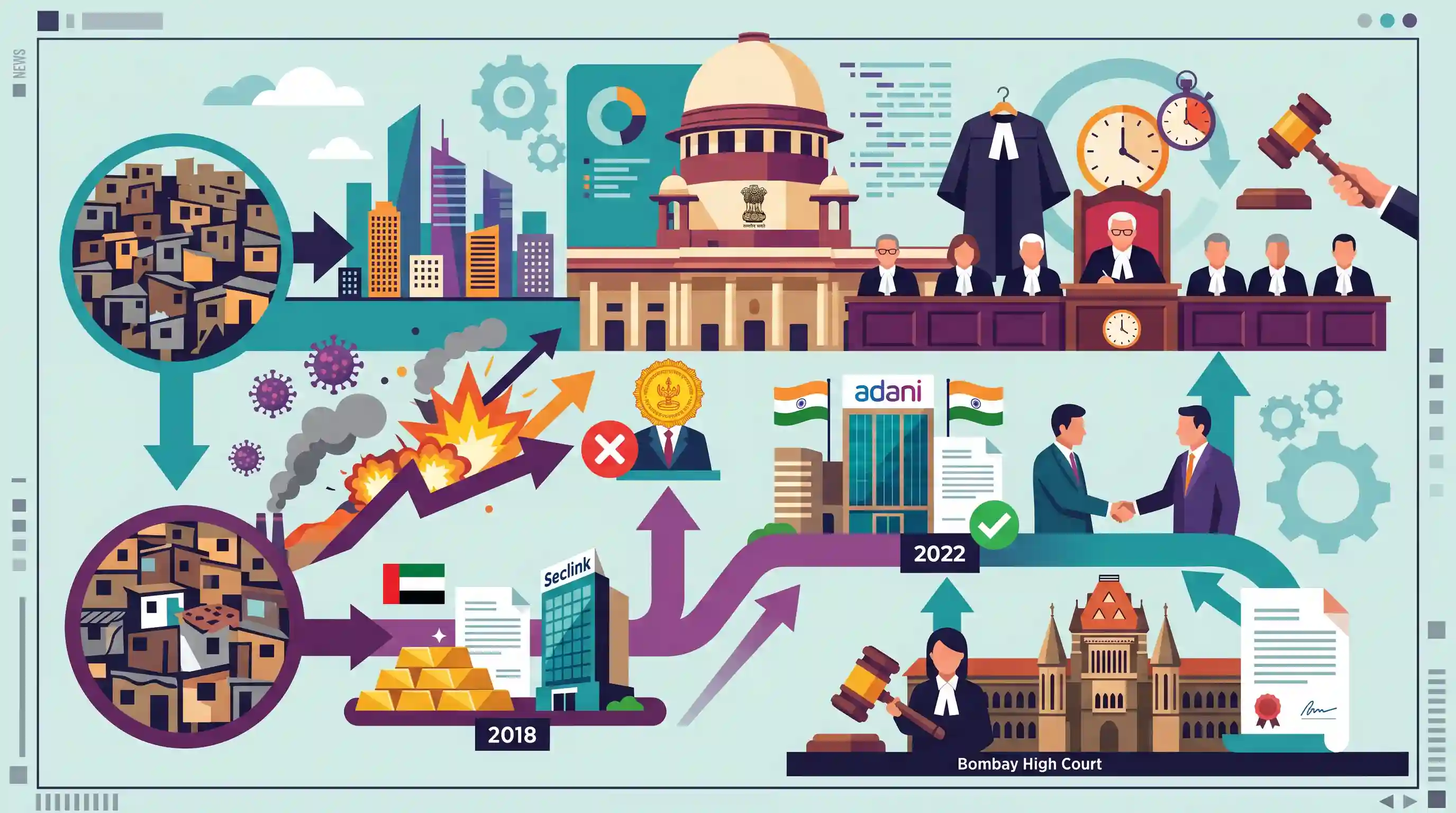
The Supreme Court has postponed hearings on a petition filed by UAE-based Seclink Technologies, which challenges the Maharashtra government's decision to grant the massive Dharavi redevelopment contract to the Adani Group. The court cited time constraints ahead of the Chief Justice's upcoming retirement. Seclink, originally the highest bidder in a scrapped 2018 tender process, contested the award of the project to Adani following a new 2022 tender. The state government defended the cancellation of the initial tender by pointing to the pandemic and geopolitical crises. Previously, the Bombay High Court upheld the Adani tender, a decision the Supreme Court refused to stay earlier this year.
Key Points
- The Supreme Court adjourned the hearing on a plea by UAE-based Seclink Technologies challenging the award of the Dharavi redevelopment project to the Adani Group.
- Chief Justice B.R. Gavai cited his upcoming retirement in November 2024 as the reason for not being able to complete the hearing.
- The Bombay High Court had previously dismissed Seclink's plea in December 2024 and upheld the validity of the tender awarded to Adani.
- Seclink argued it was the highest bidder in a 2018 tender process that the Maharashtra government subsequently cancelled, citing the pandemic and the Russia-Ukraine war, before issuing a new tender in 2022 won by Adani.
- The SC had refused to stay the project in March 2025, allowing the redevelopment process to proceed while seeking responses on the petition.
Important Terms
Judicial Review of Administrative Action

The power of the judiciary to examine the legality and constitutionality of executive or administrative decisions, ensuring they are not arbitrary, irrational, or procedurally flawed.
UPSC context
GS Paper II: Indian Constitution and Governance; crucial for understanding the check-and-balance mechanism between the judiciary and the executive.
Slum Redevelopment
An urban renewal strategy to transform informal settlements into formal housing with basic amenities, often utilizing 'In-Situ' models under the Pradhan Mantri Awas Yojana (PMAY-U).
UPSC context
GS Paper I: Society (Urbanization) and GS Paper III: Infrastructure; tests knowledge of sustainable urban planning and inclusive growth.
Public Procurement
The process by which government bodies acquire works, goods, or services from the private sector through competitive bidding and tenders to ensure transparency and value for money.
UPSC context
GS Paper III: Indian Economy (Infrastructure) and GS Paper II: Governance; relevant for understanding the General Financial Rules (GFR) and PPP models.
Dharavi Redevelopment Project
A massive urban renewal initiative aimed at transforming Asia's largest slum cluster in Mumbai into a modern township, involving a Public-Private Partnership (PPP) model.
UPSC context
GS Paper III: Infrastructure and Case Study; represents challenges in large-scale urban displacement, rehabilitation, and administrative transparency.
Adani Properties Pvt Ltd
The specific subsidiary of the Adani Group that won the 2022 tender for the Dharavi project, illustrating the role of private conglomerates in national infrastructure.
UPSC context
GS Paper III: Investment Models; highlights the private sector's involvement in major developmental projects and related legal/regulatory scrutiny.
Seclink Technologies Corporation
A UAE/Seychelles-based firm that was the highest bidder in the 2018 tender and is currently challenging the cancellation and subsequent re-awarding of the project.
UPSC context
GS Paper II: Dispute Redressal Mechanisms; serves as a case study for legal hurdles in international bidding and administrative discretion.
Prelims Trap
The highest bidder in a government tender process has an absolute legal right to be awarded the contract.
Being the highest (or lowest) bidder does not create a vested legal right to the contract. The State retains discretionary power to cancel tenders if grounded in non-arbitrary public interest.
Static Concepts Connected
What are the grounds for judicial review in public procurement and government tenders?
- Wednesbury Principle: Courts generally intervene only if the administrative decision is completely irrational or unreasonable.
- Article 14 violation: Intervention is justified if the tender process violates the right to equality or fairness.
- Mala Fides: Courts will strike down contract awards if the decision-making process is tainted by bad faith or favoritism.
How do large-scale slum rehabilitation schemes self-finance under the PPP model?
- Cross-subsidization: Private developers provide free housing to eligible dwellers and recover costs by selling the commercial or premium residential components.
- Higher FSI: Governments grant developers higher Floor Space Index (FSI) to build denser, taller structures for the saleable component.
- Transferable Development Rights: Developers are often granted rights to transfer and sell surplus building potential to other zones in the city.
Cross-Topic Patterns
Article 21 + Urban Evictions
The tension between mega PPP infrastructure upgrades and the fundamental right to livelihood/shelter established in the Olga Tellis case is a recurring GS2 Mains theme.
Slum Rehabilitation + Climate Resilience
Dharavi's redevelopment intersects with urban climate resilience, highlighting how high-density informal settlements are disproportionately vulnerable to urban flooding and require specialized infrastructure planning.

Expect a GS2 Mains question on the limits of judicial review in executive tenders and how it impacts mega PPP infrastructure projects.
Linked PYQs · 3
Linked PYQs · 3
- 2023MainsGS1
Does urbanization lead to more segregation and/or marginalization of the poor in Indian metropolises?
- 2013MainsGS1
Discuss the various social problems which originated out of the speedy process of urbanization in India.
- 2016MainsGS3
Rehabilitation of human settlements is one of the important environmental impacts which always attracts controversy while planning major projects. Discuss the measures to be adopted to mitigate the impact of the recent incidents of cloudbursts in many places of Uttarakhand.
