Monetary Policy Transmission and Lending Rate Reductions
Source:The Hindu ↗
Why It Matters
Demonstrates the real-world mechanics of monetary policy transmission. It provides practical examples of how different lending benchmarks (EBLR vs. MCLR) react to RBI repo rate changes, affecting consumer affordability and corporate borrowing costs.
Summary
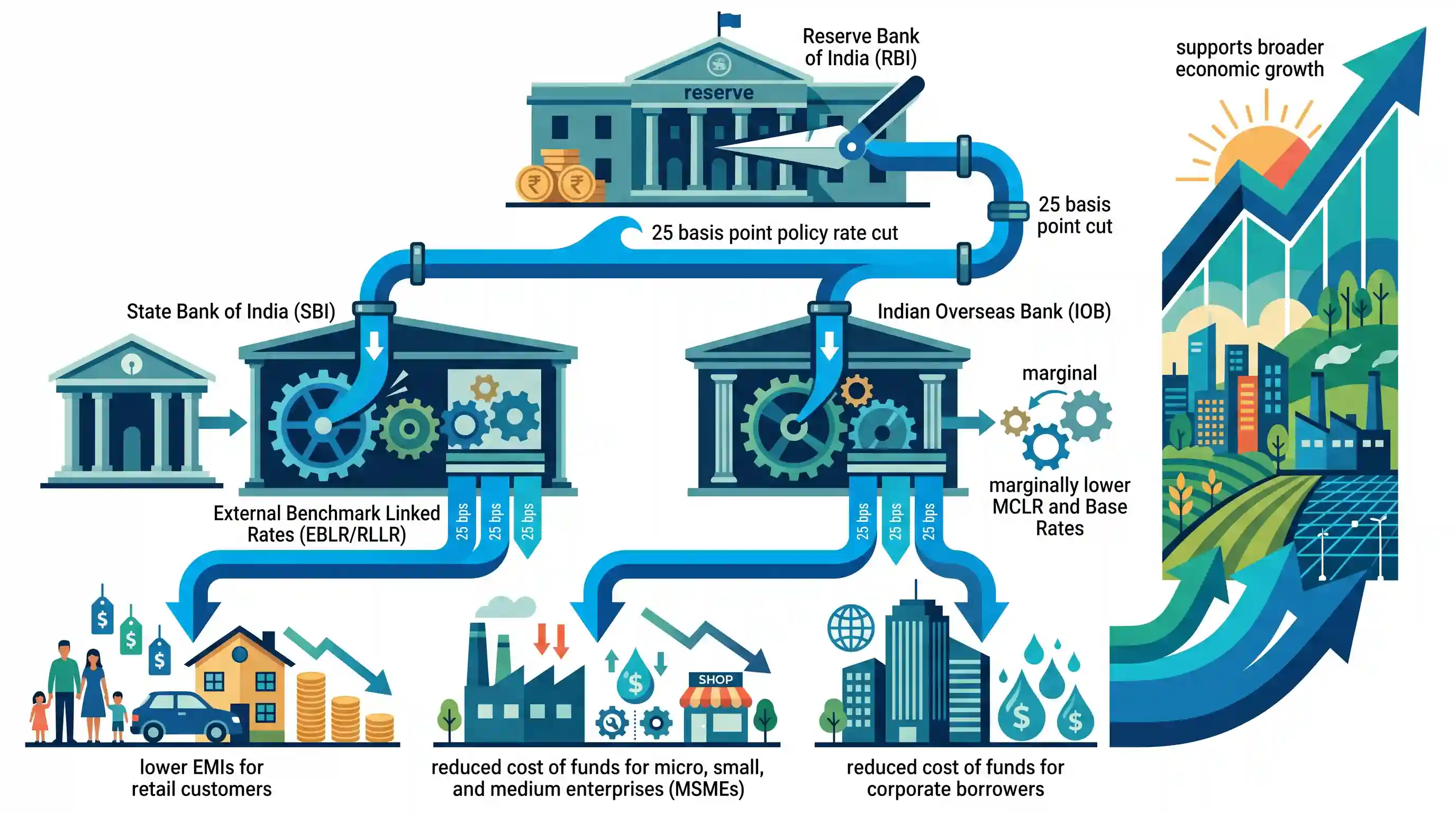
State Bank of India (SBI) and Indian Overseas Bank (IOB) have reduced their lending rates, passing on the benefits of the Reserve Bank of India's (RBI) recent 25 basis point policy rate cut. Both state-owned lenders cut their External Benchmark Linked Rates (EBLR/RLLR) by exactly 25 basis points, while marginally lowering their Marginal Cost of Funds-Based Lending Rates (MCLR) and Base Rates. The rate reduction makes credit more affordable, leading to lower EMIs for retail customers and reduced cost of funds for micro, small, and medium enterprises (MSMEs) and corporate borrowers, thereby supporting broader economic growth.
Key Points
- SBI reduced its External Benchmark Linked Rate (EBLR) by 25 basis points to 7.90% to match the RBI's recent policy rate cut.
- SBI also cut the Marginal Cost of Funds-Based Lending Rate (MCLR) by 5 basis points and its Base Rate to 9.90%, alongside slight cuts to specific fixed deposit rates.
- Indian Overseas Bank (IOB) similarly lowered its Repo Linked Lending Rate (RLLR) by 25 basis points to 8.10% and its MCLR by 5 basis points.
- The swift transmission of the RBI rate cut will result in lower Equated Monthly Instalments (EMIs) for home, auto, and personal loans, while improving credit affordability for MSMEs and corporate borrowers.
Important Terms
Monetary Policy Transmission

The process by which changes in the central bank's policy rates (like Repo) flow through the financial system to influence market interest rates, investment, and inflation.
UPSC context
GS-3 Economy; essential for analyzing the effectiveness of inflation targeting and central bank interventions in the real economy.
External Benchmark Linked Rate (EBLR)
A lending rate mechanism linked to external benchmarks (like RBI’s Repo Rate). Mandated in 2019 to ensure that policy rate cuts are quickly passed to borrowers.
UPSC context
GS-3 Economy; tests knowledge of recent banking reforms aimed at transparency and faster interest rate adjustments.
Marginal Cost of Funds-Based Lending Rate (MCLR)
The minimum interest rate a bank can lend at, calculated internally using the incremental cost of funds, operating expenses, and tenor premium.
UPSC context
GS-3 Economy; crucial for comparing internal versus external benchmarking and understanding bank-side liquidity management.
Repo Linked Lending Rate (RLLR)
A specific form of EBLR where the loan's interest rate is directly tied to the RBI's Repo Rate plus a fixed spread.
UPSC context
GS-3 Economy; relevant for retail credit topics (home/auto loans) and immediate impacts of MPC decisions.
Base Rate
The minimum interest rate below which banks were not permitted to lend (introduced 2010), typically based on the average cost of funds.
UPSC context
GS-3 Economy; useful for historical context of banking sector reforms and the evolution of lending transparency.
Reserve Bank of India (RBI)
India’s central bank, responsible for regulating the banking system, managing foreign exchange, and formulating monetary policy to ensure price stability.
UPSC context
GS-3 Economy; foundational institution for monetary governance and financial stability in India.
Prelims Trap
"A 25 bps cut in the RBI repo rate automatically reduces a bank's MCLR by 25 bps."
False. While EBLR moves identically with the external benchmark (repo rate), MCLR is an internal benchmark based on the bank's own cost of funds, resulting in partial or sluggish transmission.
Static Concepts Connected
How do MCLR and EBLR differ in monetary policy transmission?
- MCLR (Internal): Based on the bank's own cost of funds, operating costs, and tenor premiums. Transmission is often delayed or partial.
- EBLR (External): Linked directly to external indicators like the Repo rate or Treasury Bills, ensuring immediate and proportionate transmission of RBI rate changes.
- RBI Mandate: In 2019, RBI mandated all new floating-rate personal, retail, and MSME loans be linked to an external benchmark to fix sluggish transmission.
What are the four components used to calculate the MCLR?
- Marginal Cost: The primary component, reflecting the cost of borrowing and deposit rates for the bank.
- CRR Premium: The cost associated with keeping idle cash with the RBI to meet Cash Reserve Ratio requirements, which earns no interest.
- Operating Costs: Day-to-day operational expenses incurred by the bank in providing the loan.
- Tenor Premium: Higher interest charged for long-term loans to cover the additional risk associated with longer repayment periods.
Cross-Topic Patterns
EBLR Transmission & MSME Competitiveness
Faster rate transmission via EBLR directly lowers borrowing costs for MSMEs, acting as a crucial credit-easing mechanism to boost export competitiveness and support Make in India manufacturing goals.
Monetary Policy & Capital Flight Risks
RBI rate cuts aimed at growth can risk capital outflows and currency depreciation if central banks in advanced economies (like the US Fed) maintain hawkish, high-interest stances.

Expect a 2026 Prelims multi-statement question contrasting the transmission speed and exact calculation components of MCLR vs EBLR.
Linked PYQs · 4
Linked PYQs · 4
- 2016PrelimsGS1
What is/are the purpose/purposes of the 'Marginal Cost of Funds based Lending Rate (MCLR)' announced by RBI? 1. These guidelines help improve the transparency in the methodology followed by banks for determining the interest rates on advances. 2. These guidelines help ensure availability of bank credit at interest rates which are fair to the borrowers as well as the banks. Select the correct answer using the code given below.
- 2024MainsGS3
What are the causes of persistent high food inflation in India? Comment on the effectiveness of the monetary policy of the RBI to control this type of inflation.
- 2022PrelimsGS1
With reference to the Indian economy, consider the following statements: 1. If the inflation is too high, Reserve Bank of India (RBI) is likely to buy government securities. 2. If the rupee is rapidly depreciating, RBI is likely to sell dollars in the market. 3. If interest rates in the USA or European Union were to fall, that is likely to induce RBI to buy dollars. Which of the statements given above are correct?
- 2024PrelimsGS1
Consider the following statements in respect of the digital rupee : 1. It is a sovereign currency issued by the Reserve Bank of India (RBI) in alignment with its monetary policy. 2. It appears as a liability on the RBI's balance sheet. 3. It is insured against inflation by its very design. 4. It is freely convertible against commercial bank money and cash. Which of the statements given above are correct?
