Sawalkote hydropower project receives fresh environmental clearance
Source:The Hindu ↗
Why It Matters
It perfectly intersects geopolitics (IWT suspension) with energy infrastructure (run-of-the-river hydropower) and environmental/social concerns (EIA and rehabilitation), covering crucial syllabus points across GS2 and GS3.
Summary
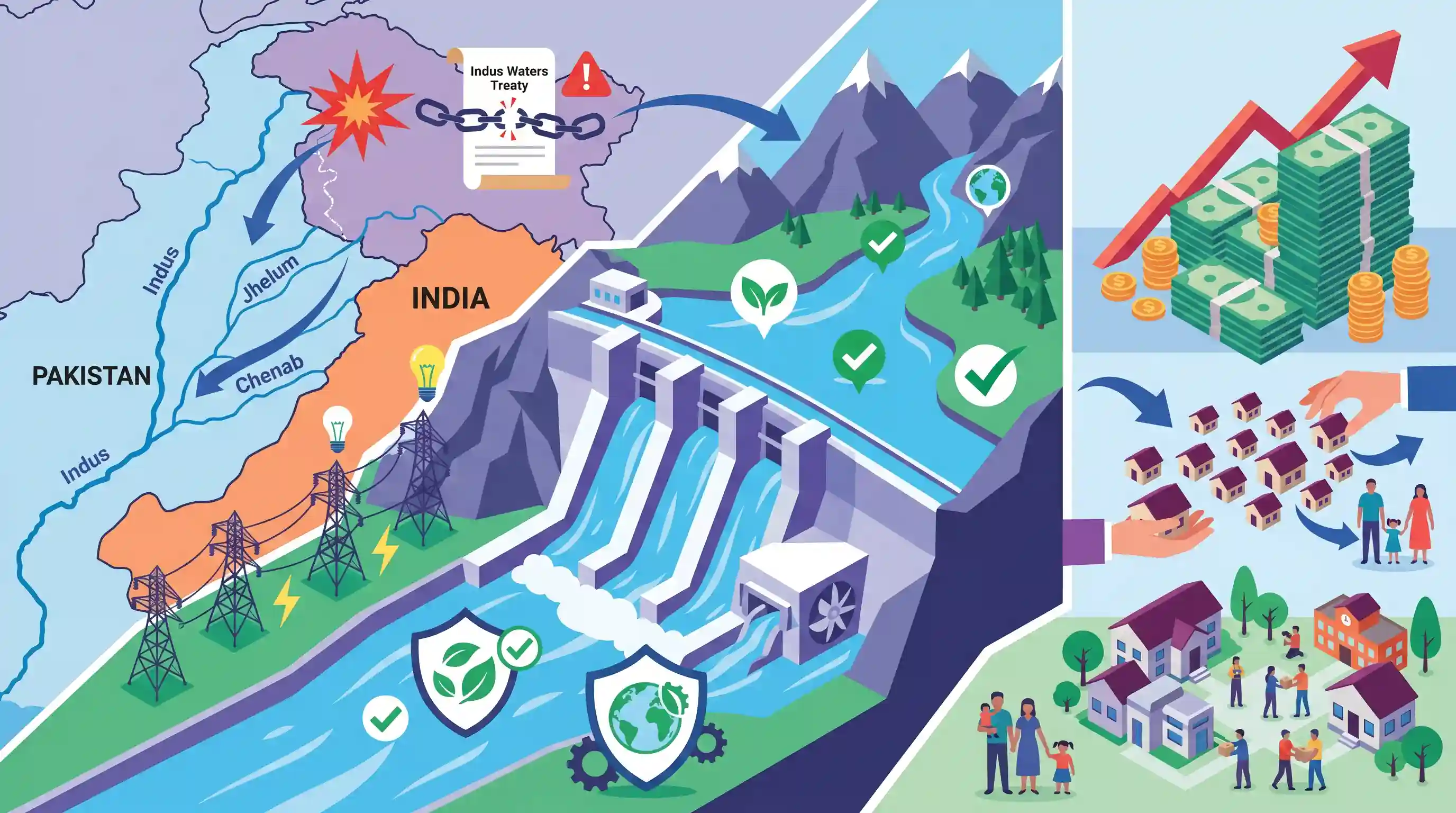
The Sawalkote hydropower project, a 1,856 MW run-of-the-river facility on the Chenab river in Jammu & Kashmir, has obtained fresh environmental clearance. Being executed by NHPC, it marks the first major energy project on the Indus river system to be cleared since India's suspension of the Indus Waters Treaty (IWT) in 2025 following a terror attack. While strategically significant for asserting India's rights over the western rivers, the project also highlights standard environmental and social challenges, including a massive cost escalation to ₹31,380 crore and the displacement of nearly 1,500 families requiring targeted rehabilitation.
Key Points
- The 1,856 MW Sawalkote hydroelectric project on the Chenab river in Ramban, J&K, has received fresh environmental clearance.
- It is the first major hydropower project on the Indus rivers system to get clearance following India's suspension of the Indus Waters Treaty (IWT) in April 2025.
- The run-of-the-river project features a 192.5-metre Roller Compacted Concrete (RCC) gravity dam and will be executed by NHPC.
- The project's estimated cost has increased significantly to ₹31,380 crore, and its construction will displace 1,477 families across 13 villages, with ₹190 crore provisioned for resettlement and rehabilitation.
Important Terms
Indus Waters Treaty (IWT)

A 1960 water-sharing pact between India and Pakistan, mediated by the World Bank, allocating three eastern rivers to India and three western rivers (Indus, Jhelum, Chenab) primarily to Pakistan.
UPSC context
GS-II (International Relations) & GS-I (Geography); tests transboundary water diplomacy, bilateral ties, and river basin management.
National Hydroelectric Power Corporation (NHPC)
India's premier Public Sector Enterprise (PSE) for hydropower development, responsible for executing large-scale projects like the 1,856 MW Sawalkote facility on a Build-Own-Operate-Transfer (BOOT) basis.
UPSC context
GS-III (Infrastructure & Energy); relevant for India’s renewable energy transition and the role of PSEs in strategic sectors.
Jammu & Kashmir Power Development Corporation (JKPDC)
A J&K government-owned entity that plans and executes power projects in the UT; it originally handled Sawalkote and retains eventual ownership after the 40-year BOOT period.
UPSC context
GS-II (Federalism) & GS-III (Energy); tests state-level infrastructure governance and regional economic development.
Central Electricity Authority (CEA)
A statutory body under the Ministry of Power that provides technical and economic appraisals for power projects to ensure grid stability and compliance with national electricity policy.
UPSC context
GS-III (Energy & Infrastructure); tests the regulatory framework of the power sector and the role of statutory advisory bodies.
Central Water Commission (CWC)
A premier technical organization under the Ministry of Jal Shakti responsible for the control, conservation, and utilization of water resources, including technical design approvals for dams.
UPSC context
GS-III (Water Resources/Disaster Management); important for understanding technical governance of river systems and national water policy.
Prelims Trap
"Run-of-the-river (RoR) hydroelectric projects do not involve the construction of dams or water storage structures."
Aspirants often assume RoR means no damming. However, large RoR projects like Sawalkote still feature massive structures (e.g., a 192.5m gravity dam) for daily pondage.
Static Concepts Connected
How does the Indus Waters Treaty divide river rights between India and Pakistan?
- Eastern Rivers: Ravi, Beas, and Sutlej are allocated exclusively to India for unrestricted use.
- Western Rivers: Indus, Jhelum, and Chenab are primarily allocated to Pakistan, limiting India's consumptive usage.
- India's Permitted Uses: India retains rights on Western rivers for domestic, agricultural, and non-consumptive uses, including run-of-the-river hydropower.
What distinguishes Run-of-the-River (RoR) hydroelectric projects from conventional storage dams?
- Natural Flow: RoR projects primarily rely on the natural flow and elevation drop of a river rather than creating massive reservoirs.
- Limited Pondage: They may utilize small dams to create 'pondage' for daily water regulation, but cannot store water across seasons.
- Seasonal Variability: Because they lack large storage, power generation in RoR plants is highly vulnerable to seasonal drops in river flow.
Cross-Topic Patterns
Water as a strategic diplomatic tool
The 2025 IWT suspension links internal security (terror attacks) with transboundary water sharing, marking a shift toward using riparian geography for coercive diplomacy.
EIA vs. Strategic Border Infrastructure
Clearances for massive border projects like Sawalkote underscore the ongoing tension between fast-tracking strategic geopolitical assets and managing severe ecological impacts and rural displacement.

Expect a Prelims question ordering Chenab hydro projects (Salal, Baglihar, Sawalkote) alongside a statement on the 2025 IWT suspension.
Linked PYQs · 5
Linked PYQs · 5
- 2012MainsGS2
The situation today is far different to that prevalent fifty years back when the Indus Water Treaty was signed." Highlight the complexity of the current challenges on both sides of the border in this regard. Do you think that a review of the Treaty is in India's best interests?
- 2013MainsGS3
What do you understand by Run-of-river hydroelectricity project ? How is it different from any other hydroelectricity project?
- 2014MainsGS3
Environmental Impact Assessment studies are increasingly undertaken before a project is cleared by the Government. Discuss the environmental impacts of coal-fired thermal plants located at coal pitheads.
- 2024MainsGS3
What role do environmental NGOs and activists play in influencing Environmental Impact Assessment (EIA) outcomes for major projects in India? Cite four examples with all important details.
- 2021PrelimsGS1
With reference to the Indus river system, of the following four rivers, three of them pour into one of them which joins the Indus direct. Among the following, which one is such river that joins the Indus direct?
