Conservation of Traditional Seed Varieties for Climate Resilience
Source:The Hindu ↗
Why It Matters
The article connects agricultural biodiversity (traditional seeds) with economic policies (MSP, procurement) and climate resilience. It directly addresses the core GS3 syllabus topics on agriculture, crop diversification, subsidies, and food security, providing a practical framework for sustainable farming.
Summary
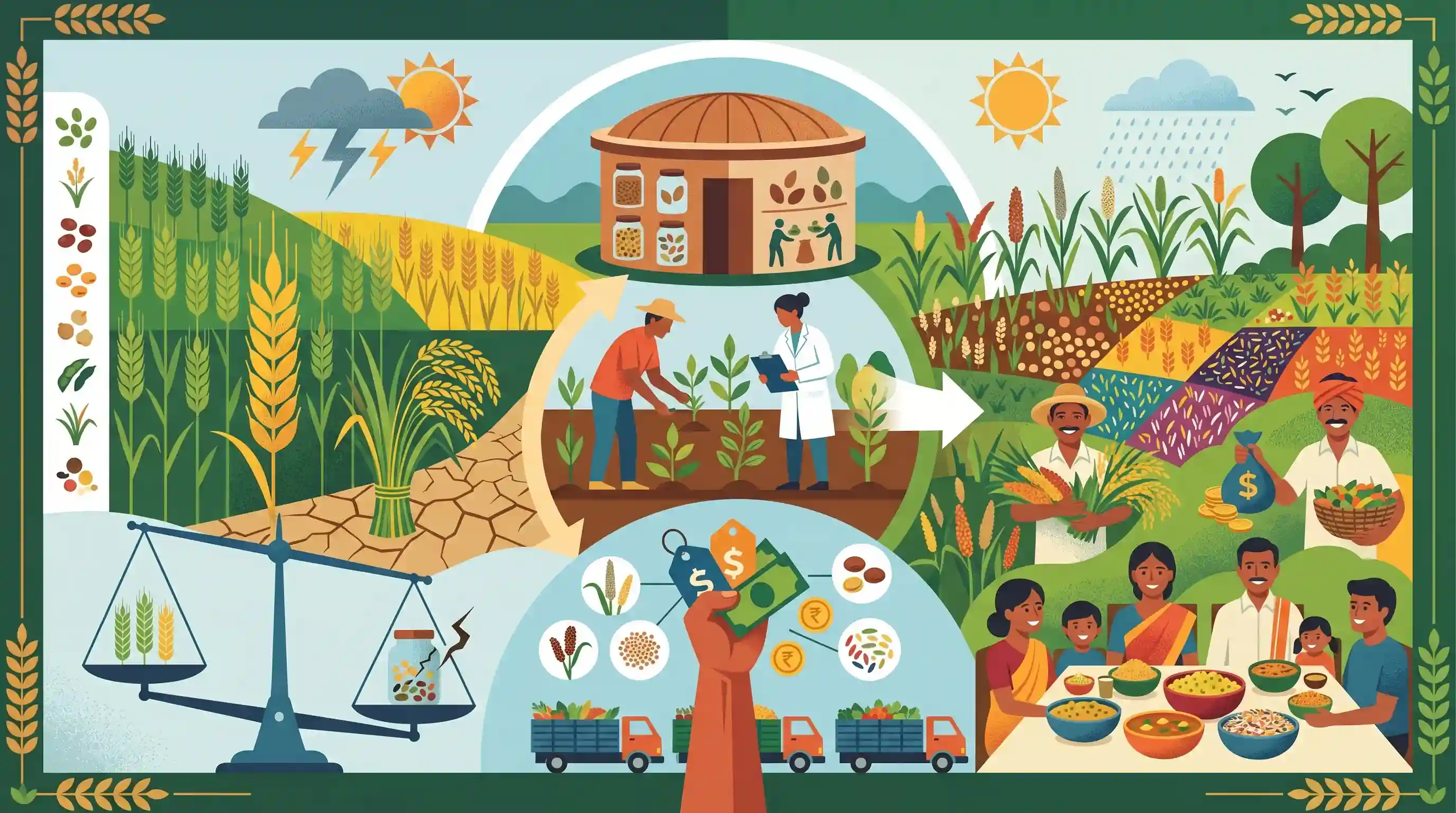
The article highlights the urgent need to conserve traditional seed varieties to ensure climate-resilient agriculture and protect agrobiodiversity in India. Historical policies favoring high-yielding varieties of wheat and rice have marginalized indigenous crops, causing structural imbalances in the food system. The author advocates for establishing community seed banks, promoting participatory plant breeding, and expanding the Minimum Support Price (MSP) and procurement systems to include millets, pulses, and traditional rice. Initiatives like the Odisha Millet Mission are cited as successful models for linking conservation with economic incentives, ultimately improving both nutritional security and farmer livelihoods.
Key Points
- Structural biases in the current food system heavily favor wheat and rice, marginalizing traditional, climate-resilient seed varieties.
- Historical agricultural policies promoting high-yielding varieties (HYV) have increased reliance on chemical inputs and water, threatening agrobiodiversity.
- Community seed banks and participatory plant breeding are critical grassroots strategies for conserving indigenous seeds.
- Expanding Minimum Support Price (MSP) and state procurement to include millets, pulses, and traditional rice can provide necessary economic incentives to farmers.
- The Odisha Millet Mission serves as a successful model for reviving traditional crops while ensuring nutritional security and supporting farmer livelihoods.
Important Terms
Odisha Millet Mission

A flagship state-sponsored initiative launched in 2017 to revive traditional millets, improve nutritional security, and empower tribal farmers through sustainable cultivation, processing, and public procurement.
UPSC context
GS III (Agriculture); tests knowledge of successful state-led models for crop diversification, nutrition, and tribal welfare.
Minimum Support Price (MSP)
A government-set price floor for 22 mandated crops and sugarcane to protect farmers from market volatility and ensure remunerative prices during bumper harvests.
UPSC context
GS III (Agriculture Economics); tests understanding of government price support mechanisms and their impact on cropping patterns.
M.S. Swaminathan Research Foundation (MSSRF)
A non-profit research trust founded by Dr. M.S. Swaminathan in 1988 to leverage science and technology for sustainable agriculture, biodiversity conservation, and rural development.
UPSC context
GS III (Sustainable Development); tests awareness of institutional roles in bridging traditional wisdom with scientific research for agriculture.
Biju Patnaik Tribal Agro-biodiversity Centre
An MSSRF regional centre in Koraput, Odisha, focusing on conserving traditional crop landraces and empowering tribal communities within a Globally Important Agricultural Heritage System.
UPSC context
GS III (Environment & Agriculture); tests knowledge of regional in-situ conservation and India's Globally Important Agricultural Heritage Systems.
Community Seed Banks
Decentralized, farmer-managed repositories that preserve indigenous, climate-resilient seed varieties and traditional knowledge to ensure local seed security and genetic diversity.
UPSC context
GS III (Environment & Agriculture); tests understanding of decentralized, community-led solutions for genetic resource conservation and climate adaptation.
Agrobiodiversity
The variety and variability of animals, plants, and microorganisms used for food and agriculture, essential for maintaining resilient food systems and ecological balance.
UPSC context
GS III (Environment); tests conceptual understanding of biodiversity's role in food security and sustainable agricultural practices.
Prelims Trap
"Indian law strictly prohibits farmers from saving, exchanging, or selling seeds of protected or registered high-yielding varieties."
The Protection of Plant Varieties and Farmers' Rights Act, 2001 uniquely allows Indian farmers to save, resow, exchange, and sell protected seeds, provided they are not sold as branded seed.
Static Concepts Connected
What are the key farmer rights under the PPV&FR Act, 2001?
- Seed saving: Farmers can save, use, sow, resow, exchange, or sell their farm produce including protected varieties.
- Branded restriction: Farmers are explicitly prohibited from selling the protected seed under a brand name or in commercial packaging.
- Benefit sharing: Provides for equitable sharing of benefits with farming communities for their role in conserving genetic resources used to breed new varieties.
How do Open-Pollinated, Hybrid, and GM seeds differ?
- Open-Pollinated Varieties: Pollinated naturally (wind/insects); offspring retain parental traits, making them genetically diverse and ideal for traditional seed saving.
- Hybrid Seeds: Cross-pollinated manually for specific traits; offspring lose vigor, requiring farmers to buy new seeds every season.
- GM Seeds: Genetically altered in a laboratory using DNA from other species (e.g., Bt Cotton) to introduce traits like pest resistance.
Cross-Topic Patterns
Climate Resilient Agriculture & NMSA
Conserving traditional agrobiodiversity (e.g., salt-tolerant Pokkali rice) directly ties into the National Mission for Sustainable Agriculture (NMSA) and India's commitments under the UNFCCC for climate adaptation.
Decentralised Procurement & PM-POSHAN
Expanding MSP for traditional millets (like the Odisha Millet Mission) links crop diversification with nutritional interventions in schools and anganwadis under schemes like PM-POSHAN.

Expect a 2026 question linking Community Seed Banks with farmers' rights under the PPV&FR Act and climate-resilient crop diversification.
Linked PYQs · 4
Linked PYQs · 4
- 2024MainsGS3
Explain the role of millets for ensuring health and nutritional security in India.
- 2021MainsGS3
What are the present challenges before crop diversification? How do emerging technologies provide an opportunity for crop diversification?
- 2018MainsGS3
What do you mean by Minimum Support Price (MSP)? How will MSP rescue the farmers from the low income trap?
- 2017MainsGS3
How do subsidies affect the cropping pattern, crop diversity and economy of farmers? What is the significance of crop insurance, minimum support price and food processing for small and marginal farmers?
